




- Bangladesh police seize bomb-making materials in Dhaka, arrest one
- Women's football team to make historic Kolkata debut with two friendlies against Russia
- Omar Abdullah welcomes tourists as Gulmarg gears up to hold national-level golf tournament
- India delivers medical supplies in Afghanistan, reaffirms humanitarian support
- Sanjay Gupta questions smoking posters of leading men in Bollywood: What about anti-smoking ads
- Nitin Nabin listens to ‘Mann Ki Baat’ with party workers at Biswa Bangla Convention Centre in Bengal
- Don’t just raise allegations, present facts: Bihar CM slams Opposition over SIR
- 'Will send wrong message': Kiren Rijiju on Rahul Gandhi targeting EC over SIR row
Google to send TPU chips to space for AI; Elon Musk reacts
In Short
Google wants to join the AI activity taking place in space. The company has announced that it will soon send its first satellite equipped with advanced TPU chips into space as part of Project Suncatcher. Here is how Elon Musk-who has often championed the idea of data centres in orbit-reacted to the news.

Share :
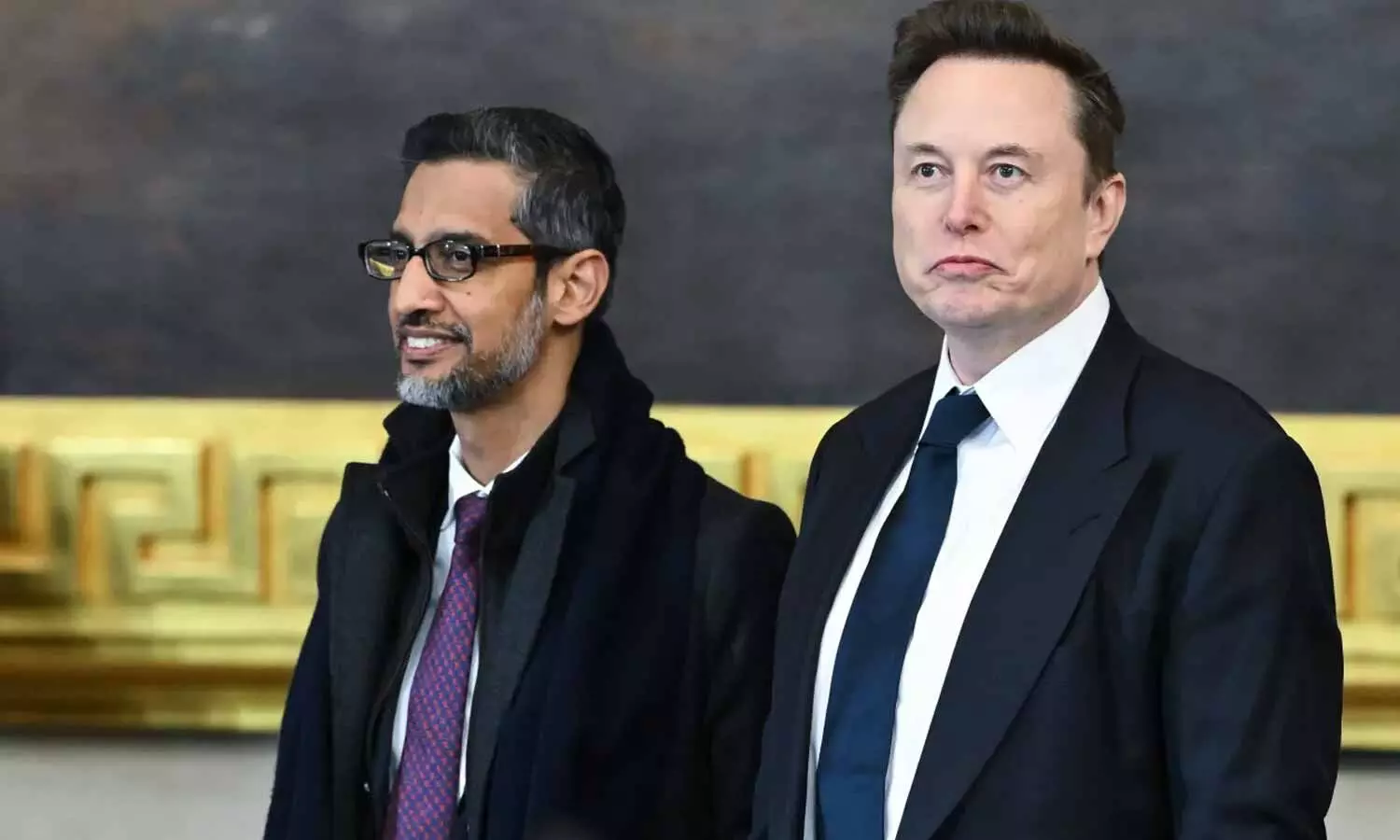
Google CEO Sundar Pichai and Elon Musk
Space is the final frontier. You may have heard this phrase before in the context of humanity's future. However, space is rapidly becoming the new arena for AI. Google has announced that next week it will launch a satellite carrying its advanced TPU chips to evaluate whether space could host AI infrastructure. To do this, the company is collaborating with SpaceX, Elon Musk's company.
In a blog post, Google announced that next week it will send a prototype satellite equipped with its TPUs (Tensor Processing Units) into low Earth orbit as part of Project Suncatcher. This project is a long-term research initiative by the company to determine if space could one day host large-scale AI computing infrastructure.
Upon announcing the launch on X, Google CEO Sundar Pichai referenced Neil Armstrong's famous phrase from the moon landing. Pichai wrote: "One small step for TPUs..."
The first in-orbit test will take place during SpaceX's upcoming Transporter-18 rideshare mission, in collaboration with Planet Labs. The goal is to determine whether Google's AI hardware-the TPUs-can withstand launch forces and operate under the radiation and extreme temperature conditions of space.
Elon Musk reacts to Google's space AI plans
Elon Musk, arguably the biggest proponent of data centres in space, reacted to this announcement. On X, the tech billionaire noted that, in the near future, space will host nearly all of humanity's computing resources. "The amount of compute in space will eventually be, like, 99 per cent of all compute," Musk wrote. Google states that this launch remains an initial experiment to assess the long-term viability of such a project, rather than the start of an operational orbital data centre for the company.
Earth-based data centres require vast amounts of energy and water to operate; in fact, companies consume billions of litres of water annually to cool their hardware. In contrast, satellites in low Earth orbit receive nearly constant sunlight, allowing them to generate up to eight times more solar energy than on Earth. This has made space an attractive alternative, as many-including Elon Musk-argue that it would enable vastly greater computing capacity without straining Earth's resources.
"Global electricity demand for AI simply cannot be met by terrestrial solutions-even in the short term-without harming communities and the environment," Elon Musk stated earlier this year. "In the long run, space-based AI is obviously the only way to scale."
Google’s plans for the first flight of a TPU into space
According to Google, the initial question is simple: can its AI hardware actually function in space? A rocket journey to low Earth orbit typically lasts about 10 minutes. During this time, the spacecraft is subjected to intense vibrations and sustained acceleration loads of up to 10 times the force of gravity (or 10 g). Google notes that components like TPU chips can withstand forces ranging from 50 to 100 g. The company conducted vibration tests by subjecting the satellite to shaking along all three axes to simulate launch conditions.
However, a key concern in space is radiation. Solar events and cosmic rays can disrupt electronic systems and cause errors. To study this aspect, Google says it tested its TPUs by running AI workloads at the Crocker Nuclear Laboratory at the University of California, Davis (UC Davis). According to the company, initial results indicated that its Trillium TPUs could withstand a total ionising radiation dose exceeding what they would receive during a five-year space mission.
Even so, Google noted that there are aspects that can only be tested in orbit, which is why it seeks to obtain real flight data from this launch.
The company is also leveraging the mission to study cooling systems. Google noted that TPUs generate a significant amount of heat within a confined space; however, due to the lack of airflow in space, heat cannot dissipate the way it does on Earth. Consequently, the company is testing a system that combines heat pipes and radiators. Google has already conducted tests in a thermal vacuum chamber designed to simulate the vacuum and temperature conditions of space.
Project Suncatcher’s long-term plan goes beyond the use of a single satellite. Future designs could involve satellite constellations, each equipped with dozens of TPU chips. If realised, this would allow Google to interconnect these groups to process larger-scale AI workloads in orbit. To achieve this, the satellites would need to determine their relative positions and transmit data via high-bandwidth laser links over very short distances with extreme precision. Google plans to test this aspect of the system in 2027, the year it intends to launch two satellites into orbit.
However, the story of AI in space extends further. In addition to Google’s Project Suncatcher and Elon Musk’s plans to create orbital data centres, companies such as Blue Origin—owned by Jeff Bezos-are also considering similar initiatives. Blue Origin has previously announced its intention to establish data centres in lunar orbit. Meanwhile, the Indian company Sarvam has revealed plans to develop orbital data centres in collaboration with the aerospace firm Pixxel. Additionally, Starcloud, in partnership with Nvidia, plans to launch satellites equipped with advanced GPUs into Earth orbit.

Children from Four Devipatan Districts Send Gratitude Letters to CM Yogi Adityanath
Drugs worth Rs 10.17 lakh seized in Ahmedabad; one held
Pakistan’s information environment defined by steady accretion of internet shutdowns, covert surveillance: Report
Clash erupts at SRFTI campus in Kolkata, many students injured
Noise, Questions and the Missing Answers
Govt is taking steps to address land issues: Minister Ponguleti Srinivasa Reddy
Rains subside in Chinturu Agency, flood relief underway
Karur Stampede Anniversary: CM Vijay Remembers 41 Victims, Says Pain Has Not Faded
Godavari breaches 40-feet mark at Bhadrachalam
Students From LPU Vandalise Campus After Unverified Gang-Rape, Suicide Rumours; Police Deny Claims


