




- Bangladesh police seize bomb-making materials in Dhaka, arrest one
- Women's football team to make historic Kolkata debut with two friendlies against Russia
- Omar Abdullah welcomes tourists as Gulmarg gears up to hold national-level golf tournament
- India delivers medical supplies in Afghanistan, reaffirms humanitarian support
- Sanjay Gupta questions smoking posters of leading men in Bollywood: What about anti-smoking ads
- Nitin Nabin listens to ‘Mann Ki Baat’ with party workers at Biswa Bangla Convention Centre in Bengal
- Don’t just raise allegations, present facts: Bihar CM slams Opposition over SIR
- 'Will send wrong message': Kiren Rijiju on Rahul Gandhi targeting EC over SIR row
Money laundering fraud: State-backed sanctions-evasion network in Russia operates globally
In Short
Uncover details on A7, the Russian state-backed fintech network used to evade Western sanctions, utilizing front companies, falsified invoices, and major global banks.

Share :
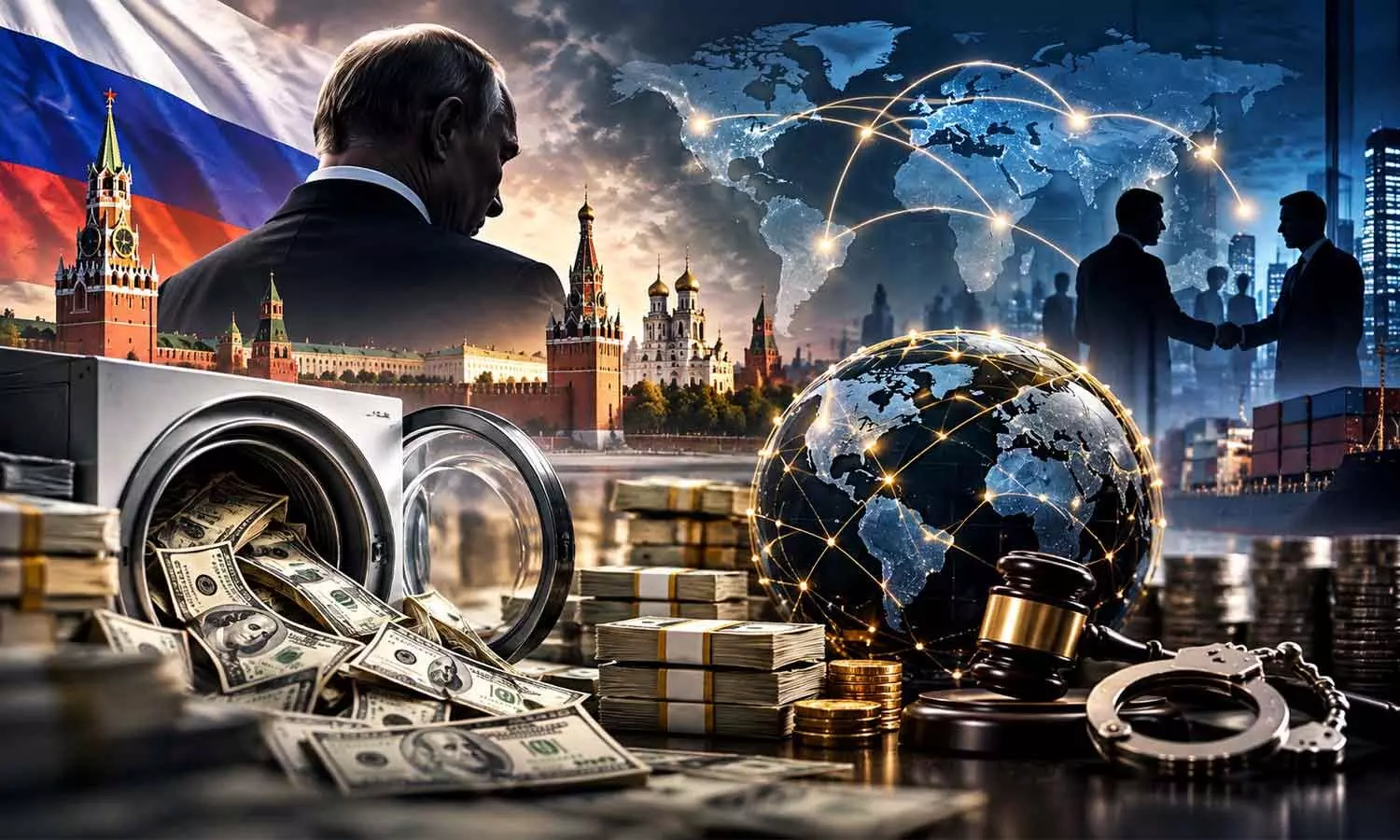
Money laundering fraud: State-backed sanctions-evasion network in Russia operates globally
A 7- a financial technology company [Fintech] was launched in Russia and Kyrgyzstan by Moldovan businessman Ilan Shor, with support from Promsvyazbank (PSB), a Russian state-owned bank with close ties to the defence sector. Shor was previously convicted in Moldova in connection with a large-scale bank fraud. A7, the Russian payments group was set up after Western governments cut major Russian banks off Swift following the 2022 full-scale invasion of Ukraine.
Enquires conducted by Financial Times (FT) and Wall Street Journal (WSJ) described A7 as a state-backed sanctions-evasion network, mixing bills of exchange, crypto and conventional banking. A7 reportedly used forged paperwork, about 100 front companies and fake invoices to move more than $6.9bn through global banks.
A7 was promoted as a flagship alternative for Russian import payments after Swift access was restricted. Shor has publicly described the system as “immune to sanctions.” According to the FT, A7 did not invent a new payments system that replaced Swift. It used old-fashioned layering through:
• Front companies and established businesses in third countries, including the UAE, Hong Kong and Kyrgyzstan
• Cash placed into accounts that did have access to Swift
• Those accounts were used for paying suppliers abroad, often in China and Hong Kong
• An “industrial-scale” forgery operation producing counterfeit invoices and altered goods descriptions and Customs HSN Codes so the paperwork would survive anti-money-laundering checks. In the early stages of its scheme in late 2024 and early 2025, A7 sent large volumes through three Kyrgyz banks: Eldik, Aiyl and Eurasian Savings Bank (ESB). FT’s investigation showed that a now-defunct Kyrgyz state trading company accounted for about $2.4bn, with UAE-based names including Gimli (about $600m) and Xentra (nearly $400m) among the larger conduits. China and Hong Kong were the main destinations: about $1.55bn to Chinese banks and $1.81bn to Hong Kong.
Subsequently, First Abu Dhabi Bank handled the bulk of flows. A7 front companies opened more than a dozen accounts at the bank, from which they transferred $1.3bn of outgoing payments and about $500mn of transactions with one another. The bank also played a key role for A7 by facilitating conversions of Emirati dirhams, via its correspondents, into dollars, euros and renminbi – a vital service for cross-border settlement. The other major banks involved are Standard Chartered, Hong Kong, received $1.1bn from A7-linked entities. Over the same period DBS, Hong Kong sent $273mn. Deutsche Bank clients in Europe sent about $18mn. A7-linked entities had used JPMorgan Chase and DBS accounts. However, no details were published. Some of the payments are alleged to be for military or security-service procurement.
A7 is also now a major payment provider for conventional civilian businesses, with the company claiming it handles nearly a fifth of Russia’s foreign-exchange transactions. This is not the first time that Russian entities resorted to money laundering operations which is now in the public domain*.
Between 2011 and early 2015, it was not uncommon for Russian brokers contacting the equities desk of Deutsche Bank’s Moscow headquarters to speak to a sales trader, and request to place two trades simultaneously. In one, he would use Russian rubles to buy a blue-chip Russian stock for a Russian company that he represented. Usually, the order was for about 10 million dollars’ worth of the stock.
In the second trade, acting on behalf of a different company— which typically was registered in an offshore territory such as the British Virgin Islands—would sell the same Russian stock in the same quantity in London, in exchange for dollars, pounds, or euros. Both the Russian company and the offshore company had the same owner. Deutsche Bank was helping the client to buy and sell to himself.
These ordinary transactions of buying and selling stock were for turning rubles that were stuck in Russia into dollars stashed outside Russia. In the Moscow markets, this had a nickname: ‘convert’, which means ‘envelope’ and echoes the English verb ‘convert.’ In the media, it was known as ‘mirror trading.’ However, repeated mirror trades suggest a sustained effort to transfer and hide money of possibly dubious origin. It is a part of flight of capital from Russia, particularly for the oligarchs, to other jurisdictions and convert rubles into US dollars, pounds or euros.
The Deutsche Bank mirror-trades operation appears to be linked to an even bigger attempt to expatriate money: the so-called Moldovan scheme. Starting in 2010, fake loans and debt agreements involving UK companies helped funnel about twenty billion dollars out of Russia to a Latvian bank, by way of Moldova. When the Moldovan scheme unravelled, in late 2015, several people were arrested. One was Alexander Grigoriev, a Russian financier who controlled Promsberbank, based in a Russian backwater called Podolsk, which counted Igor Putin as a board member. Two of Promsberbank’s major shareholders—including Financial Bridge—have been accused of making mirror trades. The Russian news agency RBC had reported that ‘the criminal dealings of Promsberbank and the mirror trades at Deutsche Bank are connected.
On 23 April 2015, Deutsche Bank agreed to a combined US $2.5 billion in fines—a US $2.175 billion fine by American regulators, and a €227 million penalty by British authorities—for its involvement in the Libor scandal uncovered in June 2012. The company also pleaded guilty to wire fraud, acknowledging that at least 29 employees had engaged in illegal activity.
The US Department of Justice after conducting investigation sought a $14 billion civil settlement with Deutsche Bank over its alleged role in 2007–08 artificially propping up the U.S. housing market in the lead-up to the financial crisis of 2007–08 followed by the Great Recession.
Deutsche Bank AG was charged and agreed to pay a US $7.2 billion and take a US $1.2 billion pretax charge, to resolve US investigations into sales of the debt that fueled the financial crisis, putting behind them a major dispute that undermined confidence in the bank and raised questions about its turnaround. Deutsche Bank will pay a US $3.1 billion civil penalty and provide US $4.1 billion in relief to consumers. The bank had set aside US $6.2 billion for all of its outstanding legal costs as of September 30, 2016.
(The writer is former Member CBIC and DG, DRI)
Children from Four Devipatan Districts Send Gratitude Letters to CM Yogi Adityanath
Drugs worth Rs 10.17 lakh seized in Ahmedabad; one held
Pakistan’s information environment defined by steady accretion of internet shutdowns, covert surveillance: Report
Clash erupts at SRFTI campus in Kolkata, many students injured
Noise, Questions and the Missing Answers
Govt is taking steps to address land issues: Minister Ponguleti Srinivasa Reddy
Rains subside in Chinturu Agency, flood relief underway
Karur Stampede Anniversary: CM Vijay Remembers 41 Victims, Says Pain Has Not Faded
Godavari breaches 40-feet mark at Bhadrachalam
Students From LPU Vandalise Campus After Unverified Gang-Rape, Suicide Rumours; Police Deny Claims


