






- Netanyahu calls for national unity; Gadi Eisenkot hits back at 'delusional' outgoing PM
- Website of the 19th Pravasi Bharatiya Diwas to be launched in Delhi today
- US-China AI talks still unfinished, says Rubio
- 100 tonnes of paddy straw donated to TTD Gosala
- Tirupati administration steps up preparations for high-level police conference
- An infant dumped in drainage
- All set for ‘CII Partnership Summit 2026’
- Murthy Yadav quits BJP
Belonging-A Journey Of Love: Sonia Gandhi’s book brings political memoirs in focus
In Short
In her newly released memoir Belonging: A Journey of Love, Sonia Gandhi reflects on her Italian roots, family tragedies, declining the PM post, and 60 years of Indian politics.

Share :
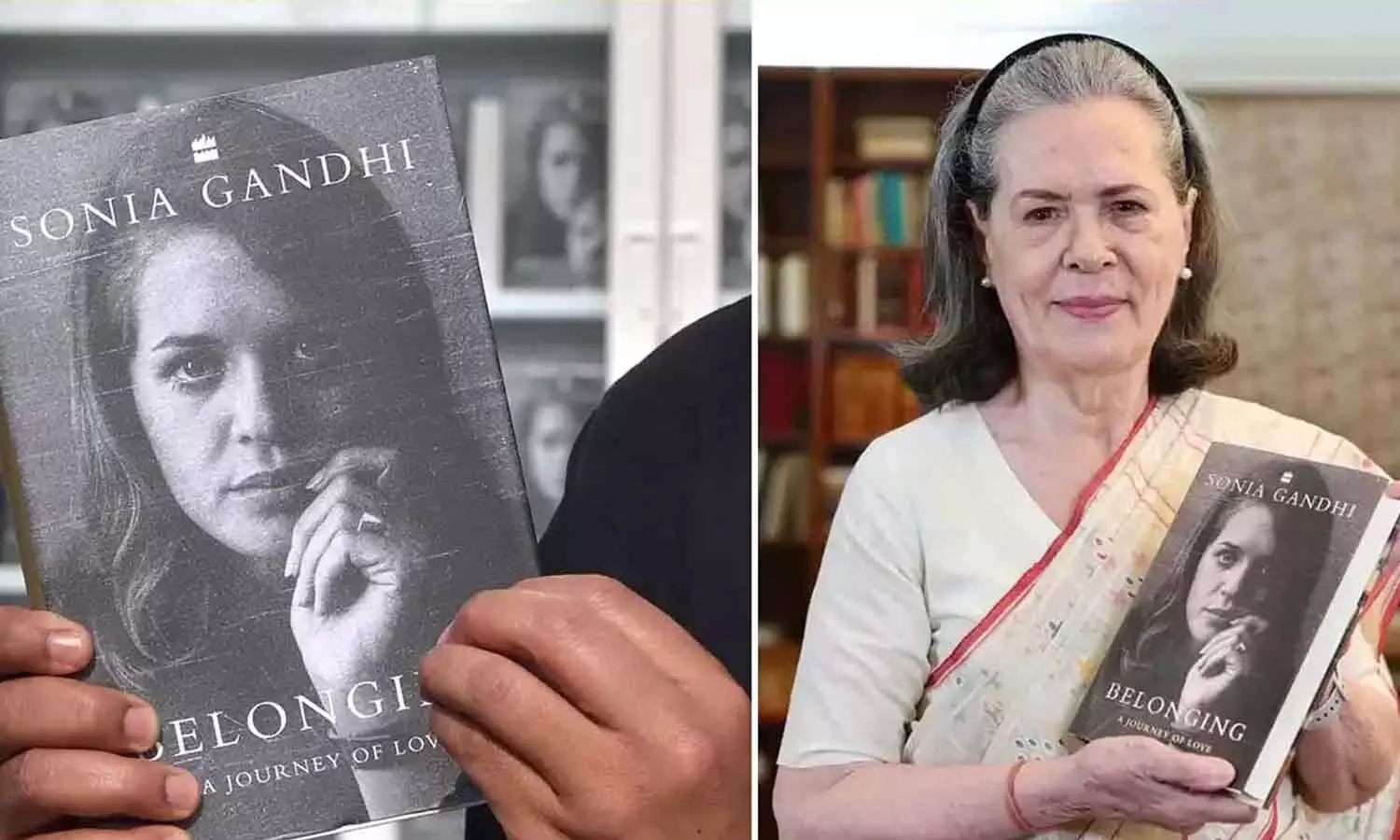
Sonia Gandhi’s book brings political memoirs in focus
New Delhi: A memoir by former Congress president and Rajya Sabha MP Sonia Gandhi released on Tuesday, with its pages offering a rare insight by the politician into how she came from humble Italian origins and went on to become the matriarch of India's most powerful political dynasty — the Nehru-Gandhi family. The book called "Belonging: A Journey of Love" was Published by HarperCollins India.
In the memoir, Sonia Gandhi opens up for the first time about the extraordinary twists and turns of a life that has largely unfolded in full public view. It contains moving glimpses of Gandhi’s private grief. She writes about the loss of her first child, who died shortly after birth, and the chilling discovery of grenades in a room of their house after Operation Blue Star, the 1984 military operation against Sikh separatists at the Golden Temple in Amritsar. She also provides a ringside view of several turbulent chapters in Indian politics, not least the violent assassinations of her mother-in-law, Indira Gandhi, in 1984 and her husband, Rajiv, in 1991.
"Much has been written about my family, but rarely with real insight into who they were, their motivations, their struggles, their very human flaws. I wanted to portray them honestly, as people I knew and loved," the 79-year-old Gandhi wrote said ahead of the release of the memoir.
Her book also revisits some of the darker episodes that have dogged the Gandhi family and the Congress party, including Indira’s imposition of the Emergency in June 1975, a 21-month period during which civil liberties were suspended, political opponents were jailed and the press was gagged, which caused fear and dismay across the country. In Gandhi’s account, it also caused a rift within the family.
Born Sonia Maino in 1946 in a small Italian village near Vicenza, she met Rajiv Gandhi — the grandson of India's first Prime Minister Jawaharlal Nehru — at a restaurant in the United Kingdom's Cambridge city. The two got married in New Delhi in 1968, when Rajiv's mother and Nehru's daughter Indira Gandhi was serving as India's prime minister.
In her book Sonia Gandhi talks about her 2004 decision to not take up the top job as prime minister of the world's largest democracy. The Nehru-Gandhi family gave India three prime ministers.
In an excerpt from the book, Sonia said her children - and now senior Congress leader Priyanka Gandhi Vadra and Leader of Opposition Rahul Gandhi - had then discussed with her, their mother's possible prime ministership. "One of them asked me straight out whether I would accept the post, just in case our party pulled off a victory. 'Absolutely not' I'd said, almost indignantly,' the excerpt read.
"Neither Rahul nor Priyanka felt that I should become prime minister. They'd lived through the trauma of their grandmother's assassination and the brutal murder of their father. In their minds, holding that office was intrinsically linked with heightened danger. They looked relieved and I, too, felt lighter, having said my views out loud on the question for the first time," Sonia wrote in the memoir.
Ultimately, Gandhi’s memoir is a vivid record of six decades of India’s political transformation from the Congress-dominated secular republic she moved to in 1968 until today. Gandhi’s account offers a glimpse of how deep the political polarisation runs in Indian politics today. In one revealing passage, Gandhi writes that she has had “practically no real contact” with Prime Minister Narendra Modi in the 12 years he has led the nation. In fact, at times when the two have been in the same room, such as the Speaker’s small chamber, Modi “tends to look away, avoiding eye contact”, she says. On one occasion, she adds, he has asked briefly about her health after a hospital stay.
After the 2001 terror attack on parliament, Gandhi immediately called then-BJP prime minister AB Vajpayee to enquire about his safety, a gesture he appreciated.
Gandhi sees an increasingly authoritarian style of politics, in which those in power seek to “belittle and torment” opponents. For years, Gandhi’s son, Rahul, has been the subject of BJP’s ridicule, which calls him Pappu, a derisive term intended to portray him as inexperienced and naive. She adds that similar things are happening elsewhere in the world, an observation that can be read in the context of US President Donald Trump’s use of personal insults and ridicule against opponents.
Don’t exploit your position for personal gain: CM Revanth to police
Global Summit 2026: Transport Minister to meet EV makers today
Govt rolls up sleeves for TG’s fair share of Krishna waters
Onus on govt and people for a pollution-free Diwali
Cultivating resilience: Why crop diversification is Telangana’s only scientifically sound climate adaptation
We need to deal with natural calamities more effectively


