






- Netanyahu calls for national unity; Gadi Eisenkot hits back at 'delusional' outgoing PM
- Website of the 19th Pravasi Bharatiya Diwas to be launched in Delhi today
- US-China AI talks still unfinished, says Rubio
- 100 tonnes of paddy straw donated to TTD Gosala
- Tirupati administration steps up preparations for high-level police conference
- An infant dumped in drainage
- All set for ‘CII Partnership Summit 2026’
- Murthy Yadav quits BJP
Cultivating resilience: Why crop diversification is Telangana’s only scientifically sound climate adaptation
In Short
An unprecedented drought crisis across 365 mandals in Telangana, driven by a post-monsoon El Niño effect and a 17 per cent rainfall deficit, threatens agricultural collapse until July 2027. To initiate a transition of the state from a vulnerable monoculture to a drought-resistant, resilient agricultural economy ensuring the livelihoods of small and marginal farmers, a comprehensive climate adaptation framework is required. This strategy is anchored by the Mandal-Wise Decentralized Alternative Production Package (MDAPP), localised soil-moisture ecological mapping, and aggressively front-loaded financial assistance through a specialized Green Transition Bonus.

Share :
Cultivating resilience: Why crop diversification is Telangana’s only scientifically sound climate adaptation
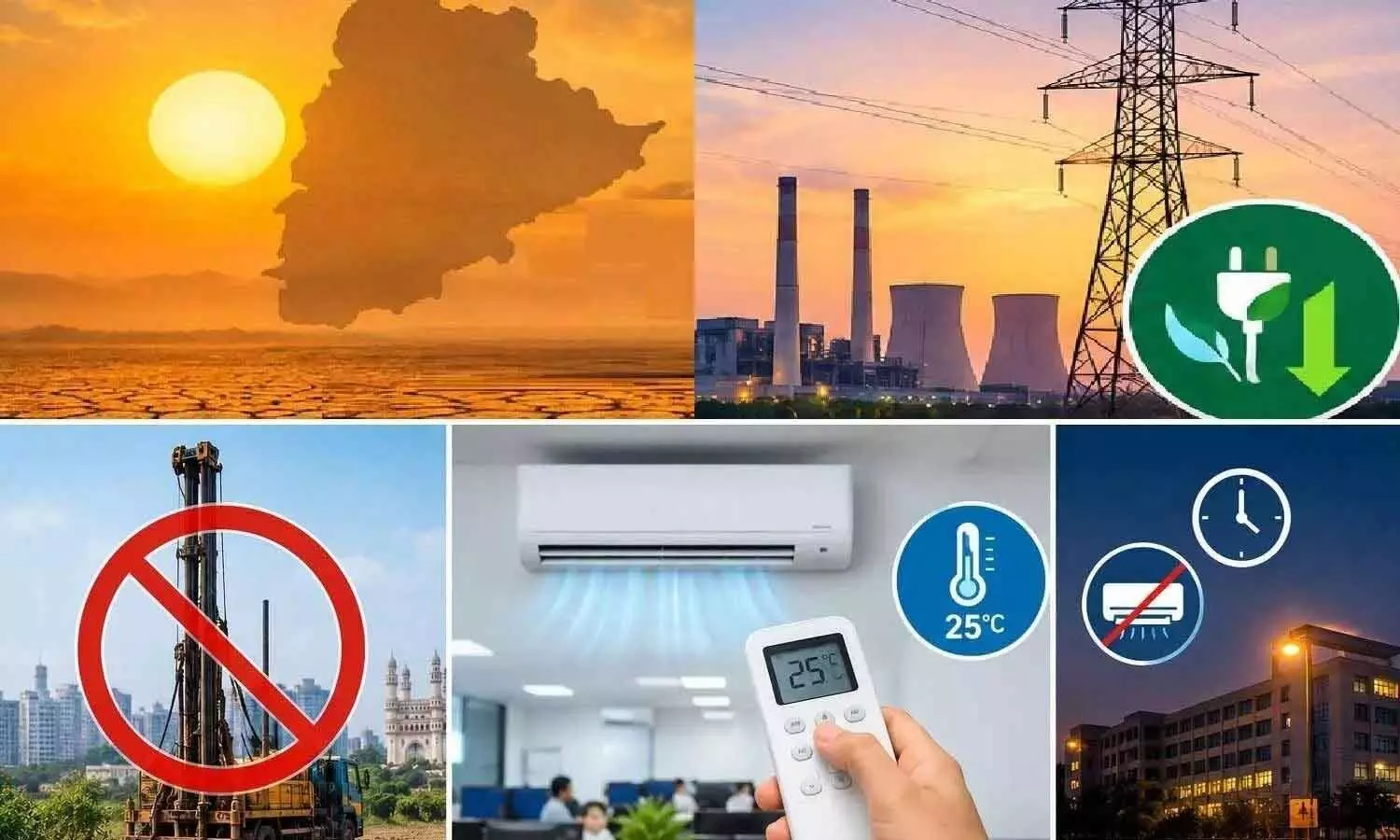
The prevailing. The state government has officially declared 365 mandals across 31 districts as drought affected. Chief Minister A Revanth Reddy has warned that this unprecedented El Niño-related water and power crisis could persist until next July. This emergency exposes the deep structural vulnerabilities of our agricultural system and demands alternative strategies.
From an ecological perspective, crop diversification serves as a scientifically validated climate change adaptation strategy specifically engineered to combat acute hydrological stress. Replacing continuous paddy with low-water alternatives directly intercepts the drought cycle by altering the microclimate and soil physics of the farm. Deep-rooted alternative crops break up compacted subsoil layers, increasing capillary porosity and maximizing water infiltration when erratic rains do occur.
By maintaining ground cover through diverse cropping architectures, farmers drastically lower soil surface evaporation and buffer the field against extreme thermal gradients. Crucially, integrating diverse root profiles optimises water extraction across varying soil depths rather than exhausting the topmost layer, significantly increasing regional water-use efficiency and preserving precious residual moisture within the root zone during extended dry spells.
However, transitioning from predictable paddy fields to complex alternative crop systems introduces severe operational hurdles for small and marginal farmers. For these smallholders, climate adaptation is not just an ecological goal—it is a high-stakes problem of daily farm management, labor allocation, and survival.
The smallholder farm management crisis
The 2026 monsoon concluded with a 17 per cent overall rainfall deficit, leaving 18 out of 33 districts severely deficient. The total kharif crop area dropped from 139.28 lakh acres to 126.06 lakh acres, leaving standing crops withering. While traditional paddy cultivation fell by 18 per cent, the remaining acreage faces disaster. Out of 30 lakh agricultural pump sets, almost 15 lakh have run dry due to the rapidly falling water table.
When the state government appeals to smallholders to avoid paddy and shift to alternative crops like pulses, millets, or oilseeds, it overlooks a critical farm management reality. Small and marginal farmers operate on razor-thin margins. Paddy is highly automated, easy to store, and insulated by guaranteed state procurement.
In contrast, alternative crops require intensive, localized agronomic management: precise sowing windows to catch brief moisture windows, entirely different seedbed preparation, specialized weeding, and delicate handling during harvest. Forcing a smallholder with less than two acres to learn and manage these volatile new crop dynamics without structural support creates a severe policy asymmetry. It expects the most vulnerable stakeholder to absorb 100% of the operational and financial risk.
Localized agroecological realities
Climate change impacts Telangana’s distinct agroecological zones differently, meaning top-down, uniform advisories broadcasted via Rythu Vedikas fail to match localized realities:
The northern zone: Experiencing erratic rains and rising thermal stress that alter the growing period.
Central zone: Facing severe groundwater depletion that rapidly strips moisture from shallow root zones.
The southern zone: High evaporation rates on shallow soils lead to immediate crop wilting during short dry spells.
To address this, the state must implement a Mandal-Wise Decentralized Alternative Production Package (MDAPP). This framework maps soil taxonomy and aquifer health across all 621 mandals to deliver a tailor-made alternative crop grid specifically optimized for smallholder management.
In zone A (deep black cotton soil with over-exploited groundwater in specific mandals within Adilabad, Nalgonda, and parts of Khammam), high soil water-retention capacity dictates a total ban on Yasangi paddy. This is replaced by long-staple cotton intercropped with pigeon pea, Bengal gram, black gram, green gram, or soybean.
In sone B (red sandy loams with critically low water tables across Mahabubnagar, Medak, and Rangareddy), the low moisture profiles require drought-hardy options like groundnut, castor, pearl millet, finger millet, foxtail millet, sorghum, and sesame.
In zone C (alluvial and medium loamy soils under deficit canal networks in Nizamabad, Karimnagar, and Warangal), flood irrigation must be eliminated in favor of safflower, mustard, green gram, sunflower, and linseed.
To institutionalise this, physical soil health cards must become digital MDAPP Smart Passbooks. When a smallholder registers their land, the portal automatically tags their mandatory crop code, blocks restricted paddy entries, and unlocks tailored input-subsidy modules.
Insulating the smallholder transition
The primary barrier to diversification is the immediate liquidity crunch faced by smallholders when changing cultivation patterns. MDAPP restructures direct benefit transfers by splitting investment support into a two-tier framework: the base Rythu Bharosa support plus a legally ring-fenced Green Transition Bonus (GTB) of ₹3,000 per acre per season, paid exclusively for alternative crops.
To prevent smallholders from falling back on high-interest private moneylenders for new tools and inputs, cash flows are front-loaded. During the pre-sowing phase, 60 per cent of the combined seasonal payout is deposited directly into the farmer’s account. The remaining 40 per cent is released 30 days after sowing following automated remote-sensing crop verification. Furthermore, Telangana’s 2,600+ Rythu Vedikas must be upgraded into local logistics hubs. Upon registration, smallholders will receive an SMS voucher redeemable at the Rythu Vedika for 100 per cent subsidized, high-yield, drought-resistant seeds developed by PJTSAU. To manage the technical shift in water utilization, alternative crops are paired with Micro-Irrigation Direct-Delivery (MIDD). Any smallholder registered under MDAPP automatically qualifies for a 90 per cent subsidy on drip or sprinkler kits, installed by technical teams within seven days.
Eliminating market volatility
The final anchor of MDAPP eliminates market price volatility. The state must establish a dedicated, legally backed statutory body: the Telangana Alternative Crop Procurement Board (TACPB). Operating under a 120 per cent MSP Procurement Accord, the TACPB will legally guarantee to buy 100 per cent of the alternative crop volume at a 20 per cent premium over Central MSP.
This bonus directly compensates smallholders for the lower physical yields characteristic of pulses and millets relative to paddy. By processing harvests at decentralized Rythu Vedika weighbridges and clearing payments via DBT within 72 hours, Telangana can effectively withstand the serious economic and social vagaries of one of the worst droughts it has been experiencing since decades.
(The writer is a former MLA and former faculty at Humboldt University)
Don’t exploit your position for personal gain: CM Revanth to police
Global Summit 2026: Transport Minister to meet EV makers today
Govt rolls up sleeves for TG’s fair share of Krishna waters
Onus on govt and people for a pollution-free Diwali
Cultivating resilience: Why crop diversification is Telangana’s only scientifically sound climate adaptation
We need to deal with natural calamities more effectively


