Flawed bus design, negligence fuel Kurnool bus tragedy

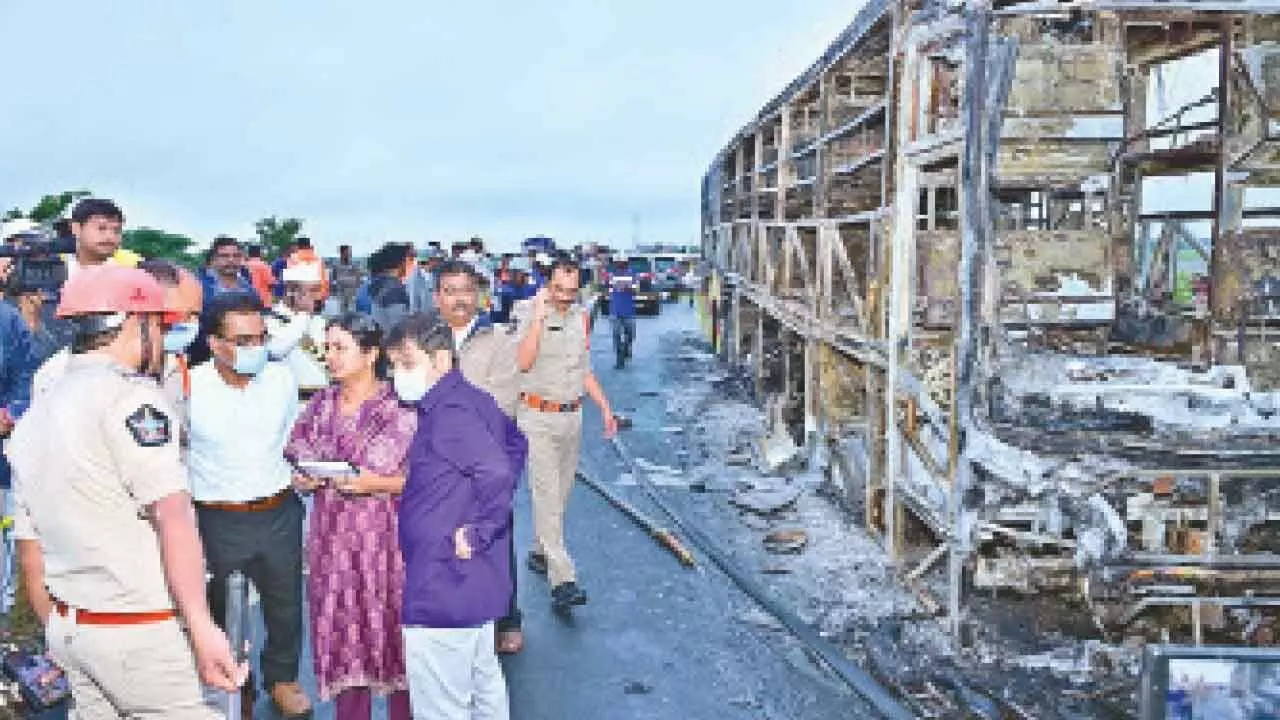
Hyderabad: The Kurnool bus fire tragedy exposes a systemic failure rooted in compromised bus ergonomics, expired safety certifications and lax enforcement where profit-driven private operators routinely bypass national safety standards, leaving passengers trapped in death traps disguised as transport.
The bus operated by Vemuri Kaveri Travels had all critical documents, including fitness, insurance, tax, pollution and permits, that had expired for over a year and carried 16 pending traffic challans.
Private buses, especially long-distance sleepers, often violate AIS-119 and AIS-052 (Automotive Industry Standards) standards, which are meant to ensure passenger safety and ergonomics. The gangway width, mandated to allow unimpeded movement, is frequently narrowed to add extra berths, making evacuation nearly impossible during emergencies.
The 2X2 berth layout, banned under AIS-119, is still standard in many private fleets, reducing aisle space and increasing crush risk. The lower berth height, required to be 200–350 mm from the floor for easy exit, is often built lower, trapping passengers during fires.
Emergency exits, including roof hatches and breakable windows with safety hammers, are either missing or non-functional, as survivors of the Kurnool fire confirmed the absence of tools to break glass. The bus involved had no smoke alarms or fire suppression systems, violating basic safety protocols.
Overloading is rampant, with buses carrying passengers beyond their seating capacity, sometimes forcing people to cram into aisles or even onto the roofs. The Supreme Court is now hearing a PIL demanding mandatory loading checks at departure and en route points to enforce compliance with seating limits. The bus in question likely exceeded its capacity, worsening the death toll as passengers struggled to escape through narrow, obstructed pathways.
India has seen repeated bus fire tragedies due to similar violations. In 2013, a Volvo bus fire in Mahbubnagar, Telangana, killed 42 people after a collision ruptured the fuel tank; the bus was overloaded, and the driver fled. In 2024, a double-decker bus crash in Uttar Pradesh revealed non-compliance with AIS-119, including altered body structures and single-driver operation on long routes.
The government must enforce mandatory pre-departure inspections using weigh-in-motion systems and digital verification of permits and fitness certificates. All private buses should be retrofitted with GPS-linked safety features, automatic door release in the event of a fire, and real-time monitoring of driver fatigue.