






- India to get preferential access in US market under trade pact: Piyush Goyal
- Along with Aatmanirbharta, India must be a developer, innovator & global leader in cutting-edge technologies: Rajnath Singh
- Tribals most affected by Maoist violence; earlier govts remained mute spectators, says PM Modi
- India must become a developer of advanced technologies: Rajnath Singh
- CM Vijay to honour Class 10, 12 toppers in Chennai on November 18
- Five private buses catches fire at a garage in Hyderabad
- Vaccinate on time and stay protected for a lifetime: Dr Bharath Reddy
- Dumping yard on Ravvala Konda to be shifted soon
Bharat Summit Turns into Political Battleground
In Short
Telangana CM Revanth Reddy’s meeting with PM Narendra Modi comes amid BJP criticism of the Bharat Summit, with political leaders raising questions over public spending, Rahul Gandhi’s remarks and the event’s objectives.

Share :
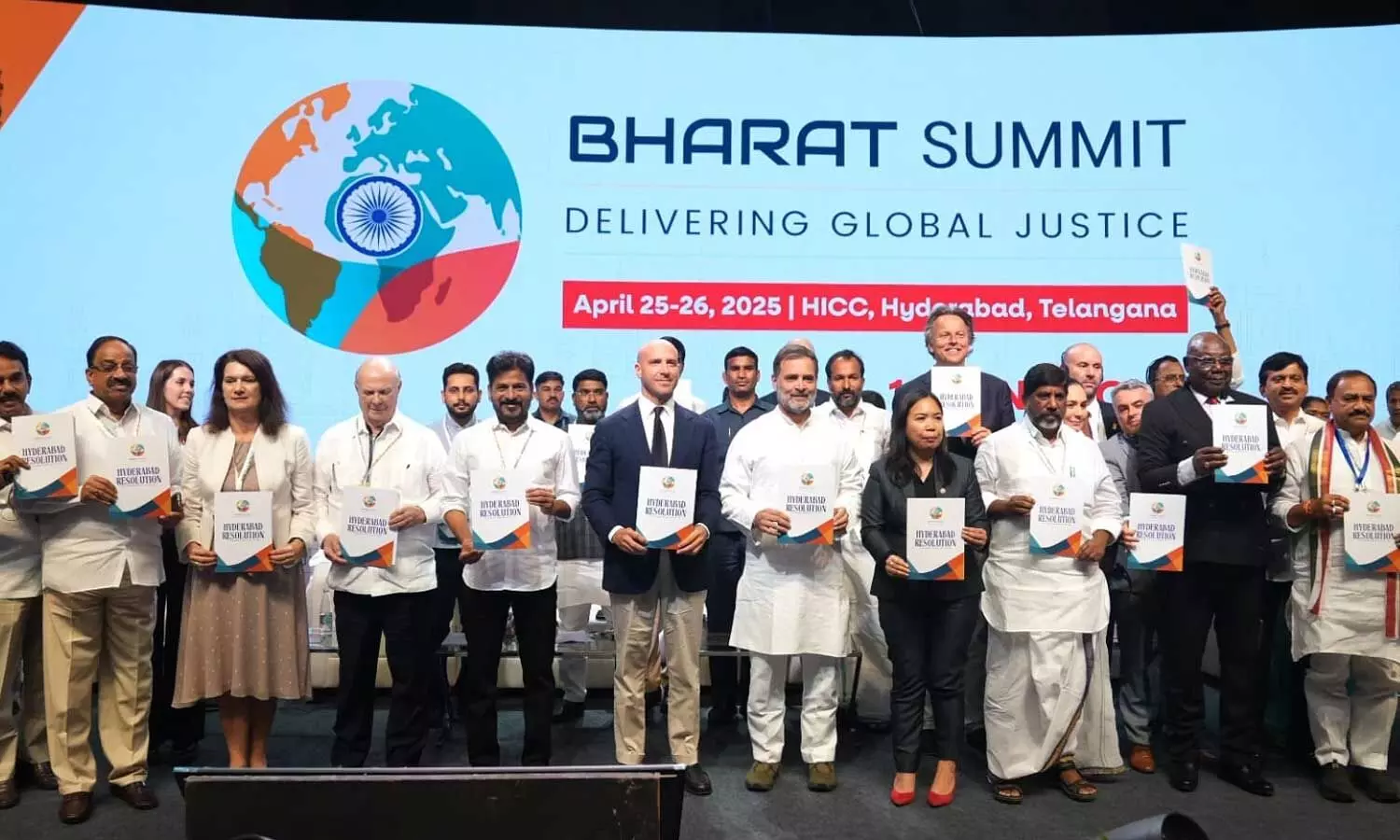
Bharat Summit Turns into Political Battleground
Telangana Chief Minister A Revanth Reddy is scheduled to meet Prime Minister Narendra Modi around noon on Sunday.
Officially, the Chief Minister is expected to submit a memorandum seeking Central assistance to mitigate the impact of El Niño and urge speedy clearances for irrigation projects. However, the meeting could also assume political significance in the wake of the Bharat Summit organised by the Telangana government, which the BJP has alleged turned into a platform for Modi-bashing.
There is a possibility that the Prime Minister may seek an explanation from Revanth Reddy about the summit, particularly since it was projected as a government programme rather than a political party event.
Meanwhile, Telangana BJP president N Ramachandra Rao criticised the state government for spending public money on what he described as a "political summit". He said there had been no meaningful discussions on how the event would benefit Telangana, nor had anyone come forward with concrete proposals to establish industries or invest in the state.
Instead, he alleged, the summit had been used by Leader of the Opposition Rahul Gandhi to attack the government. Rahul reportedly remarked that "democracy was dead in 2014", soon after the BJP-led NDA came to power.
Rao also questioned the participation of foreign delegates in discussions on India's internal policies. He alleged that Rahul Gandhi, in his capacity as Leader of the Opposition, had made every effort to portray the government in a negative light and demanded that he apologise to the people for his "anti-India" remarks.
BJP national spokesperson Tuhin Sinha, meanwhile, said the Congress had exposed itself as a party working against the country's interests. He expressed shock over a European leader, reportedly from Italy, raising the slogan "Vote Chor, Gaddi Chor".
Sinha said the Congress had laid the democratic foundations of modern India and was now claiming to fight to protect democracy, while progressive forces everywhere stood by it.
He alleged that the Telangana government had spent public money to bring people from different countries who were opposed to India and provide them a platform to level allegations against the government and the Prime Minister.
Sinha also questioned Rahul Gandhi's assertion that the Opposition had been decimated since 2014. If that was indeed the case, he said, the Congress should introspect on the reasons behind its electoral setbacks. Moreover, he pointed out that parliamentary election data showed the Congress has increased its Lok Sabha tally from 44 in 2014 to 52 in 2019 and 99 in 2024. "Where, then, is the question of Vote Chori?" he asked.
He demanded that the Congress explain the rationale behind inviting foreign delegates to discuss India's political system and reiterating what he termed unsubstantiated allegations of electoral manipulation.
Sinha also took exception to Rahul Gandhi's remarks about changing the political discourse and practising the "politics of love". He pointed out that Rahul himself regularly attacked Prime Minister Modi, while Congress president Mallikarjun Kharge had reportedly made the remark, "Modi ka baap bhi jayega". Was this the change in political language Rahul was advocating, Sinha asked.
The BJP also took issue with Rahul Gandhi's remarks about the media being kept under control. It said he should first examine the state of the media before the BJP came to power.
In this context, the BJP cited an account by senior journalist Kanchan Gupta, who began his career at The Telegraph under the guidance of M J Akbar before moving to The Statesman.
According to Gupta, his executive editor was unhappy with some articles he had written critical of the Congress. Vincent George, who served as personal secretary to former Prime Minister Rajiv Gandhi and later Sonia Gandhi, reportedly telephoned the executive editor to express his displeasure, demanding that the articles be withdrawn and action be taken against the journalist.
The BJP argued that such instances raised questions about the Congress's own record on press freedom, even as Rahul Gandhi continues to accuse the Modi government of capturing democratic institutions.
IndiGo Flight To Guwahati Returns To Pune After Landing Gear Snag, All 192 On Board Safe
Bharat Summit Turns into Political Battleground
South Korean Presidential office weighs life without parole as part of public safety push
Trinamool MP criticises CM Adhikari for praising Buddhadeb Bhattacharjee
Dignity of office a rare trait with Congress, BJP leaders, says KTR
Rahul's US Visit Triggers Fresh BJP Attack: Will Vote Chori and India's Politics Take Centre Stage


