Coastal artisans relearn the art of Kavi painting

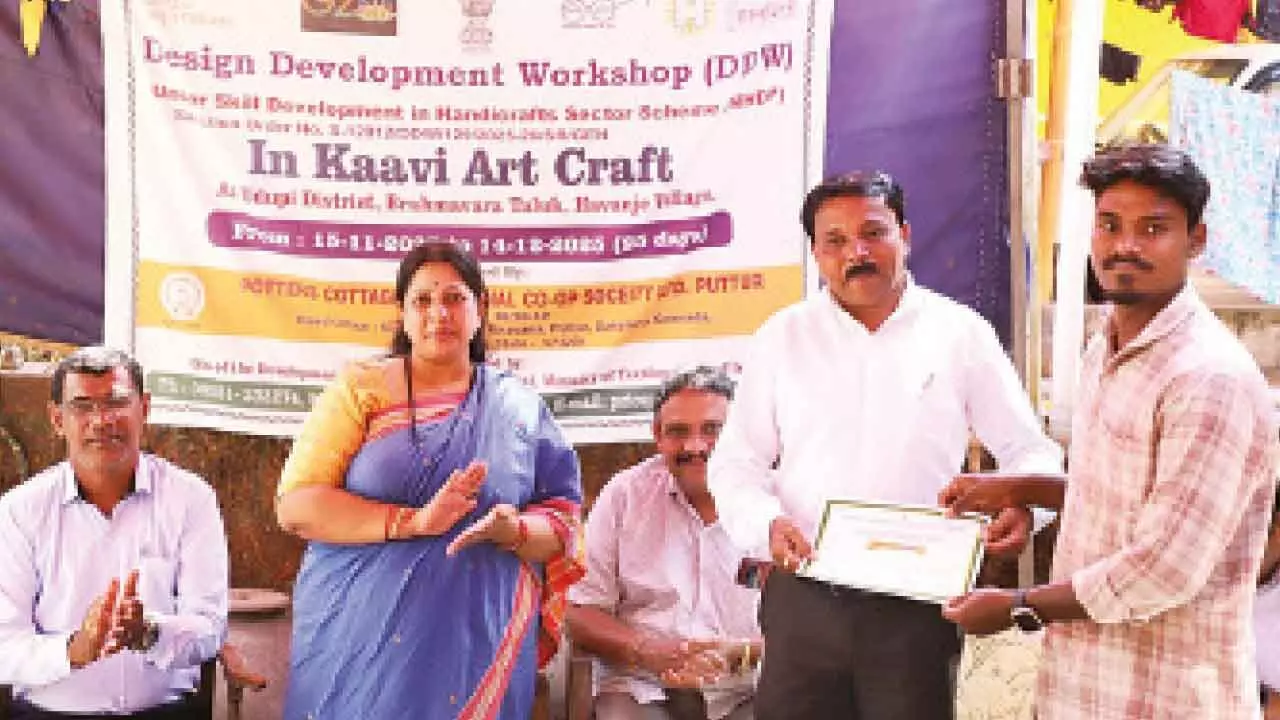
Puttur: A 25-day training programme in Udupi district brings renewed life to Kavi art—one of India’s oldest mural traditions—by equipping rural artisans with skills to adapt heritage aesthetics for contemporary markets.
In a quiet village of coastal Karnataka, an ancient art form once seen on temple walls and heritage homes is finding new expression in pottery, textiles, and wooden artefacts. A 25-day training programme on Kavi art, an age-old mural technique native to the Konkan coast, concluded on Sunday at Havanji village in Udupi district, marking a small but significant step in preserving a vanishing craft tradition.
The programme was organised by the Kumbarara Gudi Cottage Industries Cooperative Society, Puttur, which operates across Dakshina Kannada, Udupi, Kodagu, and Mysuru districts, in collaboration with the Office of the Handicrafts Commissioner under the Union Ministry of Textiles. Thirty rural artisans from the Havanji Gram Panchayat limits participated in the intensive workshop.
Kavi art, traditionally executed using natural pigments derived from laterite stone, is considered one of the oldest mural traditions in coastal Karnataka and Goa. However, rapid urbanisation and declining patronage have pushed the craft to the brink of extinction. Recognising this, the cooperative designed the workshop not only as a conservation effort but also as a livelihood intervention.
The training was led by Dr Janardhan of Havanji, a practitioner and scholar of Kavi art, with technical support from Delhi-based expert Brijesh Jaiswal. Participants were trained to adapt Kavi motifs onto utilitarian products such as pottery, fabric panels, wooden décor items, and everyday household goods—demonstrating how heritage art can be integrated into modern consumption patterns.
Officials from the Ministry of Development of North Eastern Region’s service centre in Mangaluru briefed artisans on government schemes, market linkages, and financial support available for craftspeople. Local leaders expressed hope that such initiatives would encourage greater youth participation in traditional crafts.
For many participants, the programme was more than a workshop—it was a reconnection with cultural memory and a pathway to sustainable income rooted in tradition.