




- Hindutva influencer detained
- New 'Bharath Jodo' logo unveiled; Karnataka CM Shivakumar calls it symbol of unity
- Punjab BJP condemns police action against activist who raised drug issue
- HM Shah inaugurates World Archery Para Series in Ahmedabad, eyes global sports hub status
- Morena’s Kailaras sugar factory to be restarted: CM Mohan Yadav
- Shreeniti eyes double, Tejas ousted at KSLTA World Tennis Tour J30 Bengaluru
- Assam: Akhil Gogoi targets Congress MP Rakibul Hussain over rise in declared assets
- Sikkim CM flags off NDRF mountaineering expedition 'Shikhar' to Mt Jongsong
IEEE launches FNEM Programme to support connectivity innovation
In Short
The IEEE launches its Future Networks Empowerment through Mentorship (FNEM) initiative at IIIT-Bangalore, backing early-stage innovators and startups solving rural connectivity challenges.

Share :
IEEE launches FNEM Programme to support connectivity innovation
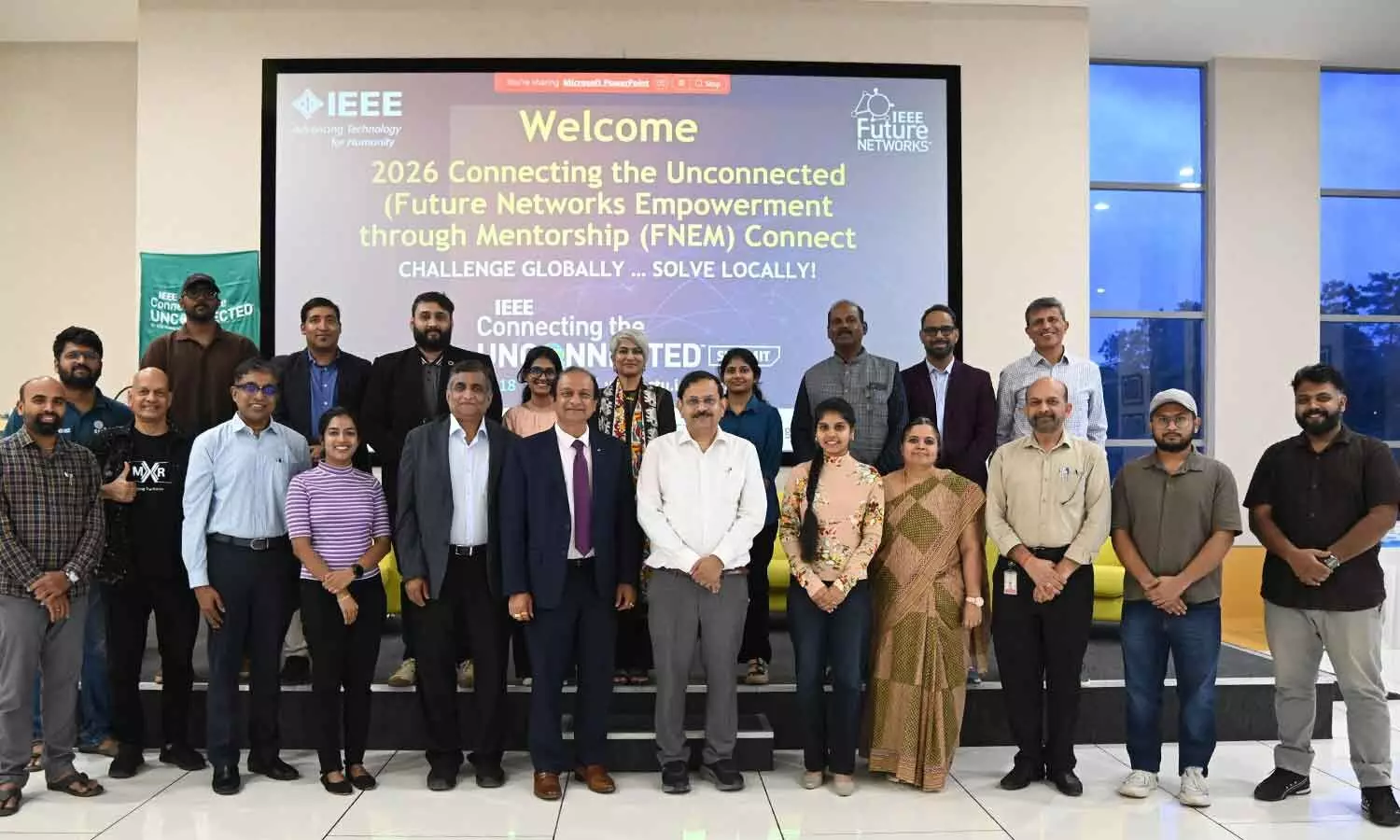
The Institute of Electrical and Electronics Engineers (IEEE) has launched the Future Networks Empowerment through Mentorship (FNEM) – Powering Connecting the Unconnected (CTU) programme in India at the International Institute of Information Technology Bangalore (IIIT-Bangalore).
The initiative is aimed at supporting early-stage technology innovators, start-ups, researchers and engineers working on solutions to rural connectivity challenges and the digital divide. The launch also marked the beginning of the programme’s first cohort in India. The programme will follow a 1,000-day LAMP journey — Learning, Action, Mentorship and Practice. Participants will receive structured mentorship and technical and entrepreneurial guidance as they develop ideas into proof-of-concepts and, where applicable, scalable solutions for rural and underserved communities.
The programme’s focus areas include technological entrepreneurship, technology and business skills, community and user engagement, and understanding local contexts and regulatory requirements. Participants will also receive guidance related to technology commercialisation, standards development, investment readiness and business strategy.
The launch event brought together researchers, start-up founders, engineers, investors, standards experts, industry representatives, faculty members and students. The programme included invited talks and a panel discussion covering entrepreneurship, mentorship, intellectual property and rural broadband standards.
The first cohort is supported by the Lemelson Foundation and IEEE Foundation, with IIIT-Bangalore serving as the host and academic partner. The COMET Foundation at IIIT-Bangalore, IEEE Standards Association, IEEE Bangalore Section and IEEE Communications Society Bangalore Chapter are among the organisations involved in the programme and event. The initiative is being led by IEEE CTU co-chairs Dr Ashutosh Dutta of Johns Hopkins University, Dr Sudhir Dixit of Basic Internet Foundation, and Prof Ruolin Zhou of the University of Massachusetts Dartmouth.
The programme is intended to connect innovators with experienced mentors and provide support across different stages of technology development, from early ideas and proof-of-concepts to validation and potential commercialisation.
The launch also featured the IEEE MOVE (Mobile Outreach Vehicle) Truck, highlighting the programme’s focus on technology outreach and connectivity challenges in underserved areas.
The initiative is expected to provide participants with opportunities to work on rural connectivity and engineering challenges while developing technical, entrepreneurial and community-focused capabilities.


