




Acharya Devo Bhava in the age of AI
In Short
As AI transforms the classroom, the human teacher remains the indispensable guide to knowledge, ethics and character

Share :
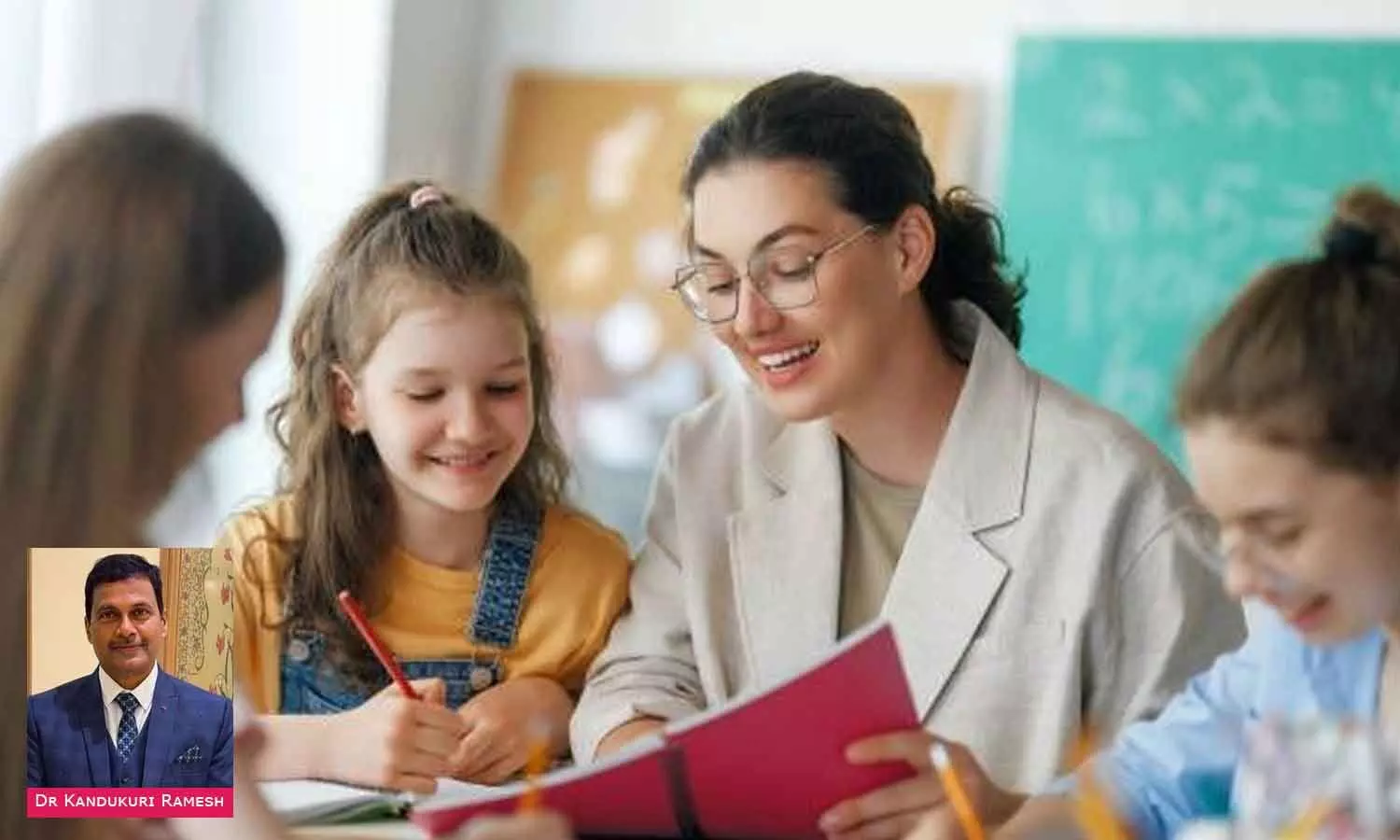
Acharya Devo Bhava in the age of AI
In the Taittiriya Upanishad, a young student departing his gurukul is given a farewell exhortation that has echoed through Indian civilisation for three thousand years: Acharya Devo Bhava — let the teacher be to you as God. What does that ancient injunction mean in a classroom where a ten-year-old asks AI to explain photosynthesis before asking her teacher; where students build robots and use smartphones to explore the natural world. The tools have changed beyond recognition. The reverence the Upanishad asked for remains necessary.
The Changing Dynamics
Today’s learners are native to the digital age. This has quietly rewritten the paradigm of teaching itself. The Indian classroom is shifting from “the sage on the stage” to a facilitator. The National Education Policy 2020 and National Curriculum Framework 2023 codify this shift, calling for competency-based learning, higher-order thinking, and “assessment as learning.”
This is being lived out in classrooms across the country. A Mathematics teacher uses GeoGebra to let students manipulate a parabola rather than memorise its equation. Computer Science students design agriculture bots and smart ambulance-priority systems. A Chemistry teacher lets an experiment fail, because confusion can teach better than explanation. None required AI. All is strengthened by it.
The Human Algorithm
Artificial intelligence can personalise a worksheet, translate a paragraph, generate a quiz, or explain a concept in forty languages at three in the morning. What it cannot do is notice that a bright, usually talkative child has gone quiet and gently ask why. It cannot decide that a lesson should pause for a conversation about conflict, peace, or hope. It cannot feel these things, and therefore cannot transmit them.
This is why the teacher remains indispensable for synchronising 21st-century skills, AI and classroom technology. AI supplies scale, speed and personalisation; technology supplies access and simulation. Only the teacher supplies purpose, ethics, context, and care — qualities that decide whether a powerful tool illuminates a mind or merely occupies it. The teacher is no longer the sole source of information. She has become its interpreter, moral compass, and human interface. As Dr. Sarvepalli Radhakrishnan once insisted, “teachers should be the best minds in the country.” When a machine can answer instantly, it is the best minds — not the most encyclopaedic ones — that a classroom needs.
A Profession Transformed
It is time to retire the tired image of the underpaid, under-respected Indian schoolteacher. That image is rapidly becoming obsolete. The modern teacher must master subject depth, pedagogy, technology, psychology, differentiation, and leadership.
Across Indian education, teachers are becoming resource persons and curriculum authors; initiatives are growing into international schools; educators are organising TEDx platforms, authoring textbooks, winning Olympiads, and participating in training exchanges. Academic leadership — headship, principalship, or founding an institution — has become an increasingly prestigious career path. As Dr. A.P.J. Kalam put it, “teaching is a very noble profession that shapes the character, calibre, and future of an individual.” India is beginning to recognise this.
Human-AI Partnership
Project the current trajectory a decade forward and a plausible picture emerges: AI handling what it does best — diagnostic assessment, personalised practice, translation, administrative load — freeing the teacher for what only she can do. The 2035 classroom will need fewer transmitters and more designers of experience, curators of curiosity, and custodians of character. Swami Vivekananda’s definition of education — “the manifestation of the perfection already in man” — will matter more, not less, in an era when a machine can tell a child every fact she might need. Facts are no longer scarce. Wisdom, discernment, and moral courage still are, and it is the teacher who cultivates them.
The gurukul is gone. The black and green boards are disappearing. The smart panel, AI tutor and robotics kit are here to stay, and rightly so. But the child in front of them is still looking for the same thing the Upanishad described — someone worthy of being followed. India’s teachers are proving themselves worthy of exactly that. A nation cannot outsource its wisdom to a machine. Its gratitude is owed to the teacher.
(The author is a former PGT & Principal of JNV and retired Additional Director of IGNOU)


