US counter diplomacy & India’s response

India’s strength lies in its civilizational identity. Unlike most modern states, India’s foreign policy does not have to be built from scratch. It flows naturally from thousands of years of accumulated wisdom in negotiation, coexistence, and conflict resolution.Our scriptures and our history are full of examples where tact, restraint, patience, and moral authority triumphed over brute force. Even in modern times, India has weathered sanctions, wars, and betrayals without losing its diplomatic dignity. From the Non-Aligned Movement to the nuclear test crises of 1998, India has consistently chosen maturity over mayhem
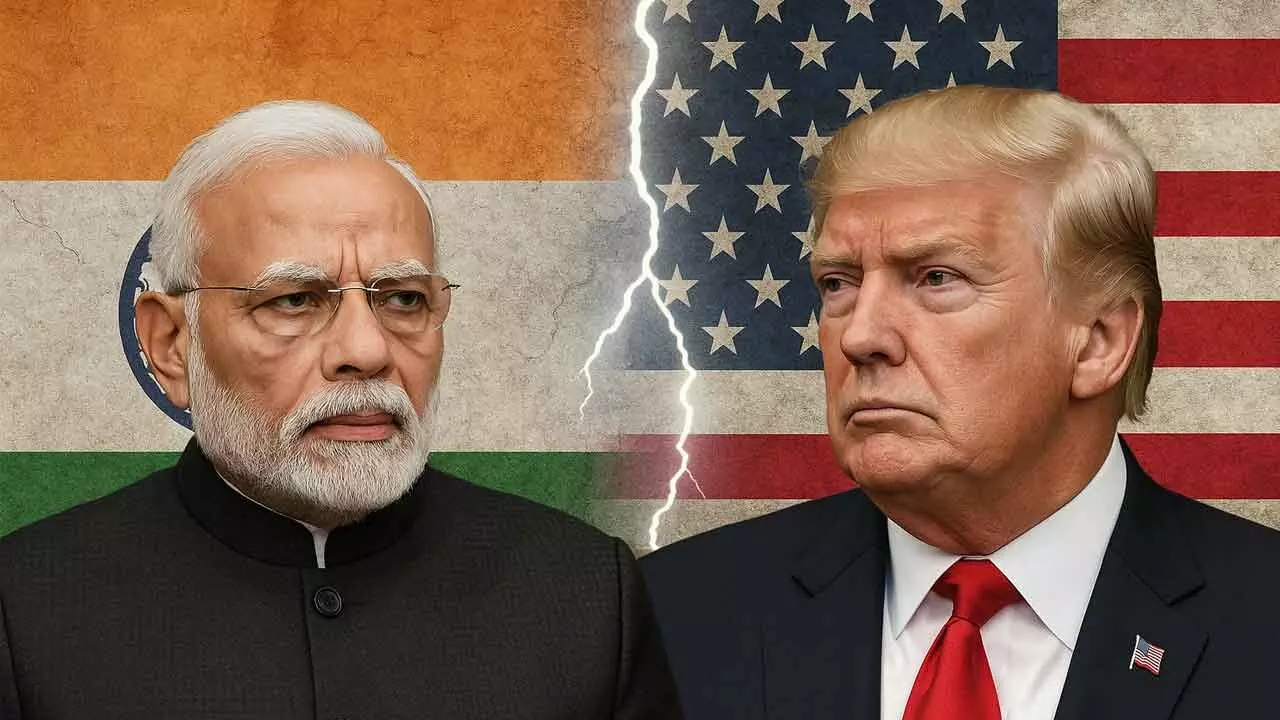
In the aftermath of the Pahalgam terror attack, India has been navigating yet another test of its diplomatic resilience. While our nation mourned the lives lost to senseless terrorism, the United States chose this fragile moment to escalate tensions by imposing punitive trade tariffs. To make matters worse, senior American voices, including President Trump’s trade advisor Peter Navarro, have crossed lines of civility by making threatening and grossly undiplomatic remarks about India’s position in the global order.
Navarro’s latest outburst of calling the Russia–Ukraine war the “Modi War” is not just preposterous but reeks of the lowest level of American diplomatic conduct. It amounts to blackmail disguised as strategy and exposes the transactional mindset that Washington has increasingly adopted under President Trump. I understand, all this is within Trump’s grand agenda of ‘America First’ code. USA has chosen ‘Counter Diplomacy’ as a state policy to coerce nations into submission.
As an Indian strategist and as a patriotic citizen, I see in this crisis both a warning and an opportunity for India. A warning, because India must remain alert to the possibility that even so-called strategic partners may arm-twist us for temporary financial advantage or geopolitical bargaining. An opportunity, because this is precisely the time for India to demonstrate to the world the strength and uniqueness of the Indian way of diplomacy, a way rooted not in reactionary impulses but in wisdom, patience, and civilizational depth.
Diplomacy is not a one-night stand
Diplomacy, by its very nature, is not meant to be reactive or impulsive. It is the antithesis of instant gratification. Wars are conducted through speed, surprise, and precision strikes intended to inflict maximum damage quickly. Diplomacy, on the other hand, is about restraint, endurance, deliberation, and creating bridges that withstand storms.
Unfortunately, what we see in Washington today is the application of war logic to diplomacy. The Trump administration’s “shoot-from-the-hip” style of public statements and policy decisions has transformed serious diplomatic engagement into a theatre of threats and counter-threats. Navarro’s reckless pronouncements reflect a mindset that mistakes intimidation for strategy.
To drag India’s name into a conflict we neither started nor inflamed, and to label it a “Modi War,” is beneath the dignity of any serious nation that claims to champion democracy. India cannot mirror such behavior. A civilizational superpower cannot afford to adopt a one-night-stand approach to its foreign policy. We cannot allow our responses to be driven by daily provocations or short-term political expediency. Our diplomacy must remain anchored in consistency, depth and genuineness for lasting relationships.
The dangers of reactive diplomacy
There is a temptation, especially in moments of crisis, to respond in kind. When an American leader makes an undignified remark, when tariffs are imposed in bad faith, or when our policies are mocked on global platforms, the urge is to strike back. That urge is juvenile and dangerous for a nation like ours.
Reactive diplomacy by some diplomats may temporarily satisfy domestic audiences and play well on television debates, social media handles for forwards, likes and shares, but it weakens our national credibility globally. Every nation is watching us closely. If India, a country with a reputation for measured wisdom, a glorious history and knowledge-based culture stoops to the same level of rare petulance as Washington is in the current phase, the damage will be long-lasting.
We must remember that America under Trump is not America forever. Presidents and their advisors come and go, but relationships between nations must outlast political cycles. The India–U.S. partnership is far too important to be defined by the tantrums of a few individuals. If we allow our diplomacy to be dictated by temporary irritations, we will squander decades of careful bridge-building.
A civilisational approach to diplomacy
India’s strength lies in its civilizational identity. Unlike most modern states, India’s foreign policy does not have to be built from scratch. It flows naturally from thousands of years of accumulated wisdom in negotiation, coexistence, and conflict resolution.Our scriptures and our history are full of examples where tact, restraint, patience, and moral authority triumphed over brute force. Even in modern times, India has weathered sanctions, wars, and betrayals without losing its diplomatic dignity. From the Non-Aligned Movement to the nuclear test crises of 1998, India has consistently chosen maturity over mayhem. From the Kargil War in 1999 to the Parliament attack in 2001, from Balakot in 2019 to the recent Operation Sindoor in 2025, India has responded firmly to provocations yet framed its statements and actions with restraint and diplomatic clarity. These episodes show how our civilisational ethos of balance and maturity has consistently guided India’s approach to both conflict and diplomacy.
While America currently indulges in the low art of threats and blackmail, India must rise above. The Indian way of diplomacy is not about submission, but about maintaining our moral high ground, asserting our national interest firmly, and refusing to be provoked into undignified conduct.
The US at its lowest standards
Let us be clear, the United States today is operating at its lowest diplomatic standards in decades. Under Trump, Washington’s approach has become openly transactional, with little regard for the respect that should define relationships between two major democracies. Navarro’s repeated threats to India, his attempts to link unrelated conflicts to our Prime Minister, and his careless accusations amount to nothing less than attempted coercion.
Such behaviour may fetch short-term applause in certain domestic circles in America, but it undermines the credibility of the US globally. By trying to arm-twist India, Washington risks alienating not just a strategic partner but a nation that represents one-sixth of humanity. This is not a wise move, strategically or morally.
The Indian response
So how should India respond? Certainly not by imitating the American style of name-calling or petty retaliation. I strongly propose that the Indian response must be marked by three principles: restraint, firmness, and long-term perspective.
Restraint is vital. We must not descend into public mudslinging. Our leaders and our diplomats must avoid statements that criticize another nation’s domestic policies, politics or attack its elected leaders personally. Such behavior demeans us.
Firmness is equally essential. Behind closed doors, India must be unequivocal in rejecting any attempt to blackmail us, whether through tariffs or threats. Our red lines must be drawn clearly, and our willingness to defend our sovereignty must be communicated with quiet strength.
Finally, we must maintain the long-term perspective. India–U.S. ties are not defined by a single President, a single advisor, or a single crisis. We must think in decades, not in election cycles. This turbulence too shall pass. Our task is to ensure that when it does, India emerges with its dignity intact.
Lessons for the future
This crisis also holds valuable lessons for the future of Indian diplomacy. First, we must build resilience into our relationships. Overdependence on any one nation, whether for trade, defense, or technology, leaves us vulnerable to arm-twisting. Diversification of partnerships is key.
Second, we must invest more deeply in projecting India’s civilizational strength on the global stage. Soft power is not a substitute for hard power, but it is a powerful complement. The more the world sees India as a voice of reason, restraint, stability, and wisdom, the less effective crude threats from others will become.
Third, we must nurture our own diplomatic talent pool. The next generation of Indian diplomats must be trained not only in negotiation but in emotional intelligence, cultural sensitivity, and strategic patience. These qualities will distinguish us in a world increasingly dominated by reactive, media focused sensationalism and personality-driven politics.
“The Indian way”
As a strategist, I am convinced that India’s greatest asset in this crisis is not military might or economic clout, but our civilizational wisdom. We must not squander it by reacting impulsively to the provocations of American leaders who are themselves struggling with credibility.
The United States today may choose to operate at the lowest rung of diplomacy, reducing statecraft to a marketplace of threats and bargains. India must not follow. We must remain the voice of maturity, the custodian of dignity, and the practitioner of patience.
Yes, Navarro’s statements are outrageous. Yes, Trump’s tariffs are unfair. Yes, the timing of America’s provocations is insensitive. But India’s response must rise above outrage, unfairness, and insensitivity. Our task is not to mirror Washington’s immaturity but to showcase our own maturity.
In the long run, history does not remember who shouted the loudest in a moment of crisis. It remembers who stood firm, who spoke with dignity, and who preserved their nation’s long-term interests without succumbing to short-term anger and frustration. That is what I call – “Indian way of diplomacy”. That is how we must manage this crisis, and that is how we will secure our rightful place in the world order.
(Author is the Chief Spokesperson of BJP, Chairman for Nation Building Foundation, an expert in Emotional Intelligence and a Harvard Business School certified Strategist.”)