All hail Vajpayee’s indelible mark on Telugu land!

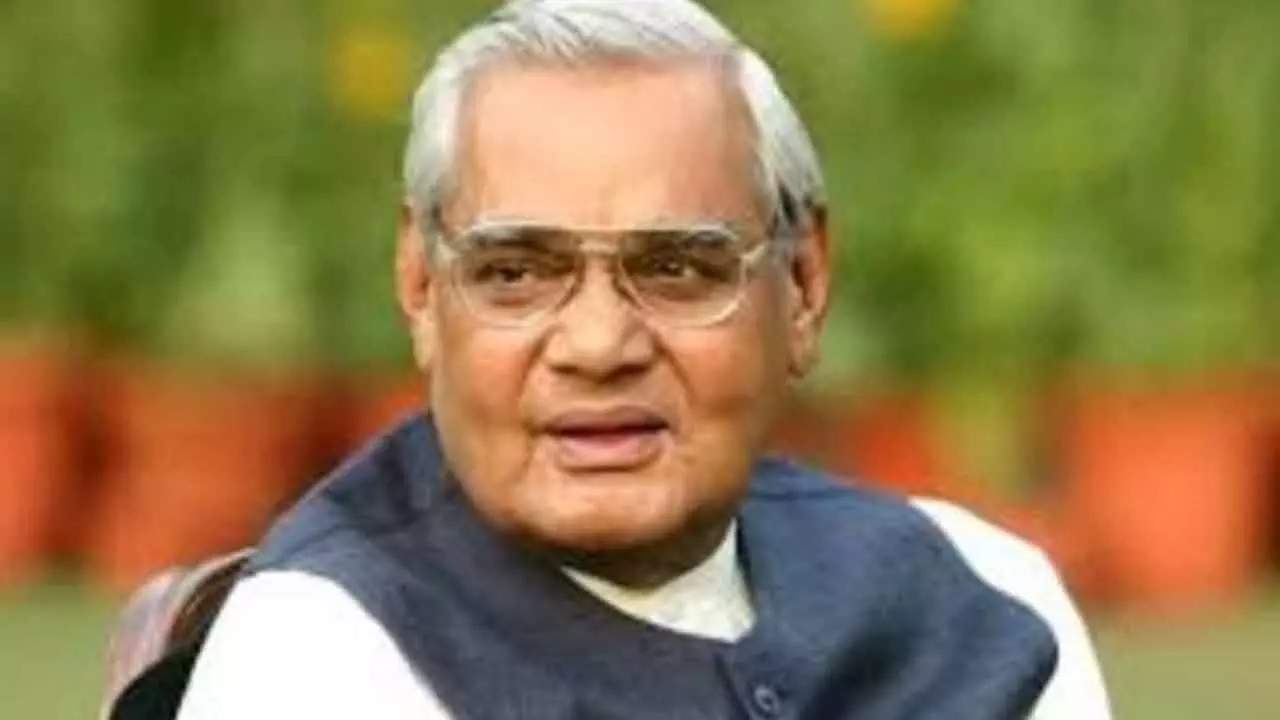
Vajpayee personally inaugurated HI-TEC City in Madhapur. With a ₹800 crore central grant and a 10-year tax holiday, Hyderabad evolved into Cyberabad and attracted global attention. He laid the foundation for the Golden Quadrilateral project at Visakhapatnam—the largest road project in the country
“Thesepeople of Andhra Pradesh have made immense sacrifices for India’s freedom and development. From the Vande Mataram movement to the Information Technology revolution… Andhras have always been at the forefront. Telugu literature is incomparable in Indian culture. Andhra Pradesh is the centre of culture, literature and arts.”
This salutation to Andhra Pradesh came from Atal Bihari Vajpayee when he was the country’s Prime Minister. He always remembered the importance of the undivided Andhra Pradesh to the nation. That is why when he led the country on the path of progress, he accorded special recognition to Andhra Pradesh and supported the development of its people. He maintained close relations with many Telugu leaders.
On December 25, the birth centenary of the Bharat Ratna will be observed across the country. The Government of India has set up a committee with several dignitaries. Atal means good governance, so the Government of India has been officially observing his birth anniversary as a Good Governance Day.
The AP unit of the BJP, spearheaded by the state chief P VN Madhav, launched the Atal–Modi Good Governance Bus Yatra on December 11 across all districts. The endeavour was to introduce the nobleness of Vajpayee to the future generations. In the first phase, his life-size statues are being installed in every district.
It was decided to launch the yatra at Dharmavaram in Sri Sathya Sai district—the birthplace of Bhagawan Sathya Sai, whom Vajpayee deeply revered.
The Yatra, which started on December 11, will conclude in Vijayawada on December 25 marking his 100th birth anniversary. This is an attempt to recall the great leader’s bond with the Telugu land.
Vajpayee always opposed the Congress party’s anti-democratic decisions, and his protection of democracy was deep-rooted. On August 16, 1984, the then Governor Ram Lal dismissed (NTR) N T Rama Rao’s majority government overnight—one of the biggest constitutional crises in Indian political history. At this time, to protect the Constitution and strengthen democracy, Vajpayee stood firmly behind NTR. Vajpayee, who was the BJP’s national president then, reacted immediately upon hearing the news of the undemocratic dismissal of NTR’s government.
NTR happened to be in Delhi that night. Before dawn, Vajpayee called him and said, “Atal is with you. Be courageous and fight.” Realising that Indira Gandhi might attempt to have NTR arrested, Vajpayee took him to his residence at 6 Ferozeshah Road and sheltered him there for two days. It became NTR’s safe house.
Between August 17 and 20, 1984, under Vajpayee’s leadership, BJP workers held the “Indira Gandhi Go Back – Save Democracy” movement in Delhi. Vajpayee himself was arrested. Vajpayee and L.K. Advani took NTR to the President of India and exerted pressure to reverse the Governor’s decision. This was a very crucial development. That people’s movement led to the restoration of democracy.
On September 16, 1984, Vajpayee personally came to Hyderabad for NTR’s swearing-in ceremony. At the Raj Bhavan gate, Vajpayee hugged NTR tightly and said, “This is the victory of democracy.” That photograph remains in history.
NTR often said, “In the most difficult moment of my life, only Atalji stood by me. Without him, I would have been finished politically.” In this way, during a sensational turning point in Andhra Pradesh’s political history, Vajpayee stopped yet another Indira Gandhi’s attempt to murder democracy and etched his name forever in history.
Vajpayee’s connection with Andhra Pradesh is visible everywhere today. National highways, rural roads, housing schemes for the poor, and especially the first major central support for Hi-Tec City in Hyderabad, were all courtesy of the Vajpayee government. The concept of the Visakhapatnam–Chennai Industrial Corridor was also his. In 2004, he decided to give national project status to the Polavaram project, but it did not materialize due to the subsequent electoral defeat. Ironically, it happened only after the BJP returned to power.
From 1998 to 2004, the NDA government under Vajpayee sanctioned central projects and funds that remain an unforgettable chapter in the state’s history.
AP received central assistance to the tune of ₹22,000 crore. Vajpayee personally inaugurated Hi-Tec City in Madhapur. With a ₹800 crore central grant and a 10-year tax holiday, Hyderabad evolved into Cyberabad and attracted global attention. He laid the foundation for the Golden Quadrilateral project at Visakhapatnam—the largest road project in the country.
He declared that Andhra Pradesh would become the economic capital of India. As predicted, Visakhapatnam emerged as an economic capital. He laid the foundation for the Shamshabad Airport and provided ₹1,500 crore as central equity. He sanctioned ₹1,200 crore to upgrade Visakhapatnam Port to a 14-meter draft and ₹100 crore to the Rajiv Gandhi International Cricket Stadium (RGICS) at Uppal in Hyderabad. The projects and funds given during Vajpayee’s six-year tenure marked the golden era that Andhra Pradesh fondly and proudly remembers.
As BJP president and Prime Minister, Vajpayee occupies a special page in the political history of Andhra Pradesh. He shared affectionate relations with many Telugu leaders, including M Venkaiah Naidu, Chandupatla Janga Reddy, Ch Vidyasagar Rao, Indrasena Reddy, Devireddy Surya Prakash Reddy, P V Chalapathi Rao, Chilakam Ramachandra Reddy, Bandaru Dattatreya, G Kishan Reddy, Haribabu, Somu Veerraju, and younger leaders like Srinivasa Varma, Satyakumar, Muralidhar Rao, Bandi Sanjay, and Challa Palli Narasimha Reddy.
Vajpayee’s bond with Telugu leaders laid the foundation for the expansion of the BJP in the state. During his terms as BJP national president (1980–86, 1993–96), he played a key role in strengthening the party in Andhra Pradesh. Former Vice-President Venkaiah Naidu was extremely close to him. Vajpayee guided Venkaiah personally when he moved from Janata Party to BJP. Venkaiah often says, “Atalji is my guru. Without him, my political journey would not have been this smooth.” He repeatedly mentioned that the opportunities he received as national president were due to Vajpayee’s guidance.
Devireddy Surya Prakash Reddy from Anantapur was the first BJP state president in the undivided Andhra Pradesh. Vajpayee personally appointed him soon after the BJP was formed. Under his leadership, district committees were established. Later, in the first organisational elections, P V Chalapathi Rao became state president. Both leaders left government jobs inspired by the RSS to join the BJP. Vajpayee mentored many such young leaders.
He had a special relationship with Ponguluri Venkata Chalapathi Rao. BJP won the first Mayor post in Visakhapatnam under Chalapathi Rao. Young leader D. Yeswanth Reddy becoming a mayor drew national attention. Such experiments were encouraged by Vajpayee to strengthen the party in Andhra. In later years, most graduate MLCs in the Legislative Council belonged to the BJP. The first state executive meeting of the AP BJP was held in Hyderabad during that period.
The period of Chilakam Ramachandra Reddy was a golden era in AP BJP history. At one point, the party won 22 MLAs and 7 Lok Sabha MPs. He was one of the senior leaders who strengthened the party in the 1980s. His bond with Vajpayee spanned 25 years—political, emotional, and personal. When Vajpayee was Prime Minister and Venkaiah Naidu became the party’s national president, many Telugu leaders were encouraged. Their efforts helped break the north-Indian image of the BJP by bringing victories in the combined Telugu states, Tamil Nadu and Karnataka.
Vajpayee also had a strong relationship with another Telugu stalwart, Bangaru Laxman, who served as BJP national president (2000–01) when Vajpayee was the Prime Minister. Vajpayee deeply respected Laxman’s service and experience. The guidance he gave to Telugu leaders like Jana Krishnamurthy, who became national president, is unforgettable.
Vajpayee also had a special bond with present Chief Minister N Chandrababu Naidu. They worked together closely in the 1999 and 2004 elections. Many national reforms and development initiatives were implemented in coordination with Naidu as Chief Minister. He often recalls that many development projects in Andhra Pradesh were successfully completed with Vajpayee’s cooperation — including establishment of national institutions in Hyderabad, rural roads under PMGSY, and expansion of the Hyderabad–Bengaluru national highway, which later became crucial for three states.
Vajpayee was a brilliant literary personality. He admired Telugu literature as well. He studied the works of eminent poets like Sri Sri, Dasarathi Krishnamacharyulu and C Narayana Reddy. He once mentioned that a poem from Sri Sri’s Mahaprasthanam inspired him greatly.
At a public meeting in 2003, Vajpayee emotionally recalled lines from Sri Sri’s Jayabheri. Although Sri Sri was a leftist ideologue, Vajpayee said that one must appreciate great poets regardless of ideology. He said, “Those lines in Sri Sri’s Jayabheri have greatly influenced me and inspired me.”
As a poet and a sensitive human being, Vajpayee respected poetry that conveyed deep emotion and societal concern — irrespective of language. He recognized how poets like Sri Sri and Dasarathi questioned inequality and envisioned transformative change.
It is impossible to fully describe Vajpayee’s connection with the people, leaders, and development of Andhra Pradesh.
The BJP is organizing his birth centenary celebrations on a grand note and is involving the public. It is commendable that the party is striving to present Vajpayee’s thoughts and ideals to the youth.
He astonished the world by successfully conducting India’s nuclear tests and leading the country through global sanctions with confidence and reform. After the nuclear success, he proclaimed:
“Jai Jawan, Jai Kisan, Jai Vigyan.”
Political leaders must take inspiration from such a statesman. Remembering the services of this Bharat Ratna is an honour for all of us.
(The writer is Member, BJP National Council)