Grace, rhythm, and divinity mark SICA’s 67th annual festival opening

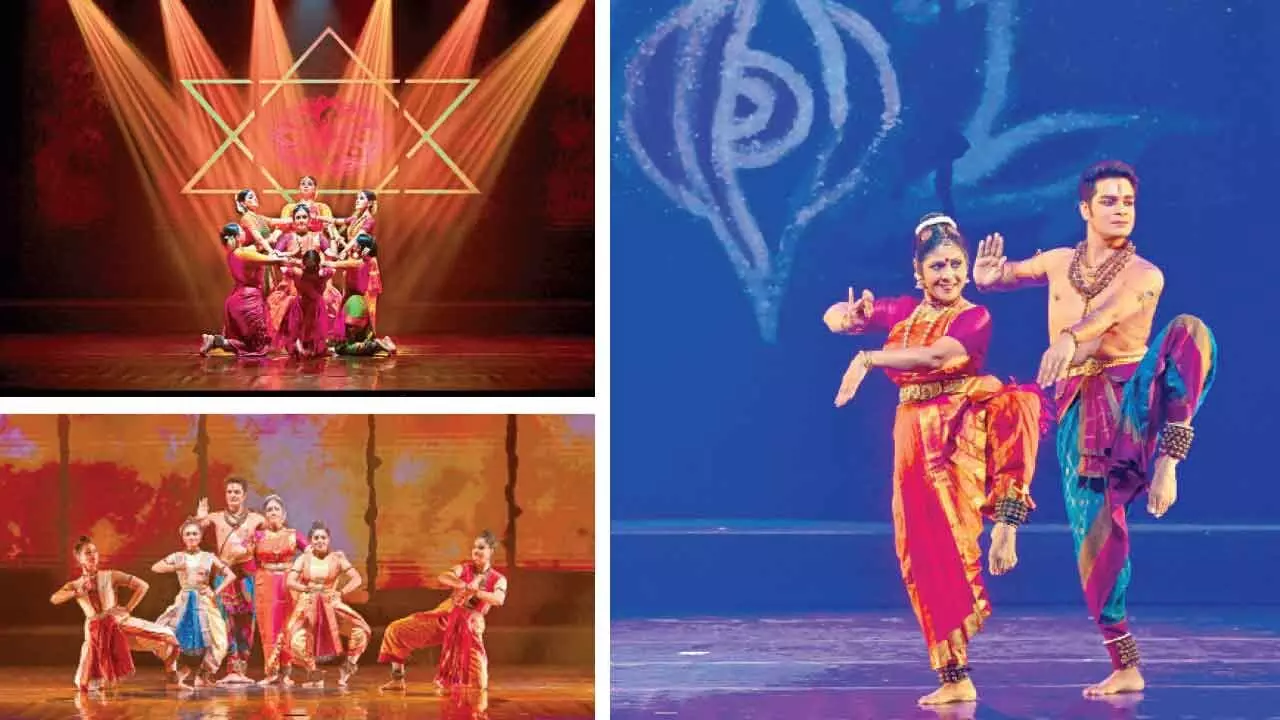
It was a special evening at Ravindra Bharathi for the South Indian Cultural Association as their 67th Annual Festival opening witnessed the conferment of the title “Natya Shiromani” to Padmasri Dr. Ananda Shankar Jayant. This is the first time the newly instituted title for classical dancers has been conferred. The celebrated senior artiste went on to present a spectacular 77-minute Bharatanatyam ballet by the Shankarananda Kalakshetra ensemble — “Tales of the Bull and Tiger.”
Blending serene melodies, enthralling choreographies, luminescent light effects, and meticulously trained students, the recital was the acme of extraordinary creativity infused with the immense experience and nuanced subtlety of a master of her field. Recorded vocals in Sathiraju Venumadhav’s voice were of such crystalline quality and resonance that it seemed as though he were singing live. Renuka Prasad’s dimensionally energetic jathis were interspersed. The brief English narrative interludes by Jayant Dwarkanath were lucid in exposition. Costumes were by Ganesh Nallari and lighting by Surya Rao, digitals by Gunjan Ashtaputre, stage décor by Deepa Krishnamachari — talents in their fields were thus brought together for a regally perfect masterpiece.
Unlike with other deities, the family of Shiva and Parvati are the only divine family constantly seen together. Their devoted vahanas are as much a part of them, along with the children Vinayaka and Skanda, who always manifest their respect to Nandi and Simha. This was the overarching central subject of the recital — a day in the life of the divine family from dawn to dusk, presented from an interior prismic view as the divine vehicles are themselves the storytellers — a novel vantage point. Each character gets introduced naturalistically as part of the mosaic of a typical day.
The Mushika vahana is endearingly mischievous, darting and bouncing with quivering energy and the quicksilver movements of a mouse — young artiste Sai Ishani, all of nine years old, was stunning to behold. Heavy-bodied Ganesha, played by Srividya, is never far from his favourite vahana and enters the scene to the strains of the Ganapati Talam. In the next sequence, a bevy of Peacocks — Shreya, Aaradhya, Krishna, Shraddha, Lakshya, and Sriyuktha — complete the menagerie in iridescent blue-violet hues as they search for their master, the lithely agile Muruga (Khevna), who soon joins in while they are performing an ornate Mayur Alarippu dance, moving eyes, necks, and limbs to enhance the birdlike gait.
The divine children are captivated by the stories told to them about their parents by Neha as the prancing, horned Nandi, and Shreenidhi as the fiercely fanged Simha. The preliminary activities of the divine wedding, symbolising Shringara Rasa, were deftly evoked by a bevy of dancers (Sneha, Anusha, Poojitha, Ridhishri, Avani, and Jeshita) to set the stage. The Ardhanareeswara Stotram was interesting as the attributes of Parvati were enacted by Shiva (Guest Artiste Mithun Shyam) and vice versa. The divine pair were entrancing during matching, symmetrically synchronised movements.
Shiva enters with a dignified mien under a glittering umbrella held aloft; Parvati bashfully follows behind a translucent veil, and the pair exchange garlands. Nritta was elaborate, but the mood was never lost. The children think their mother Parvati is winsomely cute, but the vahanas interject with the awesome forms of the Divine Mother. She is Durga, the quintessence of all the Gods. The stern-visaged countenance of Ananda as the multi-armed Goddess radiated majesty and poise, as in intricate detail different weapons in each hand were picturised exquisitely in succession. The Sri Chakra is her esoteric representation.
Their father Sadashiva is the one who curbed the pride of Vishnu and Brahma by manifesting the immense Linga of fire without beginning or end, beyond fathoming (Lingashtakam). Mithun Shyam’s nritta was balletic in extravagant leaps defying gravity. The Shiva Tandava Stotram was magnificent as Mithun whirled and twisted, dancing the tandava. The emphatic pure dance matched his abhinaya to convey a true sense of the God of Dance. Shiva dancing alone is joined by his bhaktas to create a secondary viewpoint of experience through the multiple eyes needed to absorb his incandescent radiance.
This high crescendo was wound down into the entire family resting together under the tender gaze of Shiva, surrounded by the integral vahanas. Parvati soothes her children to sleep to a gently lilting musical tone. The compositions of Tamil and Sanskrit poetry, including “Shambho, Ganesha Skanda Janani”, etc., were aptly selected to delineate the storyline.
A standing ovation was deservedly given by the audience, who, despite the rain, filled the hall. The Chief Guest was Justice Rangarajan, and the SICA team — represented by their President Dr. Chakravarthy, Vice President Gopalakrishnan, Adviser Rajasekhar, and Secretary Ranganathan — along with the compere for the evening Mahidhara Seetarama Sarma, deserve kudos for their organising skills in making the program a grand success.