Memories in monochrome: Manoj Kumar’s visual travelogue

Most of us, while attending meetings or taking notes, tend to doodle on the edges of our notebooks in small sketches born out of boredom or contemplation. These lines, though seemingly random, have been the roots of some of the world’s earliest artistic expressions. From prehistoric rock art and Warli murals to the lyrical line drawings of artists like Nandalal Bose, Rabindranath Tagore, Abanindranath Tagore, and B.B. Mukherjee, Bharat’s artistic heritage celebrates simplicity, lines that breathe life into imagination.
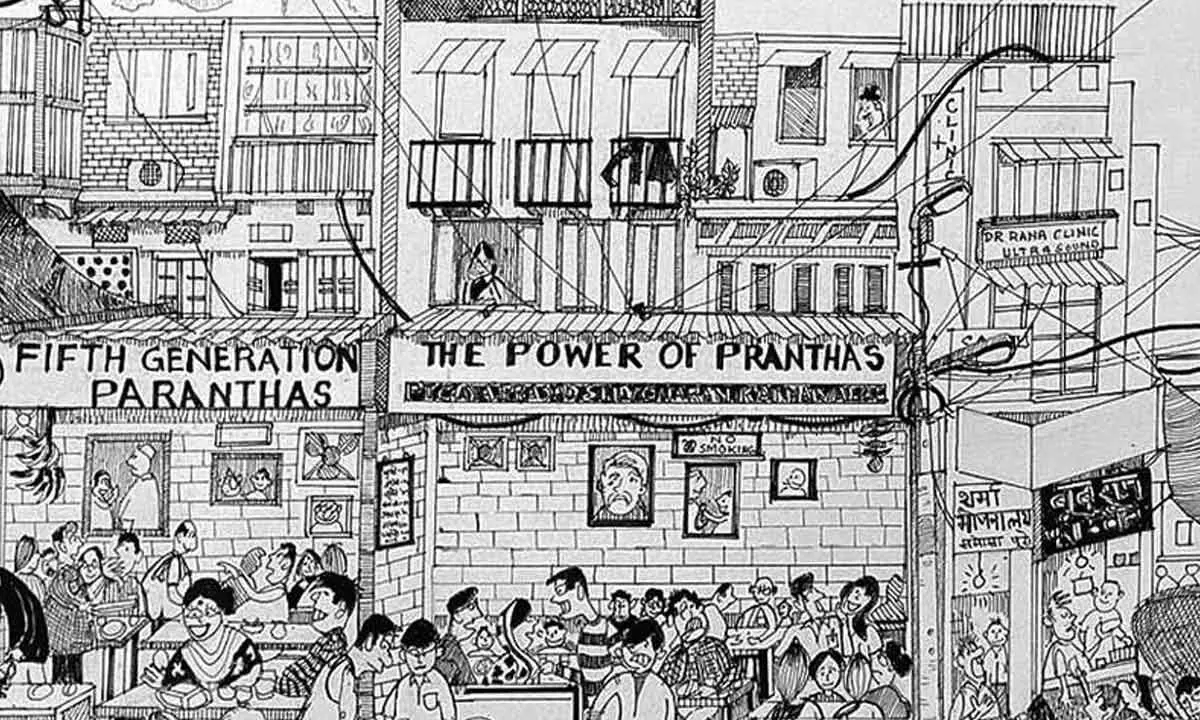
In this lineage of expressive minimalism, contemporary artist TK Manoj Kumar a superannuated bureaucrat hidden artist has brought back the power of the line through his solo exhibition “Between Delhi & the Clouds” held at the India International Centre (IIC), New Delhi, from 20–26 September 2025, curated by Dali by COMDEZ. The exhibition showcases intricate pen-and-ink drawings that capture the country’s landscapes, markets, and the rhythm of everyday life with an almost photographic precision. Yet, there is no camera here, only memory and mindfulness.
The Line as Memory
Line drawing is one of the most profound forms of storytelling. Artists like Nandalal Bose used it to depict the essence of rural India, distilling emotion and movement into single strokes. Rabindranath Tagore’s abstract sketches reflected the poet’s inner musings, while Abanindranath Tagore employed fine lines to create a distinct visual identity for Indian modern art. B.B. Mukherjee, known for his strong figurative work, also turned to line as a meditative exercise. These masters proved that art does not always need color; sometimes, the soul of the subject reveals itself through shades of black and white.
It is in this tradition that Manoj Kumar finds his voice. His sketches, though deeply personal, resonate with a universal emotion—nostalgia, serenity, and an intimate understanding of place.
The Bureaucrat Who Observes
In the high-pressure world of bureaucracy, where files, policies, and public service define the day, art often takes a backseat. But for Manoj, it became a way to record the expressions and visits in his memory. Known among colleagues as calm and unassuming, his demeanor may initially seem strict, but beneath that composure lies a sensitive observer of life. Unlike most officers who prefer delegation, Manoj chooses immersion, whether in a bustling spice market of Delhi’s Sadar Bazaar or the quiet charm of Mana Village, the first village of Bharat near Badrinath.
His sketchbook became his silent companion. “Wherever I travel, I draw,” he says, reflecting on how his pen captures what words often can’t. From the narrow streets of Old Delhi to the misty mountain passes of Uttarakhand, each line on his page tells a story of human connection, fleeting moments, and the essence of space.
Art as a Reflection of Experience
The exhibition ‘Between Delhi & the Clouds’ offers visuals of experiences. Visitors felt as if they were traveling with the artist through temple towns, urban corners, hill paths, and open skies. Each sketch invites the viewer to pause, much like Manoj must have paused to observe before he began to draw. His attention to detail, for instance, the curve of a street vendor’s hand, the pattern of wires above a bazaar, or the subtle folds of a mountain ridge, shows an artist who sees and feels his surroundings.
Curated thoughtfully by Dali by COMDEZ, the exhibition extended beyond framed artworks. Sketches were adapted into accessories like T-shirts, mugs, diaries, postcards, and wall posters, blurring the boundaries between art and everyday life. This effort reflects a growing trend of ‘art democratization,’ where creativity is beyond galleries and travels into homes and daily routines.
“Art is not decoration,” says Vishal Goyal, founder of Dali by COMDEZ. “It’s memory, philosophy, and legacy. In Manoj Kumar’s work, each line is a city carried forward, a silence remembered.”
Travel, Memory, and Mindfulness
Unlike artists who create from imagination alone, Manoj’s works emerge from lived experience. His travels across the country’s cultural geography have informed his compositions. The play of light on Himalayan slopes, the geometric rhythm of urban rooftops, the stillness of dawn over the Yamuna all find expression in his lines.
In an age of fast photography and AI-generated art, his commitment to hand-drawn documentation feels refreshingly intimate. Each drawing is an act of presence, of paying attention to what most of us overlook. In a world where screens dominate our gaze, Manoj reminds us that the act of looking deeply is itself an art form.
From Observation to Inspiration
What makes Manoj Kumar’s journey extraordinary is not just his artistic skill but his thoughtfulness. A bureaucrat’s life is bound by deadlines, responsibilities, and limited choices in postings. Yet, Manoj has embraced each posting as an opportunity to observe and create. His story becomes a quiet lesson in resilience and joy, how creativity can be a powerful antidote to stress.
He often sketches in public spaces from markets, tea stalls, railway stations, where the bustle of life is its own challenge. The ability to sit, observe, and translate chaos into calm lines speaks volumes about his discipline and composure. His art is spontaneous yet structured, reflective yet alive.
Legacy of Simplicity
Just as Bose and Tagore once used line art to represent a nation’s awakening, Manoj Kumar uses it to document a nation in motion. His exhibition, aptly titled ‘Between Delhi & the Clouds,’ captures the essence of Bharat’s niche from the grounded energy of its cities and the transcendence of its landscapes.
For visitors, the exhibition was more than an art show; it was a journey across the country through the eyes of a man who has served it. It reminds us that art can emerge from anywhere, even from the files and corridors of bureaucracy, when one chooses to see life beyond duty alone, but as discovery.
Manoj Kumar’s sketches are ‘meditations in ink,’ where every line holds a story, and every silence between lines, a breath of the artist himself.
(The writer is a Creative Economy Expert)