




- AI’s next disruption could be retirement planning
- Market volatility calls for caution, disciplined bets
- Unity vital for Arya Vysyas to secure political share: Revanth
- Task force push for stability, security and transparency in Maharashtra competitive exams
- BRICS emerging as key platform for Global South cooperation: Experts
- One Indian missing after attack on commercial vessel off Oman coast: MEA
- UCC will be implemented in 21 NDA-ruled states before 2029: HM Amit Shah
- Telangana Police facilitates refund of Rs 139 crore to cyber fraud victims
AI’s next disruption could be retirement planning
In Short
Explore how transformative AI and automation will impact retirement planning between 2026 and 2040, shifting the focus from labor income to capital ownership and wealth participation.

Share :
AI’s next disruption could be retirement planning
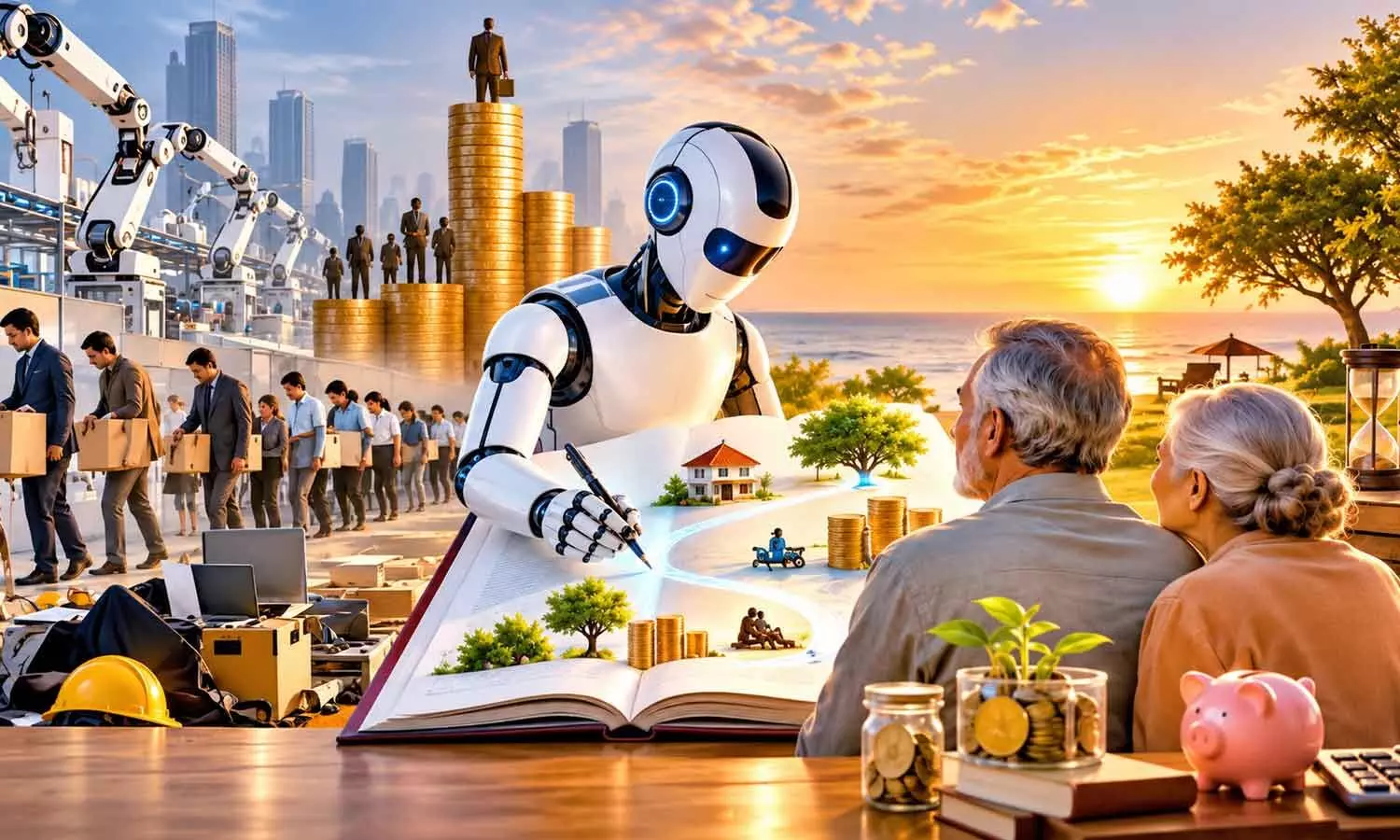
During the week, Anthropic, the parent of Claude LLM released a paper that on the “Economic scenarios of transformative AI” which presents a framework for assessing the economic consequences of AI between 2026 and 2030. In the model, AI automates a growing share of cognitive work, raising productivity and displacing workers who must search jobs in other occupations. The model maps future paths of AI capabilities into implied paths for GDP, the labor share, wages, labore reallocation, and unemployment. It further illustrates the framework in three scenarios: modest, substantial and extreme.
Going through that set me to off to thinking about how the conventional retirement planning would get affected with the changing environment. So, I began to ponder on certain aspects of the paper and the remedies that could possibly address the prospective concerns. Taking cue from the paper, I devised scenarios for those retiring by 2030 and for those planning to retire in 15 years from now i.e. about 2040-41. But lets first list out some of the prime insights from the paper.
AI is usually thought as a productivity story i.e., AI contributes for higher productivity so leads to higher GDP and eventually higher wages, but it would become more of a capital story. During the transition, AI raises the productivity of capital and shifts tasks from humans to machines. Hence, part of the productivity gains accrues to owners of capital, not workers. It means the economy could become dramatically richer while labor captures a smaller share of the wealth. The fallout is GDP growth and employment would move divergently.
In the extreme scenario, the GDP growth is projected to be 32.4% higher than the no-AI path by 2030, while the the cognitive employment is down 21.5% i.e., the knowledge industry could substantially shrink with unemployment reaching as high as 17.9%. The historical sequence of higher productivity leading to more output, more employment and higher wages could be disrupted with higher productivity leading to more output with fewer jobs. As the GDP decouples from jobs, the paper therefore separates economic prosperity from employment prosperity.
A particular insight that caught my attention is that the real bottleneck may be transition, not technology. AI doesn’t create unemployment simply because machines replace humans, but people can’t instantly move from one occupation to another. The speed of the labor market adaptation could matter almost as much as the capability of AI itself. As AI displacement isn’t necessarily equal to permanent unemployment, but AI displacement with slow reallocation is potentially large transitional unemployment.
The model includes reinstatement ratio i.e., the new jobs created. But these will not be fast enough and sufficient for the displaced workers to occupy. Another interesting aspect is that average wage rises substantially (9.7%),while the cognitive wages fall (11.5%). Of course, the wages in other occupations rise 33.6% with the share of GDP accruing to labor falls 45.2% while capital’s share rises 54.8%.
The paper clearly distinguishes between automation and augmentation. The former is the replacement of worker task by AI while the latter makes the worker more productive. So, AI productivity alone is a poor metric for judging labor market impact while AI productivity together with automation intensity is a comprehensive one.
Perhaps the biggest insight of the paper is the wealth distribution becomes a central economic problem. The aggregate gain through the increase in GDP is substantially larger (three times) than the loss suffered by displaced cognitive workers. This replaces the question of “Is AI good for the economy?” to “How do individuals participate in the wealth created by AI?”
The important lesson is that economic growth and individual economic security may no longer move in tandem as closely as we’ve assumed. The paper suggests that the pace of AI impact on economy increases from 2027. So, for someone retiring around 2030, AI is primarily a sequence of returns risk and income risk. But for those others planning to retire a decade later from 2030, the issue becomes more of a portfolio construction and ownership of capital risk.
Retiring in 2030, the immediate risk is to tide over the AI transition on how to withstand a period where markets, wages and asset valuations are being reshaped even as the employment income grinds to a halt. A bucket strategy that insulates the immediate 5–7year period of the essential retirement expenditure becomes critical. This needn’t be in cash but liquid enough to access with high-quality debt, short duration instruments, etc.
There’s a need to recognize human capital risk. The last leg of the working years would turn tumultuous for those in cognitive occupations. Human capital becomes a declining asset with a strong vulnerability to automation. However, it shouldn’t be a case of risk-averseness completely as the study says that the other side of labor displacement is capital accumulation and higher capital returns. In the extreme scenario, capital stock rises 56.3% and capital returns rises 8.3%. So, who owns the capital matters more than how fast the economy grows.
This calls for a targeted exposure to productive capital of the future, but not inevitably through concentrated AI stocks. AI exposure isn’t same as AI diversification. Owing a bunch of AI companies isn’t owning AI economy. The objective should be a broad diversification in productive capital through diversified domestic and global equities and other productive assets, with explicit AI or technology exposure potentially forming only a satellite portfolio. The other is to imbibe the pick and axe strategy of exposure to the industries where AI brings exponential growth.
For those around 45 planning to retire in 15 years’ time, the conventional life stage allocation to risk capital may need a reconsideration. The mechanical reduction of equity simply because the retirement age is approaching could turn counterproductive and not owing productive capital itself becomes a retirement risk.
The traditional retirement risks do not disappear in an AI era; they just acquire new dimensions. Longevity remains longevity risk, but employment obsolescence could arrive earlier. Inflation increasingly needs to be viewed through the lens of relative prices. Sequence-of-returns risk could be compounded by an AI-driven transition in employment and asset valuations. And wealth inequality could become a technology-driven retirement risk.
The response, therefore, could be a three-bucket approach: retain the first bucket of five-to-seven years of essential retirement expenses; build a core portfolio of diversified assets with domestic and global equities, gold, real estate and debt; and have a dedicated productive-capital/AI participation component that can survive different AI futures.
There is also an implication for the withdrawal strategy. Instead of assuming aautomatically inflation-adjusted fixed income, a more dynamic withdrawal mechanism may be required. Future consumption may not behave like that of today’s. Essential spending can be inflation-protected, while discretionary spending can be performance-driven, rising when the portfolio does well and moderating when it doesn’t.
There is one more uncertainty - institutional risk. If AI produces a substantial shift from labour income towards capital income, governments and societies may respond through redistribution, retraining, income support, universal basic income or other mechanisms. The retirement system of 2040 may therefore look different from today’s. We cannot assume what form that response will take, but retirement planning should recognise that policy could become an important part of the economic adjustment.
Overall, the very definition of financial independence may changefrom “I have enough money not to work” to “my consumption does not depend excessively on my ability to sell my labor.”The key question therefore shifts from “Can I retire safely?” to “What will fund my retirement?”
The study itself presents scenarios rather than forecasts, and none can currently be ruled out with the extreme case being an outlier. But the mere possibility is enough to stress-test conventional retirement planning.As the economic model undergoes transformation, the retirement playbook needs to be revised too.The objective is no longer merely to save enough to survive the future.
It may increasingly be to own enough of the future to participate in its prosperity. While the retirement planning may not be revolutionary to the current methods, the approach and mindset should begin to align to these upcoming changes.
The author is a partner with “Wealocity Analytics”, a SEBI registered Research Analyst and could be reached at [email protected]

“Will CURE Bill cure civic woes of Hyderabad?”
Damodar Rajanarasimha launches state-level robotic surgery workshop at TIMS
Modi Warns of Rising Geopolitical Tensions, Technology Weaponisation
BRICS outcome an eye-opener for Opposition
AI’s next disruption could be retirement planning
Market volatility calls for caution, disciplined bets


