Long-pending inter-state water disputes: TG, AP CMs reach consensus in 4 areas

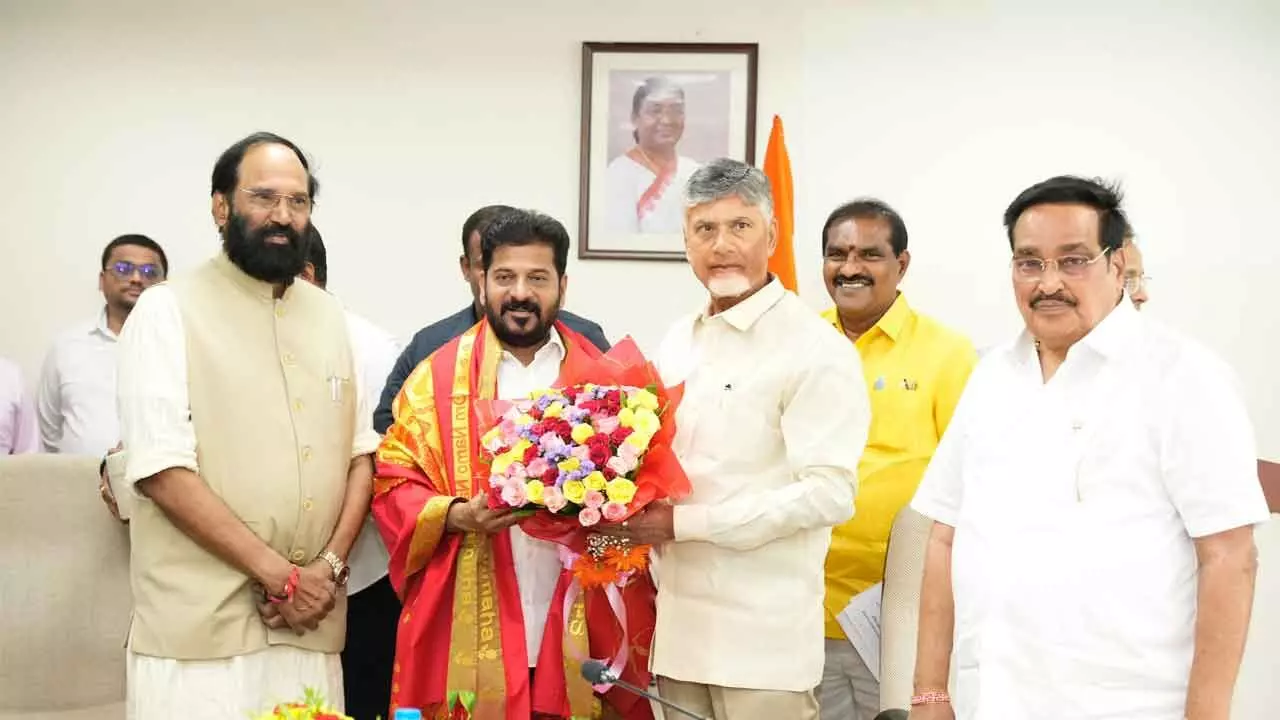
New Delhi: Telangana Chief Minister A Revanth Reddy and Andhra Pradesh Chief Minister N Chandrababu Naidu arrived at a consensus on some of the long-pending inter-state issues concerning riverine projects and utilization of water at a meeting chaired by Jal Shakti Minister CR Patil at the Jal Shakti Office in New Delhi on Wednesday. As for the residual contentious matters, the two Chief Ministers agreed to constitute an Official Committee with technical experts in a week to resolve pending approvals for new projects and water allocations from Godavari and Krishna rivers in Telangana and Andhra Pradesh.
Although the Telangana government had strategically sought to drop from the agenda of the high-level meeting the ticklish issue over the Godavari–Banakacherla project, the AP government upended it by making a presentation on the project from its standpoint and sought the help of the Union government to go ahead with the construction of the new project drawing 200 TMC of water. The Andhra CM claimed that the project was being constructed utilizing “only flood waters”.
At the meeting, which was attended by Irrigation Ministers and top officials of the two states, the Telangana CM came up with 13-point agenda covering various issues. Of these, the CMs reached agreements in four areas: AP accepted Revanth Reddy’s suggestion to install telemetry machines to quantify the release of water from the projects; setting up Godavari River Management Board in Telangana state and Krishna River Management Board in Andhra Pradesh; carrying out repairs to the Srisailam project and the constitution of an Official Committee to resolve pending issues concerning projects on Godavari and Krishna rivers in Telangana and Andhra Pradesh.
The meeting was held in a cordial atmosphere with the two Chief Ministers, though dealing with divergent issues relating to various projects, deciding to resolve water sharing and execution of projects through dialogue in the future.
Revanth Reddy, briefing the press after the meeting, claimed that the controversial Banakacharla project issues were not discussed, though AP Irrigation Minister N Ramanaidu said that AP presented a report on the project. The Chief Minister sought to clarify that the Centre was only a facilitator at the meeting and the Union Minister played the role of a judge. The meeting decided to resolve some more of the residual pending issues in 30 days as the Official Committee would hold talks with AP counterparts. The Centre also agreed to play the role of an arbitrator to resolve the issues between the two Telugu states.
Asked whether this meant that finally the Centre would take a call on the decisions taken by the two states, the Chief Minister said that the decisions arrived at in the Apex Council meetings and the provisions under the AP Reorganization Act 2014 were not taken into consideration by the Union government. He maintained that the two states would resolve the issues amicably since the role of the Centre will remain that of a mediator. “We evolved a mechanism to identify issues and take decisions on the issues.
Water allocations in Krishna and Godavari tributaries, project construction, long-pending projects etc. will be discussed and we will find solutions in the future meetings,” Revanth Reddy said, adding: “the Official Committee will hold issue-based discussions in the second step and help the two states take decisions.”
The TG Chief Minister slammed the previous Bharat Rashtra Samithi government for not addressing the water disputes and project constriction during its 10-year rule. Now, the Opposition parties were raising the issues for political gains. The Congress government was aware of how to rule the state and find solutions without any disputes with the neighbouring state, he asserted.