Indoor air pollution: India’s silent health crisis demands urgent action

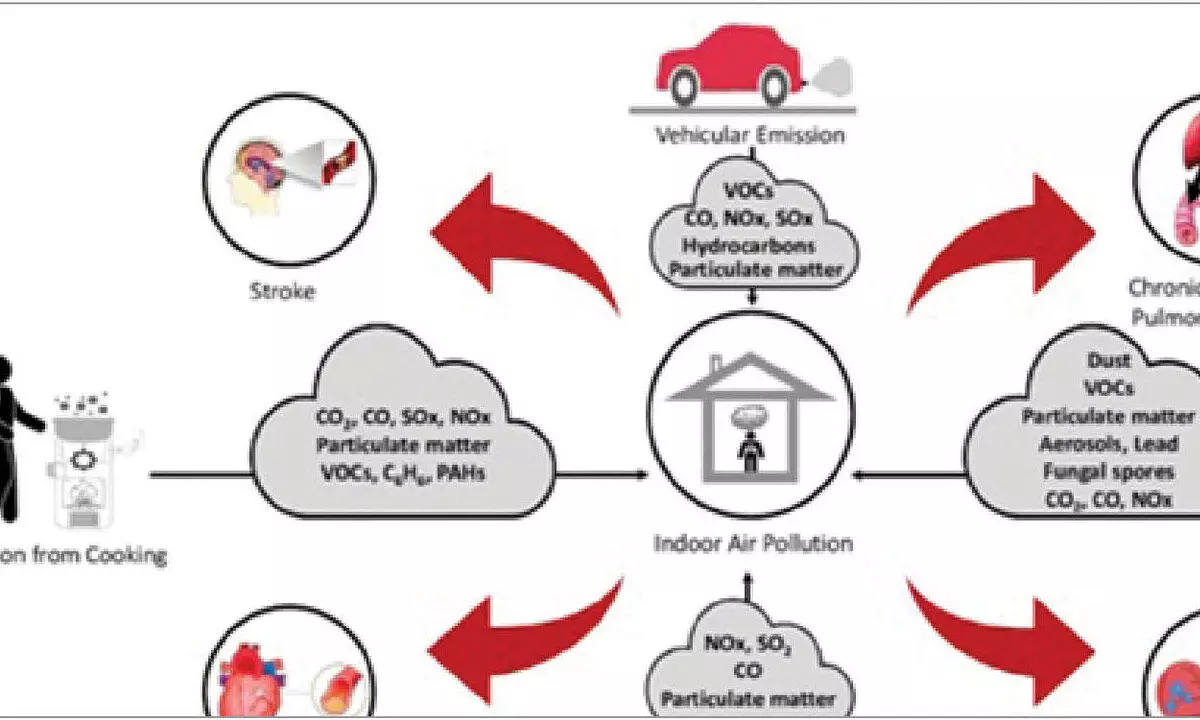
Hyderabad: Fordecades, India’s pollution discourse has been dominated by outdoor smog, vehicular emissions, and industrial smoke. Yet, a quieter and more insidious threat lingers inside homes, offices, and schoolsindoor air pollution. Contrary to the common assumption that homes are safe havens, research indicates that indoor air can be two to five times more polluted than outdoor air.Everyday activities, such as cooking, burning incense, using strong cleaning chemicals, or even storing household waste, contribute to this invisible hazard.
With people spending nearly 90 per cent of their time indoors, the absence of monitoring systems and regulations for indoor air quality (IAQ) in India represents a glaring gap in public health protection.A recent study published with the Royal Society of Chemistry underscores the severity of the issue. It found that fine particulate matter such as PM2.5 and PM10often rises well above safe exposure limits during routine household activities. Poor ventilation exacerbates the problem, allowing pollutants to accumulate and linger.
Seasonal fluctuations further worsen the situationwinter months trap pollutants indoors, while festive periods like Deepavali add layers of toxic smoke. The findings highlight the urgent need for India-specific IAQ standards, rather than relying on international benchmarks that fail to capture the country’s unique environmental and cultural realities
Dr Atun Roy Choudhury and Prof Sankar Ganesh Palani, members of the research team, shared their findings with The Hans India, stating that India cannot simply adopt global scales for IAQ because its domestic environments differ significantly. Cooking practices, building designs, fuel use, and climatic conditions vary widely across regions. Monsoon humidity, dust-prone climates, and exposure to festive smoke all shape indoor pollution levels in ways that international standards do not account for.Recognising this, researchers from BITS Pilani Hyderabad, NIT Warangal, and IIT Jodhpur have joined forces to develop a new India-specific Indoor Air Quality Scale. “This collaboration integrates household survey data with pollutant severity weights using the Analytical Hierarchy Process (AHP).
The aim is to create a relatable indexsimilar to the outdoor AQIthat empowers families to understand and manage their indoor air risks,” they said.Dr Atun Roy Choudhury pointed out that the impact of outdoor pollution events on indoor environments is equally alarming. During Deepavali and stubble burning seasons, particularly in North India, particulate matter and toxic gases surge outdoors.
These pollutants seep into homes and remain trapped due to closed windows and limited ventilation in winter.Household waste adds another dimension to the crisis. When organic waste is left to decay in bins without segregation, it releases methane and foul-smelling gases indoors.
Methane is a potent greenhouse gas—80 times stronger than carbon dioxide over a 20-year period—and contributes to harmful ground-level ozone. Even small dustbins can act like miniature landfills if waste is not properly separated, posing both health and fire risks. Further, India’s massive dump yards, such as Okhla, Ghazipur, and Bhalswa, amplify the challenge by continuously emitting methane, making effective waste management and methane capture urgent national priorities.
Prof Sankar Ganesh Palani advised that while policy reforms are essential, households can take immediate steps to reduce indoor pollution. Simple measures such as opening windows during low-pollution hours; using exhaust fans while cooking, reducing incense burning, and segregating organic waste can make a tangible difference.Policymakers, however, must shoulder the larger responsibility.
India needs tailored indoor air guidelines, mandatory ventilation standards in building codes, and awareness campaigns promoting clean cooking and waste segregation. Monitoring systems should track both outdoor and indoor pollution, ensuring that public health protection extends beyond city streets into homes and workplaces. IAQ must be recognised as a critical component of national health policy.He concluded that the message to the public is clear: air pollution does not stop at the doorstep. Pollutants such as PM2.5volatile organic compounds, benzene, radon, and dust can trigger asthma, allergies, chronic obstructive pulmonary disease, and even increase cancer risks. The introduction of an India-specific IAQ Index is a vital step towards empowering citizens to safeguard their health. Clean air begins at home, and addressing indoor pollution is as crucial as tackling outdoor smog.