Smaller Than Salt: Scientists Unveil World’s Tiniest Autonomous Robots

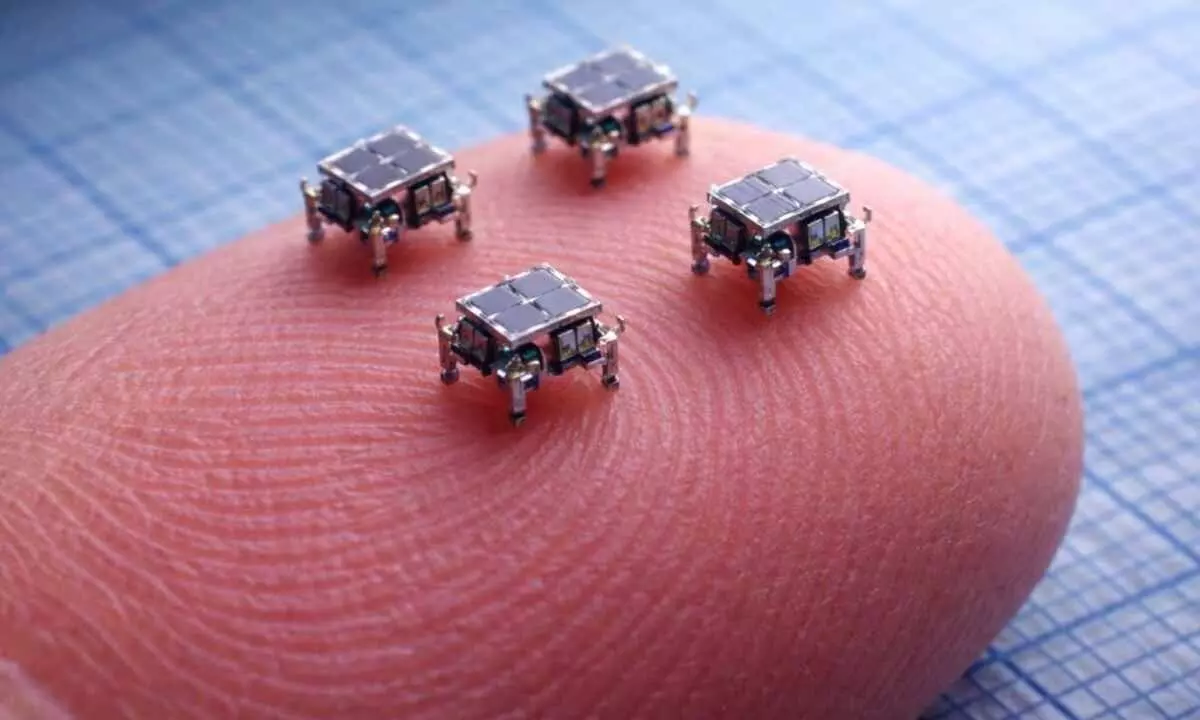
Researchers develop salt-sized autonomous robots that can swim, sense temperature, and think independently, opening new frontiers in medicine and engineering.
Imagine robots so small they are barely visible to the naked eye—yet smart enough to move, sense, and make decisions on their own. That vision has taken a major step closer to reality as researchers from the University of Pennsylvania and the University of Michigan have developed the world’s smallest fully autonomous and programmable robots, each smaller than a grain of salt.
Measuring just 200 by 300 by 50 micrometres, these microscopic machines redefine the limits of robotics. Despite their near-invisible size, they can swim through liquid environments, detect temperature changes, and alter their movement paths without relying on external controls such as wires, magnets, or radio signals. Remarkably, each robot costs about a penny to manufacture and can function for months, making large-scale deployment feasible.
The tiny robots are powered entirely by light. Minuscule solar panels built onto their surface generate energy, which is then supplied to onboard computers. These chips allow the robots to process information and act independently—something never achieved before at this scale. Highlighting the importance of the breakthrough, lead researcher Marc Miskin, Assistant Professor of Electrical and Systems Engineering at Penn Engineering, said, “We’ve made autonomous robots 10,000 times smaller. That opens up an entirely new scale for programmable robots.”
Unlike conventional robots that depend on motors, joints, or mechanical limbs, these micro-robots move using a clever and elegant mechanism. By generating tiny electrical fields, they shift ions in the surrounding liquid. Those ions push against nearby water molecules, propelling the robot forward. By adjusting the electrical field, the robots can glide in complex paths or even move together in coordinated groups, resembling schools of microscopic fish.
The absence of moving parts makes these robots exceptionally durable. Some prototypes have already demonstrated speeds of up to one body length per second—a notable achievement given their size. This robustness and efficiency could prove critical for applications in delicate or hard-to-reach environments.
Creating true autonomy at such a microscopic scale was a formidable challenge. Each robot had to include a power source, sensors, propulsion control, and a working computer within a fraction of a millimetre. To overcome this, the University of Michigan team designed ultra-low-power circuits that consume more than a thousand times less energy than conventional electronics. This innovation allows the processors to operate solely on energy harvested from tiny solar cells.
Space was another constraint. Since solar panels occupy most of the robot’s surface, the processor and memory had to be squeezed into an extremely small remaining area. The result is what researchers describe as the first sub-millimetre robot capable of genuine computation—complete with processing, memory, and sensing capabilities.
These robots can also measure temperature with an accuracy of about one-third of a degree Celsius. This precision could make them invaluable in biomedical research, such as monitoring individual cells, tracking cellular activity, or identifying subtle heat variations in tissues.
Looking ahead, the research teams aim to enhance the robots’ intelligence, speed, and resilience. Future versions may carry more complex programs and operate in harsher environments. Thanks to their modular and low-cost design, these micro-machines could one day assist in repairing tissues, delivering targeted therapies, or assembling structures at the nanoscale.
From unprecedented miniaturisation to affordable manufacturing, these salt-sized robots mark the beginning of a new era—one where fleets of microscopic machines could work inside the human body or build technologies too small for human hands to handle.