Jensen Huang Hand-Delivers Nvidia’s DGX Spark to Elon Musk and Sam Altman, Redefining AI Portability

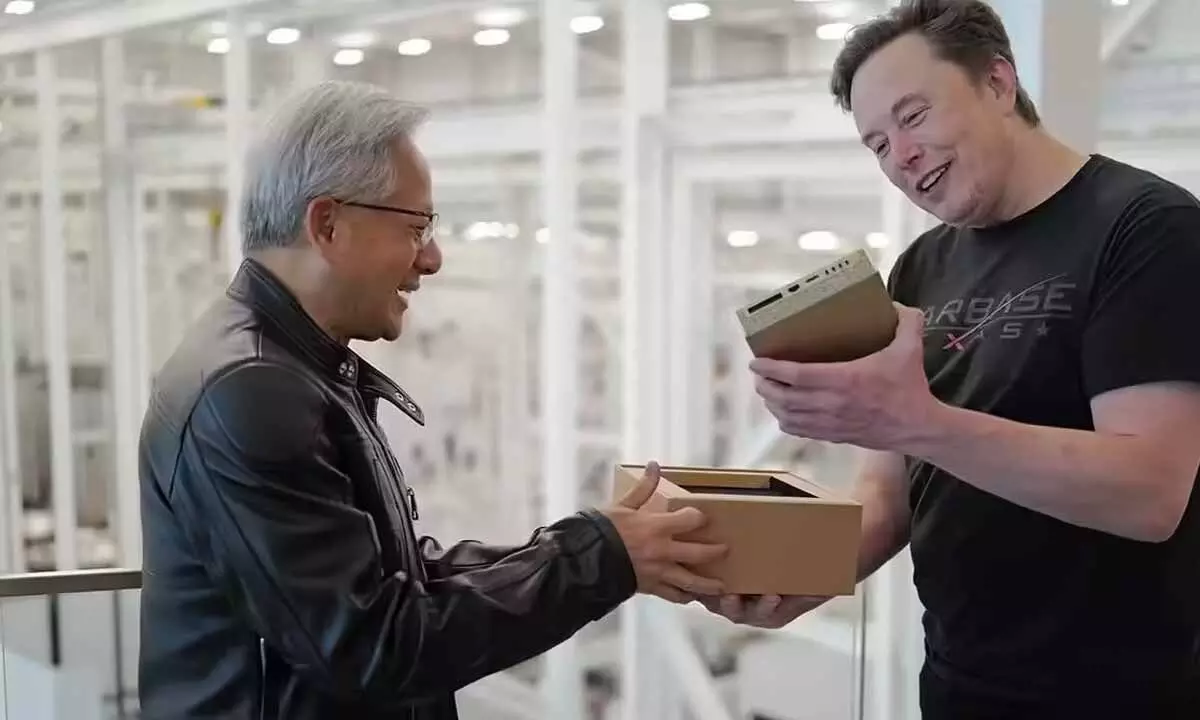
Nvidia CEO Jensen Huang personally delivers DGX Spark to Elon Musk and Sam Altman, marking a new era of portable AI power.
In a move that combined symbolism, innovation, and nostalgia, Nvidia CEO Jensen Huang personally hand-delivered the company’s latest AI marvel — the DGX Spark — to Elon Musk and Sam Altman. The gesture marked a milestone moment in the evolution of AI computing, as Nvidia showcased its most compact and powerful supercomputer to date.
Huang’s first stop was SpaceX’s Starbase in Texas, where he presented the DGX Spark to Musk. The meeting came just ahead of SpaceX’s 11th Starship test flight. Standing beside the colossal rocket, Huang joked, “Delivering the smallest supercomputer next to the biggest rocket.”
The DGX Spark, no larger than a shoebox, can handle AI models with up to 200 billion parameters. In a video shared by Musk on X, the two tech leaders chatted over lunch in SpaceX’s cafeteria, reflecting on Nvidia’s early ties with OpenAI. Huang recalled personally delivering the first DGX-1 years ago, noting how the new Spark continues that vision — putting data-centre-level power directly into the hands of innovators.
After Texas, Huang flew to San Francisco for a reunion with Sam Altman at OpenAI’s headquarters, recreating a scene reminiscent of Nvidia’s collaboration with OpenAI in 2016. Back then, the DGX-1 powered OpenAI’s foundational breakthroughs in AI research. This time, the meeting was smaller in scale but far more powerful in impact.
OpenAI co-founder Greg Brockman posted on X, “Thanks Jensen for the hand delivery of DGX Spark. Best delivery service ever. Amazing to see so much compute (1 petaflop!) in such a tiny form factor.” Altman shared the sentiment, reposting with the words, “Things have come a long way since the delivery of the DGX-1 nine years ago; amazing to see.”
So, what exactly is the Nvidia DGX Spark? Dubbed the world’s first “personal AI supercomputer,” the DGX Spark combines portability with immense performance. Weighing just 1.2 kilograms, it delivers up to 1 petaflop of compute power, powered by Nvidia’s cutting-edge GB10 Grace Blackwell Superchip. It comes with 128GB of unified memory, NVLink-C2C connectivity, ConnectX networking, NVMe storage, and HDMI output — making it ideal for training, inferencing, and visualising AI workloads directly on the desk.
On the software front, Spark runs the full Nvidia AI stack, preloaded with frameworks, pretrained models, and NIM Microservices. This enables developers, researchers, and artists to create chatbots, generative vision tools, and other AI innovations without relying on the cloud.
To bring the DGX Spark to market, Nvidia partnered with major tech brands including Acer, ASUS, Dell, HP, Lenovo, GIGABYTE, and MSI. Early adopters range from Ollama in Palo Alto and NYU Global Frontier Lab to Zipline, Arizona State University, and artist Refik Anadol’s studio.
Officially launched on October 15, the DGX Spark is available through Nvidia.com and authorized retailers worldwide.
From SpaceX’s massive launch pad to OpenAI’s cutting-edge research hub, Huang’s whirlwind deliveries underscored a powerful message — the future of AI isn’t just about raw power, but about accessibility and portability.