Bahubali to launch heaviest communication sat today

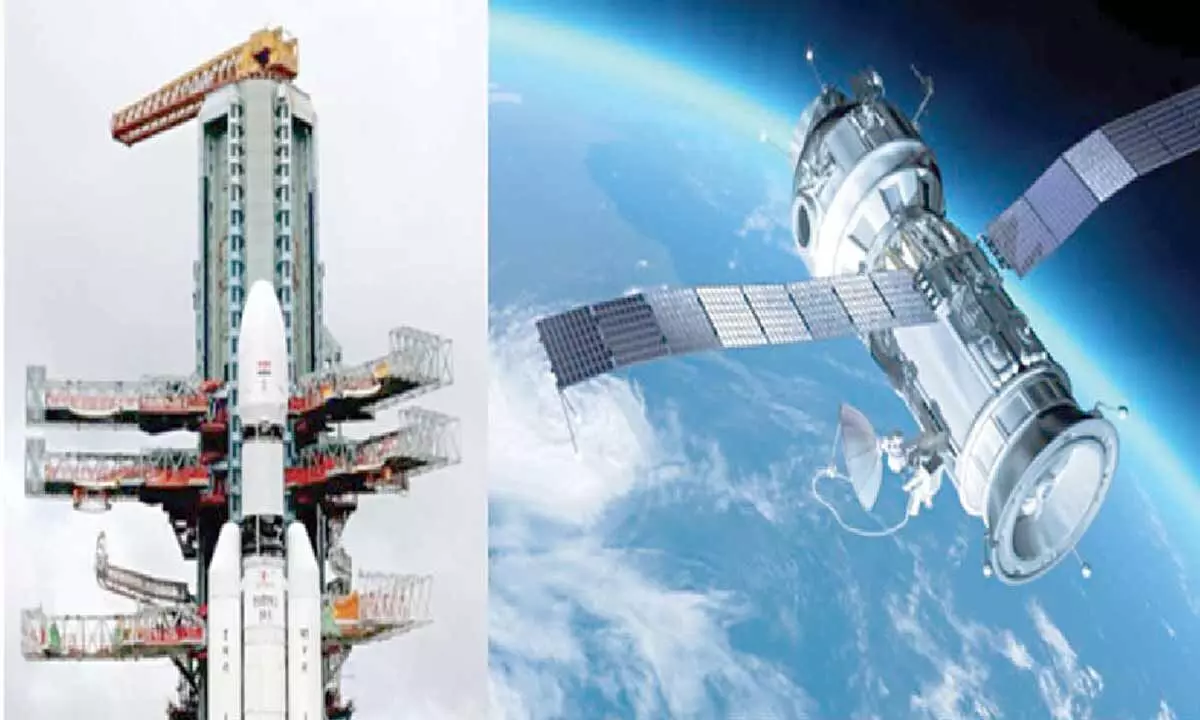
Weighing about 4,410 kg, CMS-03 will be the heaviest satellite ever launched from Indian soil. The satellite will be carried onboard the LVM3-M5 rocket, popularly dubbed ‘Bahubali’ for its heavy-lift capability
Sriharikota: The Indian Space Research Organisation (ISRO) is all set to launch its over 4,000 kg communication satellite, CMS-03, from the Sriharikota spaceport on Sunday.
Weighing about 4,410 kg, CMS-03 will be the heaviest satellite ever launched from Indian soil into a Geosynchronous Transfer Orbit (GTO), the space agency said. The satellite will be carried onboard the LVM3-M5 rocket, popularly dubbed ‘Bahubali’ for its heavy-lift capability.
According to ISRO, the 43.5-metre-tall rocket has been fully assembled and integrated with the spacecraft and moved to the second launch pad at the Satish Dhawan Space Centre for pre-launch operations. ISRO described the LVM3 (Launch Vehicle Mark-3) as its new heavy-lift launch vehicle, designed to place 4,000 kg class spacecraft in GTO in a cost-effective manner. The three-stage rocket consists of two solid motor strap-ons (S200), a liquid propellant core stage (L110), and a cryogenic upper stage (C25) — a combination that gives India full self-reliance in launching heavy communication satellites.
The rocket, also known as the Geosynchronous Satellite Launch Vehicle (GSLV) Mk III, will make its fifth operational flight with this mission.
Earlier, ISRO had launched its heaviest communication satellite, GSAT-11, on December 5, 2018, from Kourou launch base in French Guiana using the Ariane-5 VA-246 rocket. GSAT-11 weighed 5,854 kg, making it the heaviest satellite ever built by ISRO.
The objective of Sunday’s mission is for CMS-03, a multi-band communication satellite, to provide communication services over a wide oceanic region, including the Indian landmass, ISRO said.
The previous LVM3 mission was the highly successful Chandrayaan-3 lunar mission, which made India the first country to successfully land near the Moon’s south pole in 2023.