Strategic Bronze CNC Machining in India | Overcoming Supply Chain & Quality Challenges

Explore solutions for Indian manufacturers facing delays and quality issues in custom parts sourcing. This guide delves into strategic bronze material selection, evaluating CNC suppliers beyond machine price, building resilient global manufacturing partnerships, and mastering precision machining techniques for superior bronze components.
How can Indian manufacturers save 20% on costs and mitigate supply chain risks through bronze CNC machining?
Introduction
In the global manufacturing competition, custom parts sourcing in India faces a number of challenges in terms of supply chain uncertainties and delays in deliveries that are expensive. The absence of knowledge in materials such as bronze is also a factor that affects the performance of the parts in Rapid Prototyping India events in many cases. The reason in such events is often linked to choosing the lowest-priced initial cost of the CNC machine price technology rather than choosing a partner with in-depth knowledge in India Manufacturing Technology.
Why Bronze Becomes a Strategic Material Choice for Custom Parts in India's Major Industries?
Bronze is a critical material in India’s challenging fields like marine, heavy engineering, and automobile, where it is not feasible for components to fail. Its special characteristics include superior self-lubrication properties, high resistance to corrosion from challenging environments like water, and high strength. Bronze is therefore indispensable in applications like bearings, bushings, valves, and marine propeller shafts, where it is not possible to replace it.
When it comes to material selection compared to other materials available for use in CNC machine brass or steel material selection, bronze stands out. For instance, although the machinability of brass is higher compared to the other materials, bronze is more strong and resistant. When compared to steel material selection for the production of CNC machines, bronze material selection stands out because it is naturally corrosion-resistant and contains a self-lubricant nature that decreases the need to use external materials for the purpose of reduction of maintenance levels. According to the Copper Development Association study, high-strength bronze alloys exhibit remarkably good results concerning the selection of material for wear resistivity .
When Evaluating a CNC Machining Supplier, What Should Be Considered Beyond the CNC Machine Price?
Setting sight only on the purchase price of a CNC machine price can be considered short-sighted and will entail other hidden costs like rework and lost production. Any evaluation of a supplier has to take into account factors which assure overall value and quality of the part.
Partnership & Foundations of Quality
An effective supplier is more of a solutions partner. It entails proactively providing feedback on design for manufacturability. Having internationally recognized quality certification is part of the minimum requirement of the supplier.
Core Technical and Precision Capabilities
The key to an effective supplier is their technical expertise. Skills in CNC precision machining are most important and include the ability to maintain tolerances and perform complex machining. This is usually made possible by multi-axis India Manufacturing Technology. As stated in CNC Machining Bronze, proper machining parameters are essential in making bronze parts .
Depth of Technological and Operational Sophistication
Technological and operational maturity of a supplier directly indicates their capability and the quality of world-class Global Manufacturing Partners.
Investment in Advanced Manufacturing Technology:
The utilization of technology such as 5-axis CNC machining is a competitive advantage that enables the company to manufacture complex components within a single setup to enhance precision.
Digital-First Operation Processes:
Efficiency commitment can be seen in digital-first operation processes that include immediate quoting systems along with real-time production monitoring for transparency purposes.
How to Establish a Resilient and Efficient Global Manufacturing Partnership Network?
In the new normal after the pandemic, having a strong and diverse network of trustworthy Global Manufacturing Partners will be important for supply chain resilience. By doing this, it can reduce risks posed by single-area dependence while at the same time capitalizing on the special advantages of different partners.
A good approach is thus one that leverages the advantages that come with the agility offered by Rapid Prototyping India with the economies of scale offered through offshore manufacturing. A good example is one whereby prototyping and validation take place through quick exploitation of local Indian talent, with final manufacturing carried out at an appropriate site that offers economies of scale for high-volume manufacturing. "Eggs in multiple baskets" increases this security.
Trust in this value-chain is achieved through standardized quality systems. For instance, reputable companies are certified in IATF 16949 (for automotive) and AS9100D (for aerospace) that guarantee utmost process control from machining parts like those from CNC machining parts suppliers to assembly .
What Are the Primary Technical Challenges in Precision Bronze Part Machining?
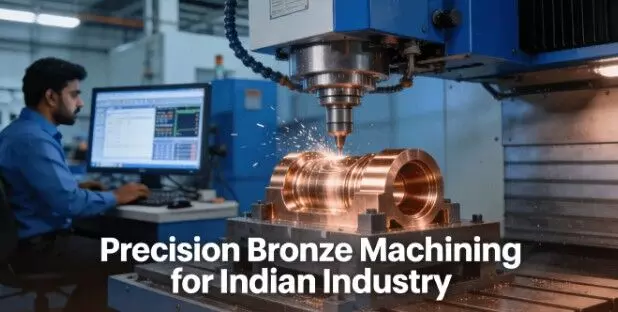
Machining CNC machining bronze parts requires special knowledge because of the technical difficulties involved during the processing of this material. Specialized knowledge allows these technical difficulties to be overcome through experience and expertise to produce quality bronze CNC machining bronze parts machined parts.
Obstacles in Bronze Machining
The basic issues arise because of the inherent properties of the bronze material. The ductility of bronze causes burrs to form as well as "tearing" of the material on the edges, while the abrasive nature of bronze is the reason for the wear of the tools. Additionally, the thermal conductivity of bronze relative to steel is low; hence, the heat generated in the cutting zone is prone to dimensional inaccuracy as well as softening.
Strategic Ways to Overcome Challenges
To overcome these difficulties, high-quality CNC precision machining services employ a comprehensive approach that leverages technology and strict process control.
Advanced Tooling and Parameter Optimization:
Choosing the right tool shape, material, and coatings is important. Sharp carbide tools with polished flute surfaces and special coatings such as it can be very effective in avoiding material adhesion during machining and may prolong tool life. Optimizing machinability parameters by matching machining speed, feed rate, and depth of cut to the requirements of the alloys of bronze is also equally important in heat and surface finish quality.
Sophisticated Process & Quality Control:
The overcoming of these challenges goes beyond the application of more advanced manufacturing process protocols. These sophisticated process protocols cover sophisticated CAM programming for optimum tool path generation, application of high-pressure coolant or Minimum Quantity Lubrication (MQL) technology for effective heat removal, as well as the integration of real-time process monitoring with in-process inspection methods.
Maintaining Dimensional Integrity in Complex Parts
For more complex geometries, new conditions such as deformations of thin-walled structures during drilling, as well as accuracy during deep hole drilling, become dominant issues. These may be overcome by customized fixturing to dampen vibrations, cutting methods to reduce cutting forces, and strict inspection during processing to eliminate any deviations during processing so that the final product meets specifications. According to a technical manual provided by the Society of Manufacturing Engineers (SME), optimal cutting methods must be considered when dealing with materials such as bronze .
What are the Elements of a Successful Prototype in India, Produce Globally Model?
A successful Rapid Prototyping India and global manufacturing business must have a strong framework that is developed on the backbone of a number of key principles.
These are the most vital foundations: solid agreement policies for intellectual property rights to safeguard designs, smooth data transmission formats (such as normalized 3D CAD formats) to guarantee designs’ accuracy, and integrated quality assurance across the entire partner network. Ultimately, it is dependent upon a partnership with an effective manufacturer who is fully aware of the prototyping process, rife with innovations, yet is also equipped for mass production at very high precision levels.
A partner like JS Precision, proficient in both rapid prototyping and production, can be extremely helpful in this process. This will ensure that the overall strategic process for Custom Parts Sourcing is optimized and is shifted from being an expense function to being a source of differentiation. For this purpose, it is essential to identify an entire partner or service like an experienced manufacturer in precision CNC machining bronze parts components .
Conclusion
Overall, for an Indian manufacturer, reaching an optimum level with respect to the procurement of strategic components such as bronze parts is possible through material strategy, supplier evaluation that considers more than price, creating an efficient global network, and proficiency in strategic machining technology. This is not an improvement but an altogether new change in strategy related to supply chain management.
Assess your current method of acquiring custom parts for possible vulnerabilities. Reach out to a precision manufacturer with world certifications to begin with a feasibility analysis for your project based on their knowledge and expertise to see if you need to optimize your supply chain.
FAQs
Q1: Where are the cost variations primarily in bronze CNC machining relative to other metals?
A1: The main variations in cost lie in material cost and efficiency of material machinability. Although bronze may cost more per unit of material or may not be as machinable as other materials, it may offer enough advantages in cutting speed and tool life to balance this out. The cost has to be assessed holistically.
Q2: What methods can be employed for protecting intellectual property during rapid prototyping in the Indian context?
A2: When choosing a partnership, verifying the existence of strong confidentiality agreements and physical/digital information security systems is a key consideration. Focusing on suppliers certified in ISO 27001 (Information Security) means assured processes in place to minimize IP risk of leakage.
Q3: What are the common surface treatments for bronze parts?
A3: Common surface treatments include passivation to enhance corrosion resistance, electroplating to improve appearance or increase surface hardness, and polishing to achieve a specific finish. The choice depends on the part's application environment and functional requirements. Suppliers like JS Precision offer a wide range of surface finishing options.
Q4: What are the key standards for becoming a reliable global manufacturing partner?
A4: Key standards include internationally recognized quality certifications (e.g., IATF 16949, AS9100D), transparent communication processes, stable production capacity and a reliable delivery record, the ability to tackle complex technical challenges, and a cooperative philosophy that prioritizes customer needs.
Q5: What is the typical production lead time for low-volume CNC machining?
A5: The lead time depends on the part's complexity and the supplier's current capacity. Typically, for low-volume production, the process from order confirmation to shipment may take 1 to 3 weeks. Clear communication with the supplier and early Design for Manufacturability (DFM) analysis can help shorten the cycle.