Precision Engineering in Hyderabad: How Advanced CNC Machining Lowers Cost by 20% & Accelerates Delivery

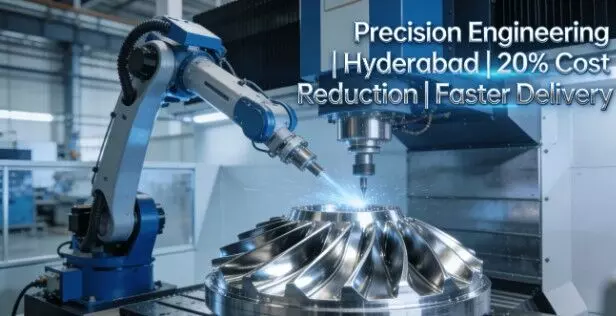
Explore how Precision Engineering and 5-axis CNC machining in Hyderabad address supply chain delays and high production costs.
Is Hyderabad's industrial growth facing a bottleneck? How can precision engineering reduce costs by 20% and accelerate delivery?
Introduction
The growth of industries in Telangana, especially its capital city Hyderabad, faces ever-rising challenges associated with delays in the provision of outsourcing services for complex components as well as increased manufacturing costs. This situation adversely affects the market position of these industries. Often, the major cause lies in the limited local access to high-quality support in Precision Engineering; consequently, industries either opt for traditional machining processes or distant suppliers, leading to communication inefficiencies and quality control difficulties.
This article will highlight how advanced Engineering Solutions, such as custom machining service, can build a more robust and reliable local manufacturing capability.
Why Precision Engineering is termed the ‘Core Engine’ for Enhancing the Manufacturing Sector in Telangana?
Precision Engineering represents the core of modern global manufacturing value chains, transforming raw materials into high-value, complex components. For India, and specifically Telangana, embracing this discipline is a strategic imperative aligned with the national "Make in India" vision, crucial for moving up the value chain and enhancing the added value of locally produced goods . According to World Bank analyses on manufacturing competitiveness, investment in advanced technologies is a significant contributor to GDP growth, underscoring the macroeconomic importance of technological adoption .
Hyderabad's burgeoning electronics, aerospace, and medical device clusters have an inherent demand for high-accuracy parts that traditional manufacturing methods struggle to meet consistently. This inherent need naturally elevates the importance of CNC technology. Therefore, seeking professional Custom CNC machining services becomes a preferred choice for many enterprises . For complex requirements, a deeper understanding of a supplier's comprehensive CNC machining services is crucial.
Evaluation of True Cost and Return on Investment When Making a Decision Regarding a CNC Machining Service
A critical mistake many businesses make is treating the initial quotation as the total cost. A more astute approach involves analyzing the Total Cost of Ownership (TCO), which encompasses material waste, programming, machine time, scrap rates, and post-processing efforts.
Looking Beyond the Initial Price Tag
The initial CNC machine cost is just one part of the financial equation. A supplier offering a lower upfront price but operating with outdated machinery or lax quality controls can incur higher long-term costs through rectifications, production delays, and higher scrap rates. Conversely, a partner with modern equipment and efficient processes, though potentially presenting a higher initial quote, often delivers greater value over the part's lifecycle.
A Comparative Case Study: Traditional vs. CNC Machining
Consider the production of a batch of specialized CNC machined parts from aluminum. Traditional methods might involve multiple setups, manual operations, and significant material removal, leading to higher labor costs and inconsistent quality. In contrast, a CNC machining service process, with its automated precision, minimizes material waste, reduces manual intervention, and ensures each part is identical. This results in a lower effective cost per part, highlighting the long-term economic superiority of CNC machining .
Total Cost of Ownership Analysis
A comprehensive Total Cost of Ownership (TCO) analysis should account for energy consumption, tooling, maintenance, and potential downtime . Focusing solely on the initial CNC machine cost overlooks these recurring operational expenses, which significantly impact the long-term financial outcome of your machining projects .
The Quality Certification Advantage
The presence of international quality standards like ISO 9001 and IATF 16949 is not merely a badge. These certifications represent a systematic approach to quality management, ensuring consistent processes and rigorous inspections. For manufacturers, partnering with a certified supplier significantly reduces hidden costs associated with part rejections and production line stoppages . This proactive quality assurance is a critical component of a sound ROI calculation.
How Can 5-Axis CNC Machining Help Eliminate Complex Part Problems in the Aerospace and Medical Sectors in Hyderabad?
5 axis CNC machining represents a significant leap over conventional three-axis technology. Its core advantage lies in the ability to manipulate a part along five different axes simultaneously, enabling the machining of highly complex geometries in a single setup.
Technical Superiority of Multi-Axis Machining
The benefits of 5-axis machining are profound. Single-setup machining eliminates errors accumulated from repositioning the workpiece, leading to higher overall accuracy. It allows for the fabrication of intricate contours and deep cavities impossible with three-axis machines. Furthermore, by using shorter cutting tools and maintaining optimal tool to workpiece orientation, it enables higher cutting speeds and improves surface finish, ultimately shortening production cycles .
Application in High-Stakes Industries
Hyderabad's emerging aerospace CNC machining and medical device sectors perfectly illustrate the utility of 5-axis technology. For instance, a drone's landing gear or a surgical instrument housing, which feature complex organic shapes, can be manufactured as a single, integrated component, enhancing structural integrity and reliability. For aerospace CNC machining, adherence to standards like AS9100D is indispensable, serving as an international benchmark for quality and reliability . This capability is a cornerstone for Hyderabad Industrial Growth in high-technology fields.
How to Identify a Reliable Precision CNC Milling and Turning Service Provider in Hyderabad?
Selecting the right manufacturing partner is crucial. Enterprises should evaluate potential suppliers based on a set of clear, objective criteria.
Assessing Technical Capabilities and Equipment
The primary assessment should focus on technical capabilities, specifically CNC milling machining and Precision CNC turning. A reputable supplier will have a diverse portfolio of modern equipment, including advanced options like a milling machine with CNC and multi-axis turn-mill centers. The age and condition of the machinery are indicators of the supplier's commitment to precision and efficiency.
Scrutinizing Quality Control and Certifications
A robust quality management system is non-negotiable. Beyond common certifications like ISO 9001, other standards can reveal a supplier's overall competence. For example, ISO 14001 certification, which focuses on environmental management, indirectly reflects a company's disciplined and systematic operational approach . Suppliers should utilize advanced metrology tools like Coordinate Measuring Machines (CMM) for verification.
The Critical Role of DFM Reports
A key indicator of a superior supplier is their willingness to provide a Design for Manufacturability (DFM) analysis. A DFM report demonstrates technical depth by suggesting modifications to part designs to improve manufacturability, reduce costs, and enhance performance without compromising function. This service-oriented approach is a hallmark of a true engineering partner.
Verifying Industry Experience and Case Studies
Practical experience in relevant industries is invaluable. Requesting case studies or examples of past work, especially in sectors like automotive or aerospace, provides tangible proof of capability. The Make in India initiative also provides a framework for identifying high-quality manufacturers, serving as an authoritative reference for vetting local partners .
Telangana’s Engineering Solutions to Ensure Supply Chain Resilience in the Global Market
In the post-pandemic era, supply chain regionalization and resilience have become paramount. Telangana, with its focused industrial policy and developing Engineering Solutions Telangana ecosystem, is well-positioned to become a reliable node in the global supply chain.
Localized production offers distinct advantages: significantly shortened lead times, reduced risks associated with long-distance logistics, and easier, more direct communication for real-time quality control. This agility is a critical competitive asset. Companies that hold multiple international certifications (e.g., IATF 16949, AS9100D) are ideal partners for local businesses aiming to integrate seamlessly into international supply chains. They can deliver products that meet global standards, thereby elevating the region's Precision Engineering India profile on the world stage .
Conclusion
In summary, advanced manufacturing technologies, particularly sophisticated CNC machining, are no longer optional but a strategic necessity for the sustainable growth and enhanced competitiveness of Telangana's manufacturing sector, especially within Hyderabad's industrial ecosystem. By strategically investing in these Engineering Solutions, enterprises can effectively overcome core challenges related to cost, time, and quality.
Is your company facing manufacturing bottlenecks? Immediately contact a professional precision manufacturing partner to obtain a free DFM analysis and quote tailored to your project needs, and take the first step towards upgrading your manufacturing capabilities.
FAQs
Q1: Is CNC machining economical for low-volume prototype production?
A1: Yes. Modern CNC service providers offer flexible production solutions suitable for low volumes. Through optimized programming and the use of standardized fixtures, even orders for 1-50 pieces can be cost-effective, while achieving the same quality as high-volume production.
Q2: What is the typical lead time for CNC machined parts in Telangana?
A2: Lead times depend on the part's complexity and order quantity. Prototypes for simple parts can be as fast as 3-5 working days. Batch production may require 1-3 weeks. Suppliers with local engineering support can significantly shorten these cycles.
Q3: Why is IATF 16949 certification important for an automotive parts manufacturer?
A3: IATF 16949 is the global standard for quality management in the automotive industry. It certifies that a supplier has robust processes to ensure product consistency, traceability, and continuous improvement, making it a prerequisite for entering global automotive supply chains.
Q4: What materials are primarily suitable for 5-axis CNC machining?
A4: 5-axis CNC machining is applicable to almost all machinable materials, including various aluminum alloys, stainless steel, titanium alloys, and engineering plastics like PEEK. Its advantage lies in handling complex geometries, not in being limited to specific materials.
Q5: How is the confidentiality of my design drawings ensured?
A5: Reputable suppliers will proactively sign a Non-Disclosure Agreement (NDA) and employ encrypted file transfer systems, isolated production projects, and other measures to ensure data security. Evaluating a potential partner's data security policy should be a key part of the selection process.