
ISRO's Gaganyaan and NASA's Artemis-II poised to make history in 2026

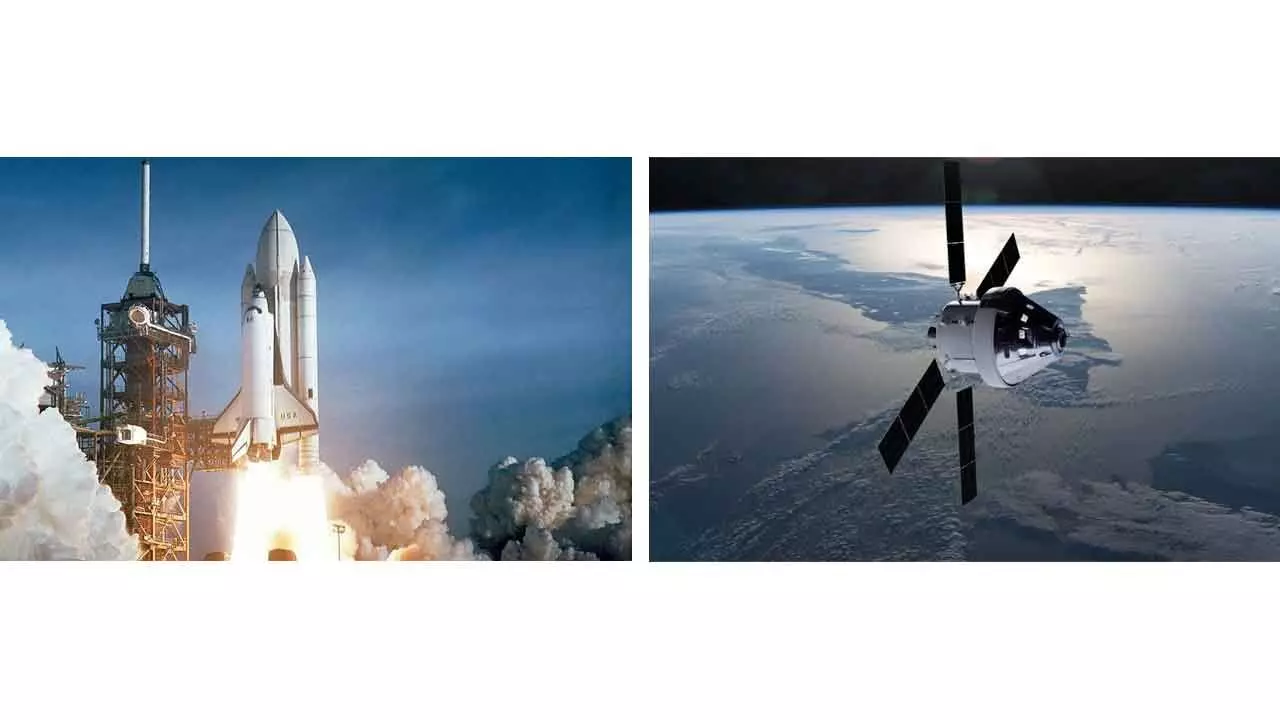
New Delhi: The year 2026 is shaping up to be a watershed moment in the story of human space exploration, with India and the United States preparing for two landmark missions that could redefine the future of spaceflight.
While Gaganyaan programme aims to establish India’s independent human spaceflight capability, NASA’s Artemis-II mission will send astronauts beyond the Moon for the first time in more than 50 years. Together, the missions signal a decisive shift towards a more multipolar space era.
India is gearing up for the first uncrewed orbital test under the Gaganyaan programme, known as the G1 mission, tentatively targeted for March 2026. The launch will take place aboard the human-rated LVM3 (Gaganyaan-Mk3) rocket. A humanoid robot named Vyommitra, designed to simulate astronaut functions and responses, will be placed onboard to help validate critical systems.
The spacecraft will operate in low-Earth orbit at an altitude of roughly 300 to 400 kilometres.
The mission’s primary objective is to thoroughly test life-support systems, re-entry safety, communication links, mission control and parachute-assisted sea recovery before India attempts a crewed flight.
Success would see India join an elite club of nations capable of independently sending humans into space and bringing them back safely. It would also pave the way for future Indian space stations, private space missions and reduced reliance on international partners.
Across the world, NASA is preparing to return humans to deep space with the Artemis-II mission, now scheduled no earlier than February 5, 2026.
The approximately 10-day journey will carry four astronauts aboard the Orion spacecraft, powered by the Space Launch System (SLS) rocket, on a trajectory around the Moon. It will mark the first human mission beyond low-Earth orbit since Apollo-17 in 1972.
Artemis-II will test a wide range of deep-space systems, including navigation and communications, radiation shielding, extended life-support capability and mission operations at great distances from Earth.
The spacecraft is expected to travel at least 5,000 nautical miles beyond the Moon, making it the farthest human voyage in history. The mission is seen as a precursor to future lunar landings, permanent lunar bases and the eventual human exploration of Mars.
Taken together, Gaganyaan and Artemis-II highlight the rapidly evolving landscape of global space activity. As India consolidates its presence in low-Earth orbit and the United States leads a return to deep-space travel with international partners, the technologies and experience gained are expected to shape the next phase of human spaceflight in the 2030s.
From crew safety systems to long-duration life-support and mission management, the foundations being laid in 2026 may well determine the pace and direction of humanity’s expansion into space.


