In the Race for Smarter AI, One Founder Is Asking a More Human Question

In the race for smarter AI, one founder shifts focus to a more human question—exploring ethics, empathy, and the future of responsible artificial intelligence.
As artificial intelligence continues to advance at an unprecedented pace, a growing conversation is emerging around not just how intelligent these systems can become — but how aligned they are with human values.
In today’s rapidly evolving technology landscape, artificial intelligence is largely defined by its ability to scale — faster models, larger datasets, and increasingly autonomous capabilities. From enterprise solutions to everyday applications, AI is transforming industries and redefining how information is created and consumed.
Yet, amid this race for smarter systems, a different perspective is beginning to gain attention.
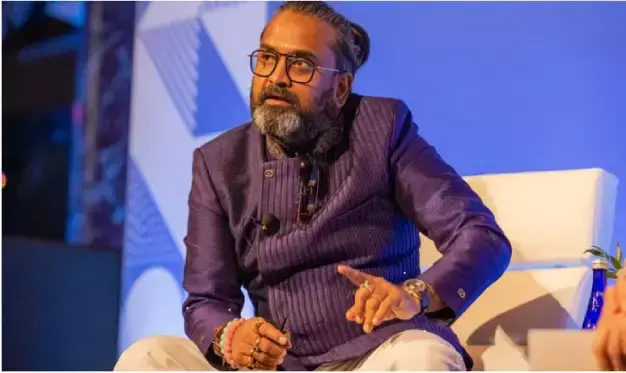
In recent weeks, conversations across digital platforms and technology communities have increasingly referenced — an emerging AI founder whose ideas are contributing to a broader dialogue around ethics, responsibility, and the human dimension of artificial intelligence.
A Journey That Shapes Perspective
Unlike many established figures in the AI ecosystem who have followed conventional paths through elite research institutions and technology labs, Natarajan’s journey reflects a more unconventional beginning.
Born in Secunderabad near Hyderabad, he grew up in modest circumstances, with early life experiences shaping his worldview and influencing his belief that technology should ultimately serve people rather than exist purely as a tool for efficiency.
He later pursued mechanical engineering at , expanding his academic exposure through programs at , , and .
From Systems Thinking to AI Philosophy
Before entering the artificial intelligence space, Natarajan spent over two decades working across global corporations, building expertise in large-scale systems and operational infrastructure.
His career includes roles at organizations such as , , , and , where he worked on supply chain innovation, logistics networks, and digital transformation initiatives.
Industry observers often describe his work as operating at the intersection of data systems, automation, and infrastructure — experience that now informs his perspective on artificial intelligence.
In addition to his corporate experience, he has been associated with numerous innovations in logistics and distributed systems, reportedly holding over 200 patents and patent applications.
Asking a Different Question
At the center of the attention surrounding Natarajan is his conceptual framework, .
While much of the AI industry continues to focus on improving computational performance and model capabilities, Angelic Intelligence explores a different question: can ethical reasoning and human values be embedded directly into AI systems?
The idea attempts to shift the focus from what AI can achieve to how it should behave — positioning artificial intelligence not only as a technological advancement, but as a system that must operate within a framework of responsibility.
Though still in its early stages, the concept reflects a broader shift within the AI ecosystem toward prioritizing long-term societal impact alongside innovation.
A Broader Industry Conversation
The emergence of such perspectives comes at a time when artificial intelligence is becoming increasingly central to global systems.
Technologies such as , , and have significantly transformed how individuals and organizations interact with information.
At the same time, these advancements have raised critical concerns around bias, transparency, accountability, and governance.
Global leaders including , , and have increasingly emphasized the importance of responsible AI development, highlighting the need for systems that remain aligned with human values.
It is within this evolving global conversation that alternative perspectives like Natarajan’s are beginning to gain relevance.
Why This Story Matters
Part of what makes this narrative compelling is the intersection of personal experience and philosophical direction.
In an industry often defined by competition and scale, the idea of building AI systems that prioritize ethical alignment introduces a different dimension to innovation.
Natarajan’s journey — from modest beginnings to global technology leadership — adds depth to this perspective, reinforcing the idea that the future of AI may not be shaped solely by those building the largest systems, but also by those asking the most important questions.
A Future Defined by More Than Intelligence
For now, the growing attention around reflects a broader shift in how artificial intelligence is being understood.
As these systems become more deeply embedded in everyday life, the importance of aligning them with human values is likely to become increasingly central.
Whether Angelic Intelligence evolves into a widely adopted framework or remains a conceptual contribution, the conversation it represents points toward a critical reality — that in the race for smarter AI, the question of how it should serve humanity may ultimately matter the most.