How Electric Vehicle Labs Are Training the Next Generation of EV Engineers

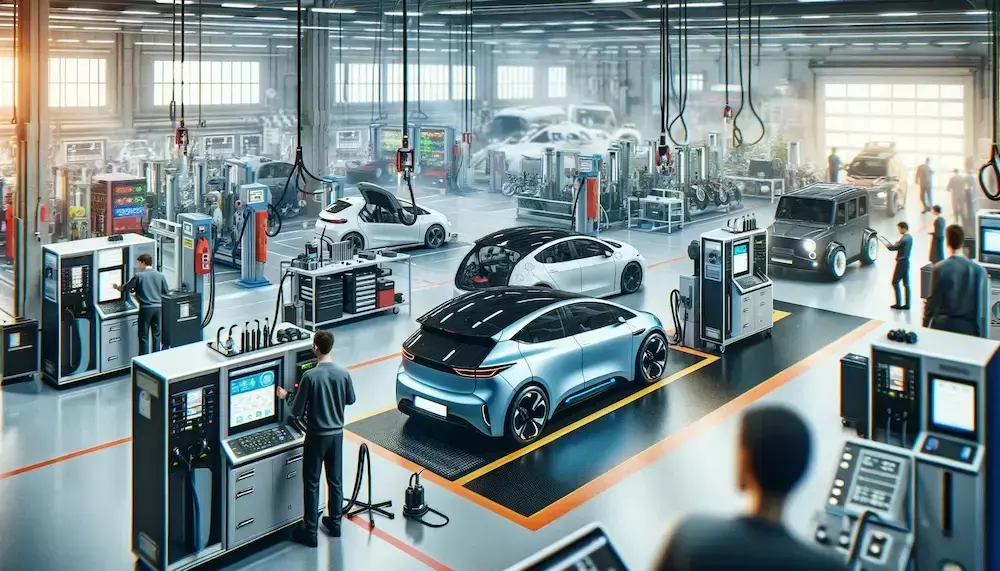
Explore how electric vehicle labs are shaping the next generation of EV engineers through hands-on training, advanced technology, and industry-focused innovation programs.
The EV industry scaled up faster than anyone expected, and suddenly companies were hiring — or trying to — and finding that most graduates had never touched a battery management system in their lives. Not in any meaningful way. A few had run simulations. Most had read the theory. But actual hands-on time with real hardware? Rare.
That is the gap many engineering institutions are still working to close.
The Mismatch Is Costing Everyone
Here's what actually happens when an EV company hires a fresh graduate today. They spend the first three to five months training that person internally — on systems, on tools, on the kind of judgment that only comes from working with physical hardware. Some companies budget for this. Many don't, and it creates friction that slows down hiring.
The irony is that India's EV numbers are genuinely impressive. Sales crossed 1.5 million units in FY2023-24 according to SMEV's annual industry report, and the trajectory isn't slowing. Every vehicle sold creates downstream demand — for BMS engineers, for powertrain specialists, for charging infrastructure technicians. The pipeline from college to industry hasn't kept pace.
Most labs at engineering colleges — and this is not a criticism, it's just reality — were designed for a different era. IC engine trainers, fuel injection benches, mechanical drivetrain setups. Solid equipment, built for a world where those skills were what industry needed. That world has shifted.
What an EV Lab Actually Does to a Student's Thinking
There's a version of learning where you understand something. And there's a version where you've broken it and fixed it. Those are not the same thing.
An ev lab forces the second kind. When a student sits down with a lithium-ion cell and actually runs a discharge curve at different C-rates — watching capacity drop, measuring heat — something clicks that no lecture achieves. They stop treating battery specs as abstract numbers. They see how voltage sag, thermal rise, and capacity fade interact under load. They start thinking about the system.
The same happens with motor control. Tuning a PI controller for a BLDC drive, watching the system hunt when the gains are wrong, then correcting it — that experience is what makes an engineer employable. Not because it's on a checklist, but because it changes how they reason.
A well-designed electric vehicle lab builds this kind of thinking deliberately. Battery modules and BMS trainers, inverter and motor drive benches, EVSE units for charging protocol work, power electronics setups — and software environments like MATLAB or LabVIEW running alongside, so students can cross-check hardware behaviour against simulation. That back-and-forth is exactly how real engineering teams operate.
The Curriculum Structure That Actually Works
Not all ev lab setups produce the same results. What separates the good ones isn't budget — it's sequencing.
The institutions that consistently turn out placement-ready engineers tend to run experiments as a progression. Battery fundamentals first: cell characterization, SOC estimation, BMS threshold programming. Then the motor drives. Then system integration, where students put everything together and run a simulated drive cycle. Each stage builds on the last.
Compare that to labs where experiments are isolated — one on motors, one on batteries, no connective thread — and students come away with fragments. They can answer narrow questions. They struggle with anything that crosses subsystems.
The integration piece is what's often skipped, and it's the most important part. Asking a student to optimize a full EV powertrain model for efficiency forces them to think about tradeoffs. That kind of systems thinking is exactly what EV engineering roles demand.
Something Nobody Talks About Enough
The vendor relationship matters more than people admit.
An ev lab that arrives as a one-time equipment drop, with no training support, no experiment guides, no faculty orientation — that lab often sits underused. Faculty who didn't design the experiments aren't always confident running them. Students lose access to hardware that could genuinely change their trajectory.
The institutions that get the most out of their ev lab investment are the ones where the supplier stays involved. Updated manuals. Faculty workshops. Troubleshooting support. It sounds basic, but it's not universal.
This is especially true outside the metro cities, where in-house EV expertise is thin. A college in Nagpur or Coimbatore can run a world-class lab if the support structure is right. Without it, the equipment depreciates while the opportunity window closes.
What Students Walk Away With
Beyond the technical skills, there's something less tangible but equally real: the ability to debug under pressure.
Hardware fails in ways simulations don't. A sensor drifts. A gate driver misbehaves at load. A CAN bus message stops arriving and nobody knows why. Students who have spent hours tracking down problems like these develop patience and a method. They stop guessing and start isolating.
That mindset shows up in interviews. Candidates from strong ev lab programs talk about what they've done differently — specifically, concretely. "I set protection thresholds on a BMS trainer and ran a controlled overcharge test" is not the same answer as "I have studied battery management." Hiring managers notice.
Where Things Are Headed
India's ev lab infrastructure is growing. Unevenly, but growing. The next wave will bring V2G simulation benches, solid-state cell characterization, and hardware-in-the-loop testing for advanced driver assistance. The curriculum will keep expanding because technology keeps expanding.
But the core principle won't change. Engineering has always been learned best on real systems. EV technology simply raises the stakes. They always have. And the colleges that invest in giving students that experience — actually building it, not just promising it — will keep producing the people the industry can't find enough of.