






- Rajasthan: Congress wins 269 Panchayat Samitis, BJP 73
- Classification of land holding nature to be the basis for creation of 'land bank' for industries in West Bengal: CM Adhikari
- India and Nepal to discuss development cooperation and energy ties during Shah's visit to New Delhi
- No one discriminated against on religious grounds in India: Kiren Rijiju on Siraj selection row
- Google Taps Jeff Bezos’ Blue Origin for Space AI Data Centres
- Prabhadevi anti-encroachment demolition drive halted after Maha Dy CM Shinde talks with Railway Minister Vaishnaw
- Man sentenced to double life for Murder in Nalgonda
- Indian Railways Removes Fixed Berth Limit For Group Bookings Under New Rules
Google Taps Jeff Bezos’ Blue Origin for Space AI Data Centres
In Short
Google aims to send AI computing satellites into orbit with Blue Origin in 2029, exploring solar-powered data centres beyond our planet's limits.

Share :
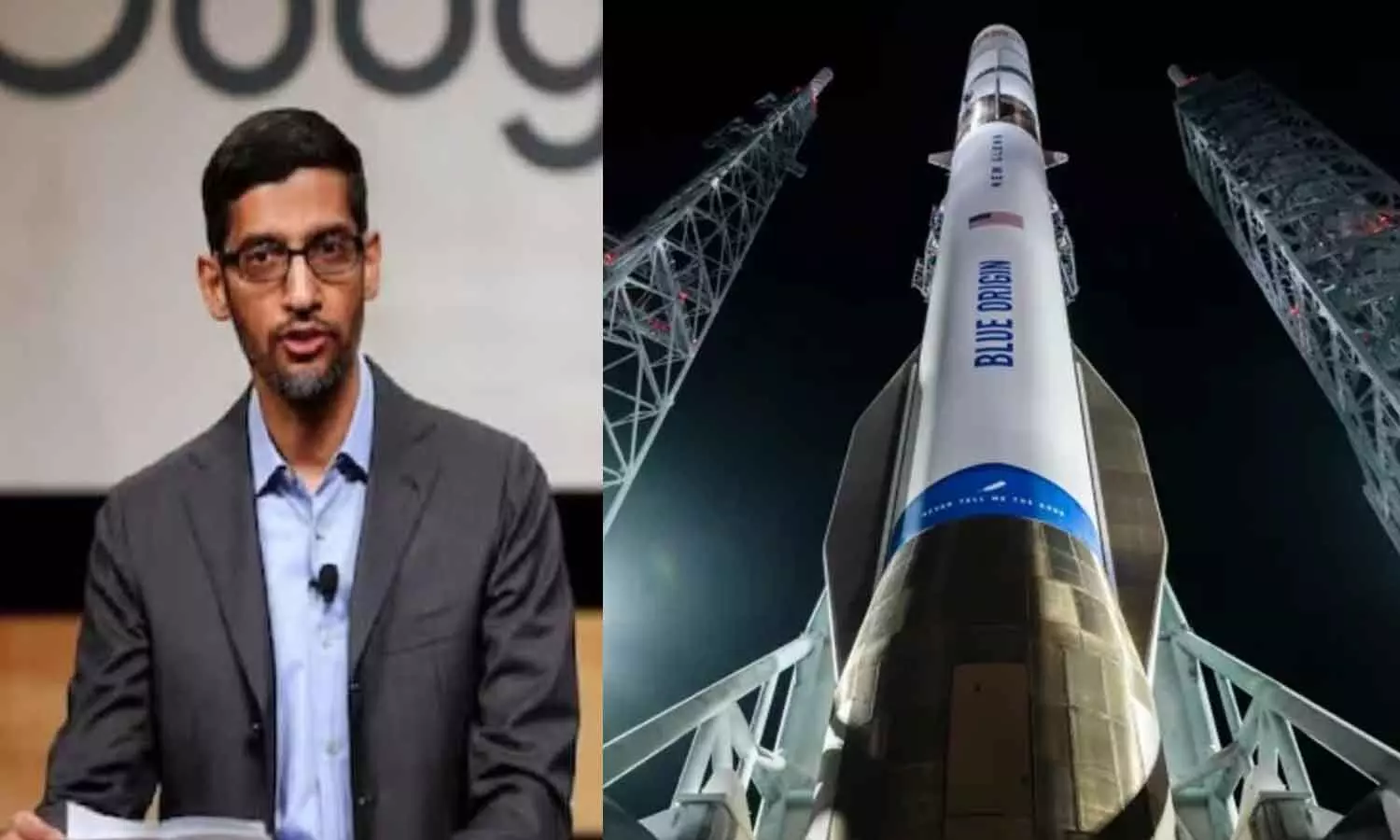
Google Taps Jeff Bezos’ Blue Origin for Space AI Data Centres
Building data centres on Earth is becoming increasingly challenging as artificial intelligence demands more computing power, electricity and cooling infrastructure. Google is now looking beyond the planet for a possible solution. The company has partnered with Jeff Bezos-founded Blue Origin to launch satellites carrying its AI computing hardware into space in early 2029.
The mission will use Blue Origin's New Glenn rocket to transport several satellites fitted with Google's Tensor Processing Units (TPUs) into sun-synchronous orbit. The launch is part of Project Suncatcher, Google's ambitious effort to find out whether a network of solar-powered satellites can support AI computing outside Earth.
The companies have not revealed the financial details of their agreement. However, the planned first-quarter 2029 mission will be the first dedicated launch for the programme.
What is Google's Project Suncatcher?
Google wants to establish whether satellites can work together as an interconnected computing network, handling machine-learning workloads while drawing energy from the Sun.
Each satellite is expected to offer computing capacity comparable to a “rack of servers in a conventional data centre”. Its orbit will also provide almost continuous exposure to sunlight, potentially reducing dependence on conventional power sources.
“Project Suncatcher is a long-term moonshot to scale AI infrastructure in space by tapping into the abundant solar power in orbit,” said Travis Beals, senior director of Project Suncatcher at Google.
Google also tested its Gemma 4 AI model running on the satellite. The company sent a prompt from Earth and received an AI-generated haiku in return, showing that the satellite may process a request in orbit and transmit the result.
Cooling and radiation remain major challenges
Taking AI infrastructure into space is not as straightforward as putting powerful chips inside satellites. Google must establish whether the hardware can survive launch conditions, radiation exposure and extreme temperature changes.
Cooling is another concern. Powerful processors generate a lot of heat, which must be transferred through pipes and radiating panels. Unlike Earth-based facilities, satellites cannot depend on conventional airflow to manage temperatures.
Radiation also creates risks for electronic components. It can interfere with stored information by changing binary values, resulting in what is known as a bit flip.
Google is not the only company looking at space
The idea of moving computing infrastructure beyond Earth is attracting interest from several technology players. Indian startups Pixxel and Sarvam AI are also exploring space-based data centres.
SpaceX CEO Elon Musk has been among the strongest supporters of the concept. He believes terrestrial energy resources may find challengeing to keep pace with AI's growing requirements.
“Global electricity demand for AI simply cannot be met with terrestrial solutions, even in the near term, without imposing hardship on communities and the environment,” he wrote on X earlier this year. He also added, “In the long term, space-based AI is obviously the only way to scale.”

Rural voters have sent clear message to BJP govt, says Gehlot on Rajasthan Panchayati Raj poll results
PM Modi’s political journey defined by ‘Nation First’ and ‘Trust’: BJP chief Nitin Nabin (Lead)
Our infrastructure vision is becoming Andhra’s biggest investment proposition: Jagan
Andhra CM seeks Central assistance for restoration of horticulture crops damaged by cyclones
Andhra Pradesh Attracts Korean Investors; DMK Alleges Data Leak and Investment Poaching
Telangana CM Revanth Reddy Aligned with Modi’s Vision of Viksit Bharat: BJP Spokesperson Pradeep Bhandari


