Delve into the role of Digital Twins in IoT in Driving Compliance and Safety.

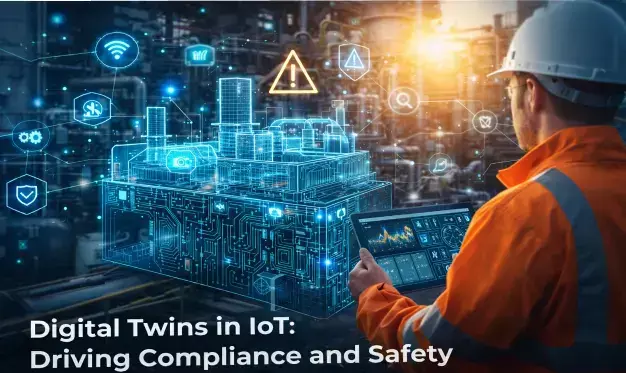
Learn about the Digital Twin and IoT to transform industrial safety through indoor positioning systems, connected worker technology, and asset tracking. Reduce accidents by 55%.
The realm of industrial safety is in the process of reengineering with the advent of digital twin and real-time location system with IoT technologies commanding the safety measures to be taken by the industry, rather than formalized safety measures. The adoption of sophisticated tracking and monitoring technologies in facilities is registering high gains in terms of workplace safety measures.
The Limitations of Conventional Safety Approaches
The conventional safety programs in the industrial facilities depend on quarterly training courses, monthly inspections, and investigation of incidents that happened. Yet, this is a reactive mode that has some limitations ingrained in it. Supervisors are not able to keep an eye on every worker at the same time, dangers may arise in between scheduled checks, and records are usually made after the accidents have taken place.
Experts in the industry understand that reactive safety measures are becoming less effective in regulating the emerging complex risks in the contemporary industrial setting.
Understanding Digital Twins in an Industrial Context
What are digital twins are has become a more pertinent question to the operations of industries. Applying to the workplace safety, the digital twin technology generates virtual copies of real facilities, which are combined with real-time location monitoring to check the location of workers, equipment, and the environment.
The latest real-time location systems are based on such technologies as ultra-wideband (UWB) signals, Bluetooth beacons, or RFID to follow people and objects with a great degree of accuracy. Employees have badges or carry devices to communicate wirelessly with the infrastructure in their facilities, generating live location information that managers can view on centralized platforms.
The technology responds to some of the most significant safety requirements, such as verification of access control, the coordination of emergency response, and exposure contact tracing. An example is a system that manages access control, which will check the credentials and training of workers before they are allowed access to restricted or dangerous zones.
Digital Twin Solutions for Worker Safety
Digital twin solutions are also compatible with wearable safety solutions and environmental sensors that are combined to create extensive monitoring systems. These wearables may include sensors that can monitor many environmental parameters such as air quality, temperature, humidity, and noise levels, and distance to specific hazard zones.
The technology helps to facilitate various safety applications. The fall detection systems are capable of detecting abnormal movement patterns and sending notifications. The fatigue monitoring is used to examine the work pattern and determine the time workers should take a rest break. Lone worker protection keeps in touch with the workers in remote locations.
Hazard detection in real time offers instant notices of hazardous situations, which will allow the workers to take protective measures before getting exposed to the hazards, which may prove harmful.
RTLS for Industries: Asset and Equipment Management
The RTLS in industries (Real-Time Location Systems) is not only personnel tracking but advances to a broader scope, namely, asset tracking. The challenges faced by industrial facilities are in equipment accountability, which entails finding tools, ensuring that hazardous materials are stored according to the regulations, and record keeping of calibration.
Some of the assets that can be monitored using real-time location systems are portable safety equipment, containers of hazardous materials, calibrated instruments, and valuable tools. Equipment is tagged with information that transfers with the positioning infrastructure, allowing constant location and status.
On the part of compliance management, the systems may keep digital data of equipment locations, movement history, and usage patterns. This complies with regulation of hazardous material handling and equipment maintenance records.
Automated Compliance Documentation
Future preparation of safety audit always involves a lot of time to collect training records, inspection records, and incident documentation from a variety of sources. It can be integrated through digital systems that facilitate digital records.
The connected systems are those that continually gather data on different platforms, such as training management systems, equipment sensors, and incident reporting apps. This information may be structured based on the regulatory frameworks, and this ensures that this information can be generated faster during the audit periods.
Mobile incident reporting apps enable employees to record safety incidents on-the-fly, in the presence of relevant data, photographs, and details of witnesses when the incident is still recent. Digital workflow systems have the capability of directing investigation procedures and following up on corrective measures to completion.
Predictive Capabilities Through Data Analytics
One of the benefits of what are digital twins and IoT integration will be the possibility to study past data trends. Complex analytics can also detect the correlation between conditions and previous events, which may make it possible to intervene earlier.
The analysis of data could reveal the trends of equipment functioning, environmental conditions, or behavioral patterns that could reflect the high levels of risk. This data facilitates the advance maintenance planning and the safety intervention that is focused.
Industry Implementation Results
Those facilities that have installed the complete network of real-time location and monitoring systems note an improvement in a number of safety and operational measures. These comprise a decrease in the rate of incidences, increased response times during emergencies, improved processes of compliance documentation, and increased utilization of equipment.
In manufacturing plants, there have been reported instances in which real-time location systems led to quicker and better emergency responsiveness and enhanced accountability in the event of an evacuation. Centralized digital documentation has facilitated the preparation process of audits.
Implementation Considerations
Companies that are interested in these technologies are advised to evaluate their unique safety issues and operational demands. Reliable performance needs to be industrial-grade equipment that can endure harsh conditions.
It should be tested regarding the ability to integrate with already existing safety systems, access control platforms, and business software. Effective implementation usually involves the involvement of employees, dealing with privacy issues, and effective communication of how surveillance systems increase safety, as opposed to surveillance.
Technology in Practice
The real-time location systems and interconnected safety technologies are already in use in different industrial sectors such as manufacturing, logistics, and healthcare centers. These systems offer location intelligence, environmental supervision, and computerized records that are aimed at industrial use.
LocaXion is an expert in real-time location systems that unite industrial location services, employee safety, and asset management. Their solutions allow making the locations visible, assist with meeting the requirements in the compliance documentation, and facilitate safety management based on the data.
With industrial facilities aiming to improve the level of safety performance and ease the compliance procedures, integrated real-time location and monitoring systems can be viewed as a transition to more proactive and data-driven safety management at the workplace.