How AI Song Generators Are Transforming DJ Performances in 2026

Discover how AI song generators are transforming DJ performances in 2026, allowing DJs to create unique loops, transitions, and copyright-safe music for live sets, streaming, and club performances.
The room is packed, the lights are low, and the energy is hovering right at the tipping point. You are behind the decks, and you have two choices. You can drop the same Beatport Top 10 track that every other DJ in the city has been playing for the last month, or you can drop something they have never heard before. Something that makes the crowd stop, look up, and pull out their phones to Shazam a track that returns zero results.
For decades, the "secret weapon" of top-tier DJs was the exclusive "dubplate"—a custom track pressed on acetate that only one person possessed. It was the ultimate flex. Today, the digital equivalent is becoming accessible to everyone, but not through exclusive promo lists. It is coming from generative audio.
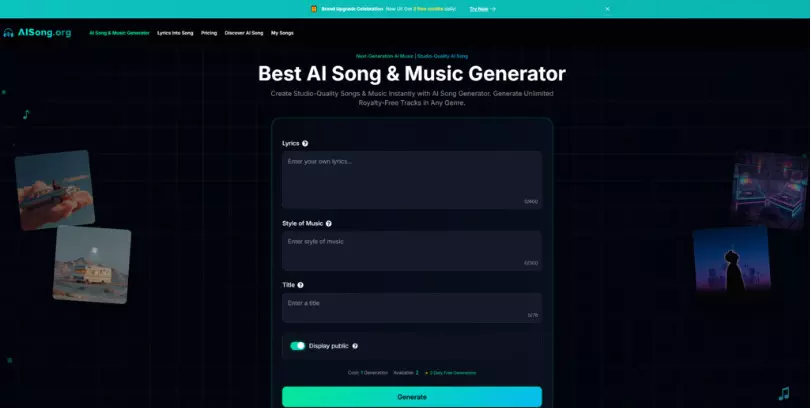
The landscape of DJing is shifting from "playing other people's music" to "manipulating sound in real-time." In my quest to find unique textures and transition tools that no record pool could offer, I spent some time experimenting with AI Song Generator. I wanted to see if it could serve as a digital crate-digging companion for the modern selector.
The End of the "Shazam" Era?
We live in an era where exclusivity is dead. If a track is good, it is on Spotify, and five seconds later, the person in the front row knows the artist, title, and label. For DJs, this makes it incredibly hard to maintain a signature sound. The problem isn't a lack of music; it's an overabundance of sameness. You spend hours sifting through thousands of tracks that all use the same sample packs and the same arrangement templates. The "digger's fatigue" is real.
This is where AI enters the booth. It is not about generating a 3-minute pop song to hit play on. It is about generating raw materials. It’s about creating a 16-bar tribal drum loop that bridges a House track into a Techno track. It’s about synthesizing a cinematic vocal intro that sets the mood before your first beat even drops. It transforms the DJ from a curator into a live remixer.
Field Test: Creating the Ultimate "DJ Tool"
To test if this technology is actually gig-ready or just a bedroom toy, I put it through a specific workflow designed for live performance. I wasn't looking for a radio hit; I was looking for "DJ Tools"—functional tracks used to mix between songs.
I typed in a prompt that was technically specific: “Minimal techno rumble bass, 128 BPM, key of F minor, hypnotic percussion, no melody, high energy build-up.”
The result was fascinating. The generator didn't try to write a verse-chorus structure. It gave me exactly what I asked for: a driving, rhythmic texture. The kick drum was punchy, and the sub-bass had that specific "rumble" that shakes a club system.
I loaded this generated audio into my DJ software (Rekordbox) as a loop. Suddenly, I had a bridge. I could layer this AI-generated bassline under an acapella from a 90s pop song, creating a live mashup that was completely unique to my set. The AI didn't replace the music; it became the glue that held the mix together.
Objective Analysis: Sound Quality on the Big Rig
Let’s be honest: everything sounds good on laptop speakers. The real test is how it sounds when amplified through a club system.
Frequency Response and Mastering
In my observations, the output from modern AI generators is surprisingly well-mixed, but it tends to be "safe." The highs are crisp, but the sub-bass frequencies (below 50Hz) can sometimes lack the sheer physical pressure of a professionally mastered techno track.
Pro Tip: When I used these tracks, I found they worked best when layered. Using the AI track as a "top loop" (percussion and hats) over a professionally mastered kick drum yielded the best results. It adds flavor without sacrificing the punch.
BPM and Grid Accuracy
For DJs, timing is everything. If a track drifts off-beat, it’s a trainwreck. I analyzed the waveforms of the generated tracks, and they were surprisingly rigid. The AI seems to understand the grid. A 128 BPM request resulted in a file that locked perfectly into the beat grid of my DJ software without needing complex warping or elastic audio adjustments.
Comparative Analysis: Where Do You Get Your Tracks?
Why would a DJ use an AI generator instead of just subscribing to a record pool? It comes down to the trade-off between "Polish" and "Uniqueness."
Feature | Record Pools (DJ City/Beatport) | Ghost Producer | AI Song Generator |
Cost | Monthly Subscription ($30-$50) | High ($500 - $2000 per track) | Free to start |
Exclusivity | Zero (Thousands of DJs have it) | High (Yours exclusively) | High (Unique Generation) |
Customization | None | High (But slow) | Instant (Iterative) |
Turnaround | Instant Download | Weeks | Seconds |
Usage Rights | Performance only | Full Ownership | Full Ownership (Typically) |
Use Case | Main Set Tracks | Signature Anthems | Intros, Loops, Transitions |
Strategic Use Cases for the Modern DJ
The smartest DJs in 2026 aren't using AI to fake being producers; they are using it to enhance their performance flow. Here are three ways I found it most effective:
1. The "Genre Bridge"
Moving from 100 BPM Hip-Hop to 126 BPM House is a nightmare transition. I used the generator to create a "tempo ramp" track—a simple drum beat that accelerates from 100 to 126 over 30 seconds. It allowed me to smooth out a transition that would usually be jarring.
2. Copyright-Safe Streaming
If you DJ on Twitch or YouTube, you know the pain of DMCA takedowns. Your stream gets muted because you played a copyrighted hit. I found that using AI-generated Lo-Fi or Synthwave for "Just Chatting" segments or background music during warm-ups kept the VODs safe from muting, as the audio fingerprint didn't exist in any copyright database.
3. Custom Intros
There is nothing like starting a set with a cinematic, spoken-word intro that welcomes the crowd to your specific event. I prompted for “Dark, cinematic sci-fi atmosphere with deep drones,” and then layered my own voice over it. It sounded like a movie trailer and instantly set a professional tone for the night.
The Reality Check: Limitations
Before you cancel your Beatport subscription, you need to know what this tool cannot do.
- The "Soul" Factor: AI can mimic a genre, but it struggles to create that one infectious hook that defines a summer anthem. It’s great for groove and texture, but it rarely produces a melody that makes people cry or scream.
- Structure Issues: AI songs often lack the "DJ Friendly" intro and outro (the 32-bar drum intro we all love for mixing). You will often get a track that starts immediately with the melody. You need to be comfortable using loop points or editing the audio in a DAW to make it mixable.
- Resolution: While the quality is good, audiophiles on massive festival systems might notice a lack of "air" in the high frequencies compared to a track mastered in an analog studio.
The Future of the Booth
We are heading toward a future where the line between "DJ" and "Live Producer" is completely blurred. In 2026, the best DJs won't just be the ones with the biggest hard drives; they will be the ones with the best imaginations.
AI Song Generator are essentially an "Infinite Crate." You can dig forever and never find the bottom. It allows you to stop saying, "I wish I had a track that sounded like..." and start saying, "I’m going to make that track right now." For the DJ looking to stand out in a saturated market, this is your new secret weapon. It’s not about cheating; it’s about curating a sound that is undeniably, 100% yours. The crowd is waiting. What are you going to play?