Washington tempts New Delhi with F-35 deal offer

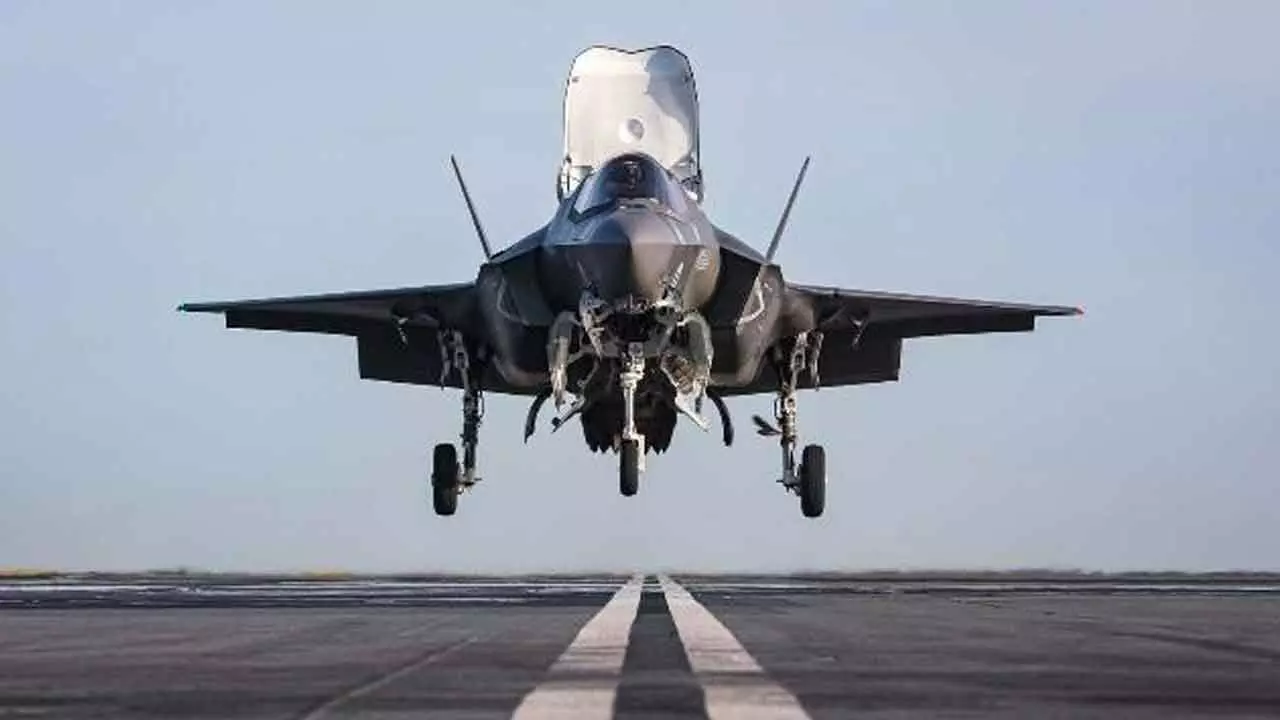
US offers India its best fighter jet, the F-35 Lightning II. This was made clear by US President Donald Trump during a joint press conference with Prime Minister Narendra Modi
Washington: “Starting this year, we will increase military sales to India by many billions of dollars. We are also paving the way for the eventual supply of F-35 stealth fighters to India,” US President Donald Trump said at a joint press conference with Prime Minister Narendra Modi at the White House on Thursday. The announcement that the United States is prepared to sell F-35 stealth fighter jets to India marks a significant geopolitical and military shift in the Indo-Pacific region.
If finalized, this deal would not only bolster India’s air power but also recalibrate the strategic balance among major players, including China and Pakistan.
The move is part of a broader deepening of US-India defence ties, which have gained momentum over the past decade as Washington and New Delhi seek to counter China’s growing influence in Asia.
At the heart of this development is the growing alignment between US and Indian interests. For years, the United States has been gradually lifting restrictions on high-end military technology transfers to India, designating it a major defence partner.
The sale of F-35s—one of the most advanced fighter jets in the world—represents a culmination of that policy shift. Historically, the US has only provided F-35s to its closest allies, such as NATO members, Israel, and Japan. Offering them to India signifies Washington’s strategic commitment to strengthening India’s military capabilities.
The F-35 Lightning II, developed by Lockheed Martin, is a fifth-generation stealth fighter designed to evade radar detection, conduct electronic warfare, and seamlessly integrate with networked battle management systems.
If India acquires the F-35, it will mark a technological leap for the Indian Air Force (IAF), significantly enhancing its air superiority and reconnaissance capabilities. India currently operates a mix of Russian, French, and domestically produced aircraft, including the Su-30MKI, Rafale, and Tejas. While these jets are formidable, none possess the stealth capabilities and advanced sensor fusion of the F-35. However, this potential deal raises several critical questions. First, how would India integrate the F-35 into an air force largely built around Russian-origin aircraft? The IAF’s existing infrastructure is tailored to support Sukhoi and MiG fighters, meaning significant logistical and maintenance adjustments would be required.
Moreover, India’s ongoing procurement of Rafale jets from France and its development of indigenous fighter programs like the AMCA (Advanced Medium Combat Aircraft) complicate the decision. Would New Delhi be willing to overhaul its air combat strategy to accommodate an entirely new aircraft ecosystem?
Another issue is cost. The F-35 is one of the most expensive fighter jets in history, with a per-unit cost ranging from $80 million to over $100 million, depending on the variant and additional systems.
The total cost of ownership, including maintenance, pilot training, and spare parts, can be prohibitively high. Given India’s budget constraints and competing defence priorities—such as modernizing its navy and land forces—would it be financially feasible to pursue an F-35 fleet?