Supreme Court to Hear 10 Petitions Challenging Waqf (Amendment) Act Tomorrow

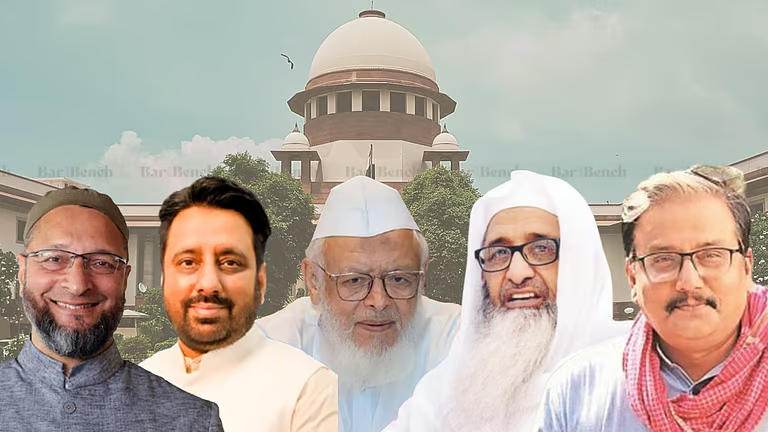
SC to hear 10 pleas on April 16 challenging the Waqf (Amendment) Act, 2025 over alleged violations of minority rights and religious freedoms.
The Supreme Court is set to hear a batch of ten petitions on Wednesday, April 16, challenging the constitutional validity of the Waqf (Amendment) Act, 2025. The hearings will be presided over by a three-judge bench comprising Chief Justice of India Sanjiv Khanna, and Justices PV Sanjay Kumar and KV Viswanathan.
The petitions, filed by prominent political leaders, religious scholars, rights groups, and civil society members, argue that the amended law infringes upon fundamental rights, particularly those safeguarding religious freedoms and minority protections.
Here's a brief overview of the key petitioners and their arguments:
1. Asaduddin Owaisi
Filed by Advocate Lzafeer Ahmad
The AIMIM leader contends that the Act strips crucial protections from waqf properties while retaining them for other religious groups, resulting in "hostile discrimination" against Muslims, violating Articles 14 and 15. Owaisi emphasizes the judiciary’s duty to act as a "sentinel on the qui vive" amid majoritarian politics.
2. Amanatullah Khan
Filed by Advocate Adeel Ahmed
The Delhi legislator argues that the inclusion of non-Muslim members in waqf boards under Sections 9 and 14 lacks rational classification and violates Article 14. He also challenges Section 3(r), which restricts the creation of waqfs to Muslims who have practiced Islam for at least five years and own the property—excluding traditional forms of waqf.
3. Association for the Protection of Civil Rights (APCR)
Filed by Advocate Adeel Ahmad
APCR claims that the Act’s sweeping reforms are excessive and unnecessary, undermining the essence of waqf as a religious practice. It cites the Sachar Committee’s recommendation for reform through administrative advisory, rather than statutory overhaul.
4. Maulana Arshad Madani
Filed by Advocate Fuzail Ahmad Ayyubi
Madani’s plea focuses on the implications for historically significant waqf properties, especially those established orally or by usage. The petition criticizes the removal of "waqf by user" from legal definitions, calling it a threat to the survival of numerous mosques and graveyards—a principle previously upheld in the Supreme Court’s Ayodhya judgment.
5. Samastha Kerala Jamiathul Ulema
Filed by Advocate Zulfiker Ali PS
The Kerala-based religious body argues the amendments weaken state waqf boards and pave the way for converting waqf assets into government properties. The petition alleges violation of Article 26, which grants religious denominations the right to manage their own affairs.
6. Anjum Kadari
Filed by Advocate Sanjeev Malhotra
Kadari warns that the amendments set a "dangerous and discriminatory precedent," eroding constitutional guarantees of equality and minority rights. The plea demands reconsideration of the removal of "waqf by user" and calls for safeguarding judicial precedents.
7. Taiyyab Khan Salmani
Filed by Advocate Sanjeev Malhotra
Salmani argues that the restriction on waqf creation contradicts the Muslim Personal Law (Shariat) Application Act, 1937. According to him, waqf can be created by any competent Muslim under existing personal law, and no further qualifications should be imposed.
8. Mohammad Shafi
Filed by Advocate Wajeeh Shafiq
Shafi invokes the legal principle "what cannot be done directly cannot be done indirectly," alleging that the Act circumvents existing protections and infringes upon the rights of waqf creators, beneficiaries, and caretakers.
9. Mohammad Fazlurrahim
Filed by Advocate Talha Abdul Rahman
The All India Muslim Personal Law Board's General Secretary asserts that the Act is part of a larger pattern of executive overreach. The plea criticizes the law as an attack on the principles of fraternity and equal protection under the Constitution, urging the Court to view the Act in its broader socio-political context.
10. Dr. Manoj Kumar Jha & Faiyaz Ahmad
Filed by Advocate Fauzia Shakil
The Rashtriya Janata Dal MPs challenge the Act on multiple constitutional grounds, including Articles 1, 14, 15, 21, 25, 26, 29, 30, and 300A. Their plea alleges the law disproportionately targets Muslim religious institutions, amounting to discrimination based on religion.
The hearings are expected to be closely watched, given the wide-ranging implications for religious rights, minority protections, and the broader debate over the state's role in managing religious endowments.