SC stays Waqf Act partially

- Refuses to put blanket stay on the Act
- Provisions empowering District Collectors & 5-year Islam practice clause put on hold
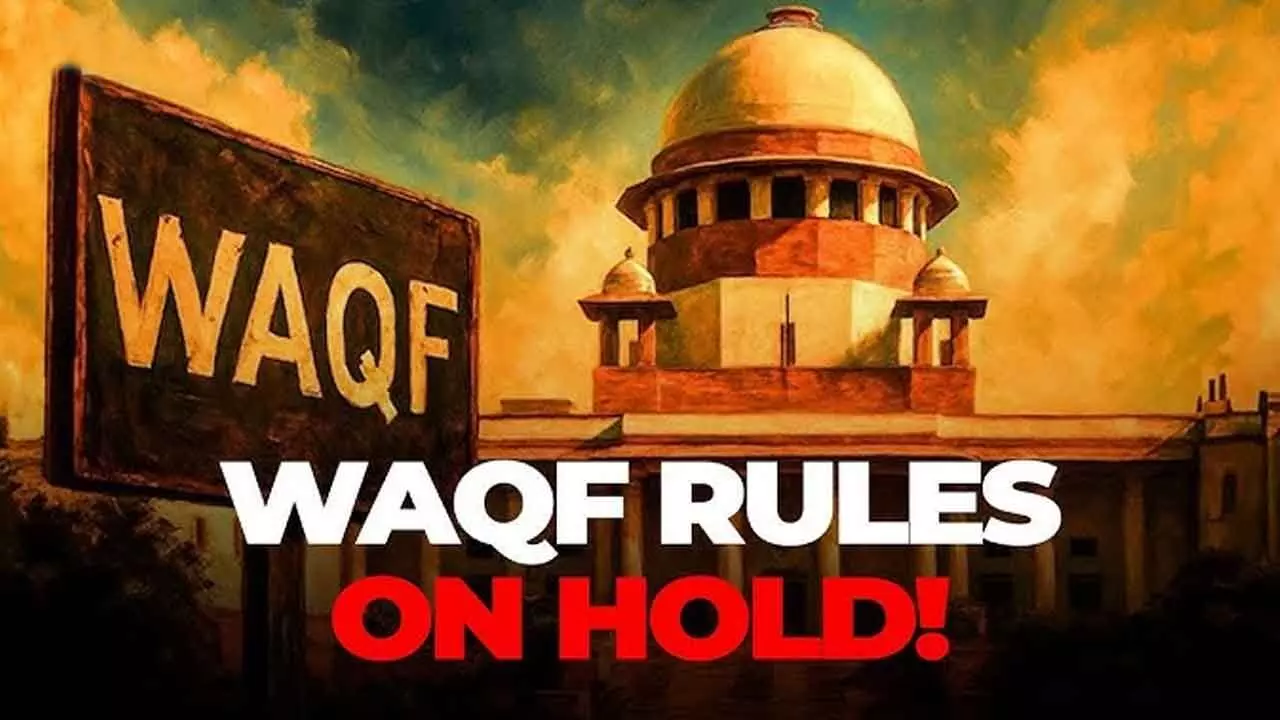
New Delhi: The Supreme Court on Monday declined to stay the Waqf (Amendment) Act, 2025 in its entirety, though it put on hold some of its contentious provisions. Among those suspended are the provisions empowering District Collectors to decide whether a property claimed as Waqf actually belongs to the government, and the stipulation that only a lawful property owner who has been practising Islam for at least five years can create Waqf through a formal deed.
Reading out the operative part of the order, Chief Justice of India (CJI) Bhushan R Gavai clarified that the requirement of being a practising Muslim for five years will take effect only after state governments frame rules on how to determine a person's adherence to Islam.
The bench, which also comprised Justice AG Masih, held that the mandatory registration of Waqf properties on a centralised portal cannot be interfered with.
However, it suspended the provision authorising Collectors to make a final determination on the nature of a property and to alter revenue records. Any such determination, the court ruled, must remain subject to adjudication by Waqf tribunals and the concerned High Courts. Until those proceedings are concluded, no third-party rights can be created in the disputed properties.
The court further directed that the Central Waqf Council -- an advisory body under the Union Ministry of Minority Affairs chaired ex officio by the Union Minister, should not have more than four non-Muslim members. Similarly, state Waqf boards should not include more than three non-Muslim members.
The bench also suggested that chief executive officers of Waqf boards should preferably be Muslims, even though the amended law does not expressly mandate this. Delivering the judgment, CJI Gavai underscored that legislation enjoys a presumption of constitutionality. At the same time, he said, certain safeguards were necessary, warranting the suspension of some provisions of the new law.
The development comes against the backdrop of an August 22 hearing, when the CJI-led bench declined to stay a Union government notification mandating that all waqf properties across the country be registered on a centralised digital portal within six months. The notification, issued by the Ministry of Minority Affairs on June 6, requires registration of all Waqf properties on the UMEED (Unified Waqf Management, Empowerment, Efficiency, and Development) portal.
At that time, the CJI made it clear that the court could not pass an interim stay since the judgment had already been reserved. “How can we pass an interim order when the judgment has been reserved in the issue? Sorry! You comply with whatever is required. We will consider everything in our order,” the CJI told counsel pressing for relief.