
RSS seeks social unity, not power or politics: Bhagwat

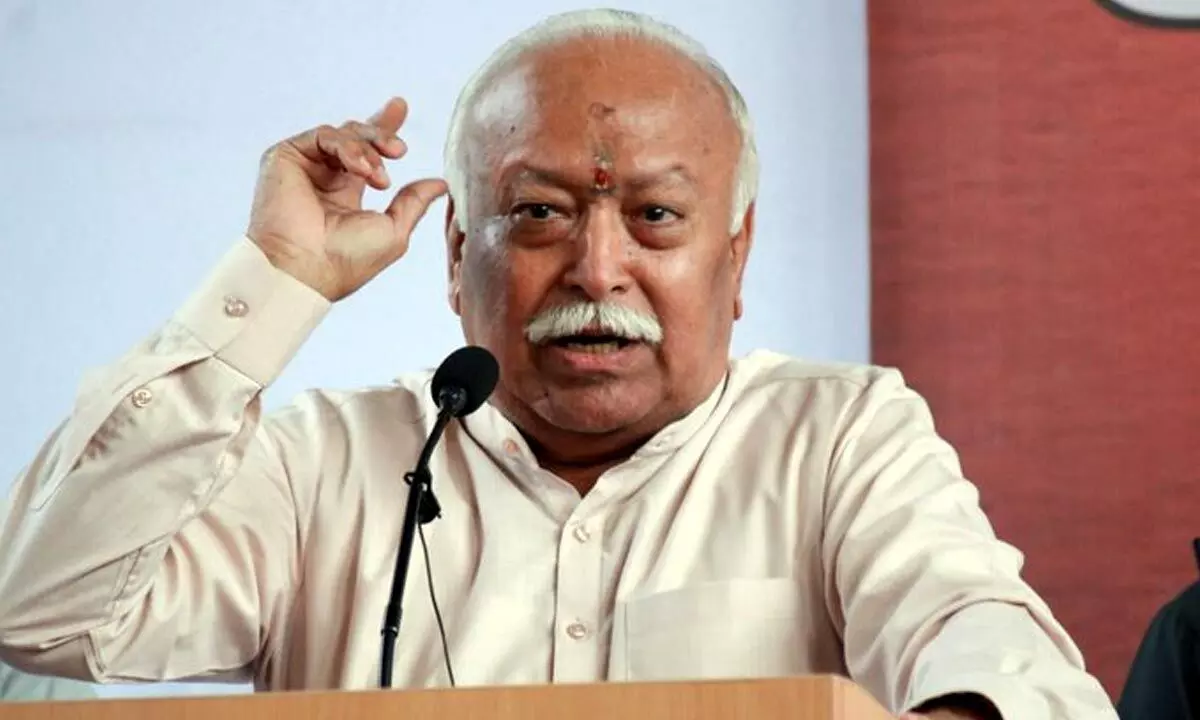
Rashtriya Swayamsevak Sangh chief Mohan Bhagwat
MUMBAI: Rashtriya Swayamsevak Sangh chief Mohan Bhagwat on Saturday said the Sangh is not "against anyone", and does not seek power or aim to become a "pressure group", but its objective is to unite society.
Dr Keshav Baliram Hedgewar identified several shortcomings in society including the lack of unity and it finally led him to found Rashtriya Swayamsevak Sangh in 1925, Bhagwat said, speaking at a programme organised to mark the organisation's centenary. Saturday was day one of the two-day lecture series titled 100 Years of Sangh Journey: New Horizons at Nehru Centre in Worli, Mumbai.
The RSS long ago decided that it would not take up any work other than the unification of society, and once that task is achieved, it would not pursue any other agenda, Bhagwat said. Many people believe that Narendra Modi is the Prime Minister because of the RSS, he said, adding that while Modi leads a political party and many RSS volunteers are active in public life, "the political party is a separate entity and not an organ of the RSS."
In his lecture, Bhagwat referred to various streams of thought that emerged during the freedom movement, represented by reformers and leaders including Raja Ram Mohan Roy, Swami Vivekananda and Dayananda Saraswati. "But still it is seen, to some extent, that the work of giving a direction to society and creating an (enabling) environment is not happening," he said.
The RSS was not "against anyone" and did not work as a reaction to any incident, Bhagwat said, adding that its focus was supporting and strengthening positive efforts underway in the country.
The Sangh was also not a paramilitary force even though it conducts route marches, and though its volunteers wield the lathi, it should not be seen as an "akhada" (wrestling club), Bhagwat said. Nor is the RSS involved in politics though some individuals with the Sangh background are active in political life, he added.
Talking about what led Hedgewar to found the Sangh, Bhagwat said in his early days Hedgewar campaigned for the non-cooperation movement and was charged with sedition and even sentenced to one year's imprisonment.
"Dr Hedgewar held extensive discussions on the condition of the country with leaders such as Lokmanya Tilak, Mahatma Gandhi, Subhash Chandra Bose, Dr B R Ambedkar and Bhagat Singh. Through these deliberations, Hedgewar concluded that political freedom would eventually be attained, but the more important question was what guarantee existed that India would not be enslaved again," he said. The British, he noted, were not the first invaders of the country. India had faced repeated invasions even before Alexander's time. Freedom would come, but unless deeper societal weaknesses were addressed, enslavement could recur, Bhagwat added.


