Rare royal copper plate deciphers Odisha’s forgotten legacy

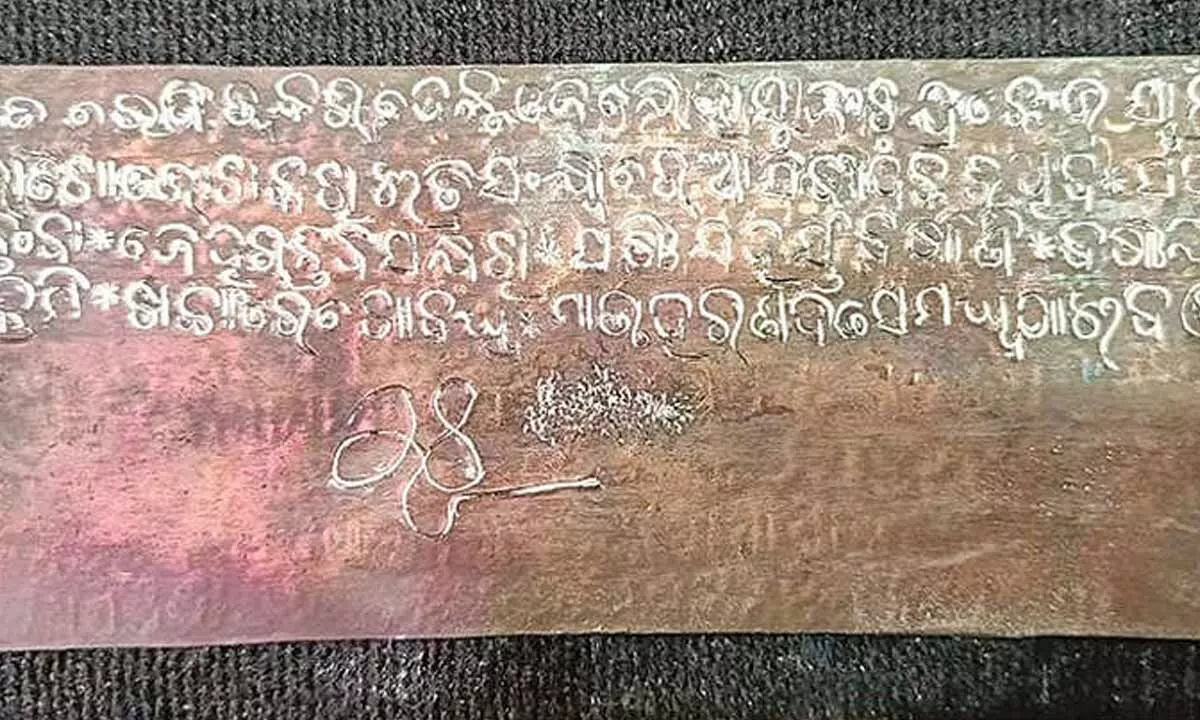
Berhampur: In a discovery that radiates the splendour of Odisha’s royal and religious heritage, a rare copper plate inscription dating back to 1649 CE has emerged from the mists of history at Gunupur in Rayagada district. The discovery unveils a golden chapter of the reign of Mahārāja Lālakṛṣṇa Deva of the illustrious Nandapur Surya Saṅkara dynasty.
The inscription, delicately etched on a 19×7 cm copper sheet, was found in the ancestral home of late Gobinda Chandra Mahāpatra by Śrī Sadananda Paṇḍā on June 14, 2025. It had been safeguarded for decades by Trinātha Mahāpatra (92) from the ruins of the historic Sānā Jagannātha Maṇḍira.
This epigraphic marvel came to light through vigilant efforts of local history guardian Gyana Ranjana Niśanka, who sought the expertise of eminent epigraphist Bishnu Mohan Adhikari of Paralakhemundi. Adhikari, renowned for his scholarship across Odisha and Andhra Pradesh, meticulously deciphered the inscription and dated it with precision to February 9, 1649 CE, Phālguna śuk.
The plate records a grant of two villages to Mahanta Sahaja Rāma Gosāin, for the purposes of conducting religious rituals and offerings dedicated to Śrī Bālājī Mahāprabhu in Gūṇupur taluka. The boundaries of the granted land are meticulously detailed—bordered by Jira, Seramā canal, Bansabali river (Bansadhara) and Dibirisiṇgī village—indicating a substantial endowment.
“The significance of this find lies not only in its pristine condition and clarity of inscription but in the insight it provides into the political and religious patronage systems of 17th-century southern Odisha,” said Adhikari.
The plate, measuring 19 × 7 cm, is a single copper sheet inscribed on both sides with a total of 14 lines, 10 on the obverse and four on the reverse. The reverse also bears a royal sign-manual which is a traditional khadga Santaka, associated with Nandapur lineage.
The script, used is early-modern Odia, showcases the transitional paleographic features of the period. This rare artifact offers valuable evidence of land distribution, regional governance and temple-based religious institutions under Nandapur rulers.