Local to Global: UP eyes to unleash language education and economic growth

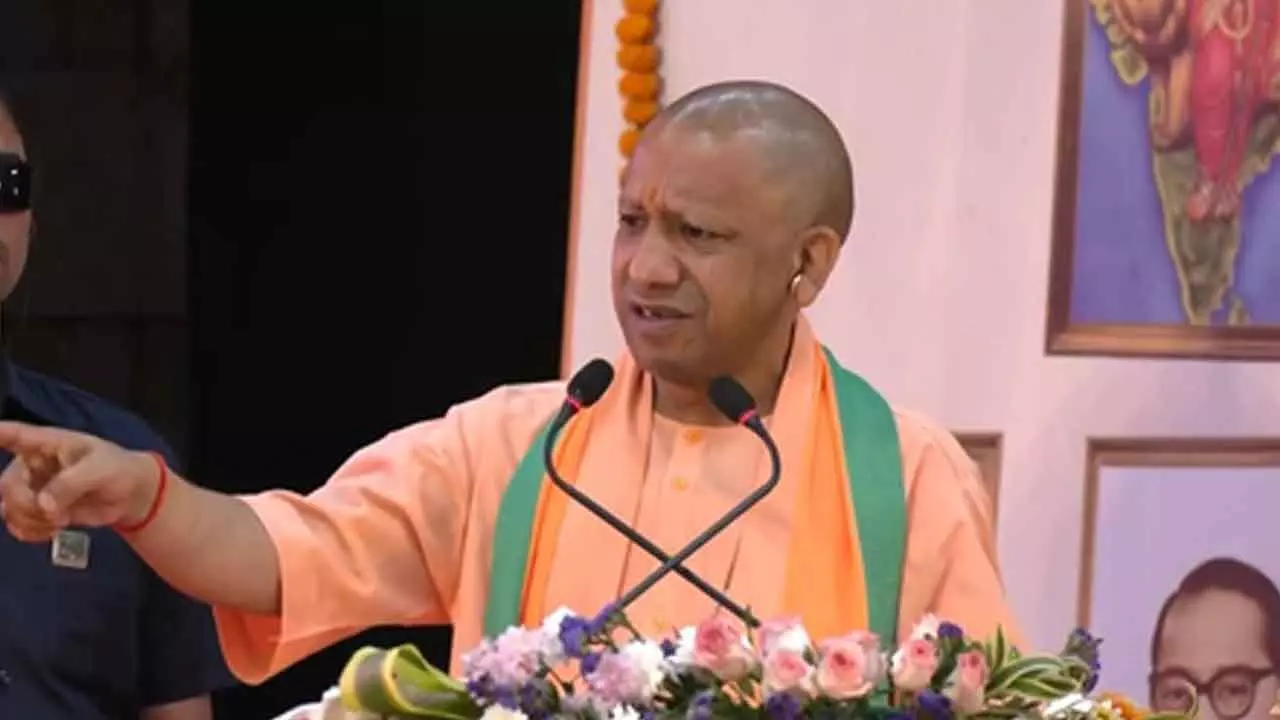
Following the successful conduct of the Maha Kumbh Mela 2025, which has become a unique case study on how indigenous traditions and culture can boost economic growth, the Uttar Pradesh government, under Chief Minister Yogi Adityanath, is now focused on achieving more milestones.
Lucknow: Following the successful conduct of the Maha Kumbh Mela 2025, which has become a unique case study on how indigenous traditions and culture can boost economic growth, the Uttar Pradesh government, under Chief Minister Yogi Adityanath, is now focused on achieving more milestones.
Recent developments indicate that the state government has taken several decisions to promote a new initiative termed ‘Sanskritonomics’. This concept combines centuries of the Indian tradition of learning Sanskrit with employment-oriented education.
Officials say that the Chief Minister’s proactive measures have led to the establishment of 73 new Sanskrit colleges, with a total of approximately 184 institutions offering diploma-level Sanskrit courses in the state.
Furthermore, the Uttar Pradesh Secondary Sanskrit Education Council has introduced four new diploma courses designed to connect students with job opportunities. “The diploma-level training is being provided in 184 institutions across the state. The recognition of new Sanskrit colleges will benefit millions of students. Additionally, the establishment of new schools will provide students in rural areas access to Sanskrit education, helping them build a better future,” official sources noted.
A senior official from the education department highlighted that Sanskrit is not only a crucial part of India’s ancient knowledge tradition, but it also offers modern educational and employment prospects. “With this in mind, the state government is actively promoting Sanskrit education, expecting that the youth will significantly benefit from these initiatives,” the official stated.
Shiv Lal, the Secretary of the Secondary Sanskrit Education Council (SSEC), claimed that the government’s efforts have resulted in a notable increase in employment opportunities for youth in Sanskrit-led economic growth and job creation. It is anticipated that in the coming years, the young population of the state benefit from the government’s initiatives. Inquiries have revealed that the National Education Policy 2020 opens up several opportunities for about 54 lakh children across more than 27,000 schools in the state. This policy combines three significant initiatives that demonstrate how language learning can contribute to economic growth and job opportunities.
Firstly, learning Sanskrit will help students understand and pursue the Indian Knowledge Systems (IKS), which have immense economic potential. In areas such as health and wellness, advanced levels of consciousness, and cognitive studies rooted in IKS, with the potential to contribute to the Large Language Models (LLMs) in AI-driven economic growth.
In addition, the UP State Board of Higher School and Intermediate Education plans to implement a curriculum change for Classes 9 and 10 starting in the academic year 2025-26, as per the National Education Policy. “In line with the three-language policy outlined in the National Education Policy, the total number of subjects has increased from six to ten.
While Hindi is mandatory, students will also have the opportunity to study two additional languages from a wide range, including Sanskrit, Gujarati, Urdu, Punjabi, Bengali, Marathi, Assamese, Oriya, Kannada, Kashmiri, Sindhi, Tamil, Telugu, Malayalam, Nepali, Pali, Arabic, Persian, and English,” officials stated.
The three compulsory subjects of study—Mathematics, Science, and Social Science—will provide students with fundamental concepts and theories across primary knowledge domains.
Students can then choose one applied subject area such as Home Science, Anthropology, Commerce, NCC, Computer Science, Agriculture, or Environmental Science.
Additionally, students can select music (both vocal and instrumental), painting, and various options within the Physical and Health Education segment, which covers moral education, yoga, sports, and productive work related to societal utility. Having a direct bearing on the quality of psycho-somatic health of the students.
The vocational education curriculum will offer 31 subjects to choose from. Adding another layer, the Uttar Pradesh Skill Development Mission (UPSDM) has launched a new initiative in collaboration with the Lucknow campus of the Hyderabad-headquartered University of English and Foreign Languages (UEFL). This initiative offers students the opportunity to learn foreign languages—namely German, French, and Spanish—free of charge.
Students in the districts of Banda, Prayagraj, Jhansi, Azamgarh, Ayodhya, Varanasi, Kanpur, Gorakhpur, and Lucknow will have access to this free foreign language training. The main objective of this initiative is to enhance employability skills.
State Minister for Vocational Education, Skill Development, and Entrepreneurship (MSDE), Kapil Dev Agarwal, emphasised that these courses can be pursued on weekends by students in tourism and hospitality, nursing and health care, and engineering fields, allowing them to explore employment opportunities in countries like Germany and France. Additionally, this initiative aims to reduce the time required for students intending to study abroad for higher education in Europe, where proficiency in the native language is often a mandatory requirement upon arrival.