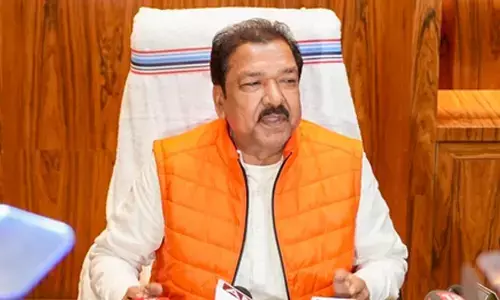
India changing to fuel-exporting nation: Gadkari


Bhubaneswar: Union minister Nitin Gadkari on Friday said India is transitioning from a fuel-importing to a fuel-exporting nation, driven by the growing production and use of ethanol, methanol and green hydrogen. Gadkari, addressing the 84th annual session of the Indian Roads Congress (IRC), emphasised the government’s commitment to road safety, focusing on advanced engineering standards, intelligent transport systems and awareness initiatives.
“India is the fastest-growing economy in the world. The dream of our Prime Minister is to make India the third-largest economy. Our mission is to make the country a ‘Vishwaguru’. For that, we need world-class infrastructure in water, power, transport, and communication segments,” the Union Road Transport and Highways Minister said.
Gadkari said the government’s aim is to build a modern infrastructure rooted in innovation and sustainable mobility solutions. “This transformative approach will generate extensive employment opportunities, strengthen the infra-skill ecosystem, and steer India towards a self-reliant and resilient future,” he said.
Underscoring the crucial role of road engineers, Gadkari said their precision and innovation are key to preparing accurate detailed project reports (DPRs) and developing safe highways. He also noted that the use of bio-bitumen and recycled plastic waste in highway construction is enhancing durability, sustainability and cost efficiency, while supporting the nation’s eco-friendly infrastructure goals.
At the event, Gadkari announced Rs 1,000 crore for Odisha under the Central Road Fund (CRF). He said technology used in the construction of roads, bridges and tunnels should be cost-effective and of superior quality. “To achieve this goal, we need to upgrade technology, research and innovation in the road sector. At the same time, we need to protect our ecology and environment. We need to have a policy so that we can convert waste into wealth,” Gadkari said.
“We also need to encourage implementation of new international practices, codes and guidelines,” he said. Gadkari, citing a recent study by IIM-Bangalore, IIT-Chennai and IIT-Kanpur, said India’s logistics cost has reduced by 5 per cent due to “improved infrastructure, particularly expressways and economic corridors”.