




- Haryana expands Chirayu-Ayushman Bharat scheme to cover more families
- Make Karnataka free of unsafe open borewells: Minister
- Police stations have become Congress offices, BJP-JD(S) complain to Guv
- FIR filed over alleged misuse of Form-7 applications in Jayanagar
- Integrated physio and performance lab to bring services under one roof
- Hanumakonda takes up Rs. 20.52 crore road and drainage works
- Ponnam vows to fight alleged voter purges
- Don’t ignore persistent joint pain & stiffness, warns rheumatologist
Physicist Francis wins Nobel Prize for IceCube neutrino discovery
In Short
The Belgian-born scientist said it was predicted that he would win the prize, but the announcement still made him feel strange

Share :
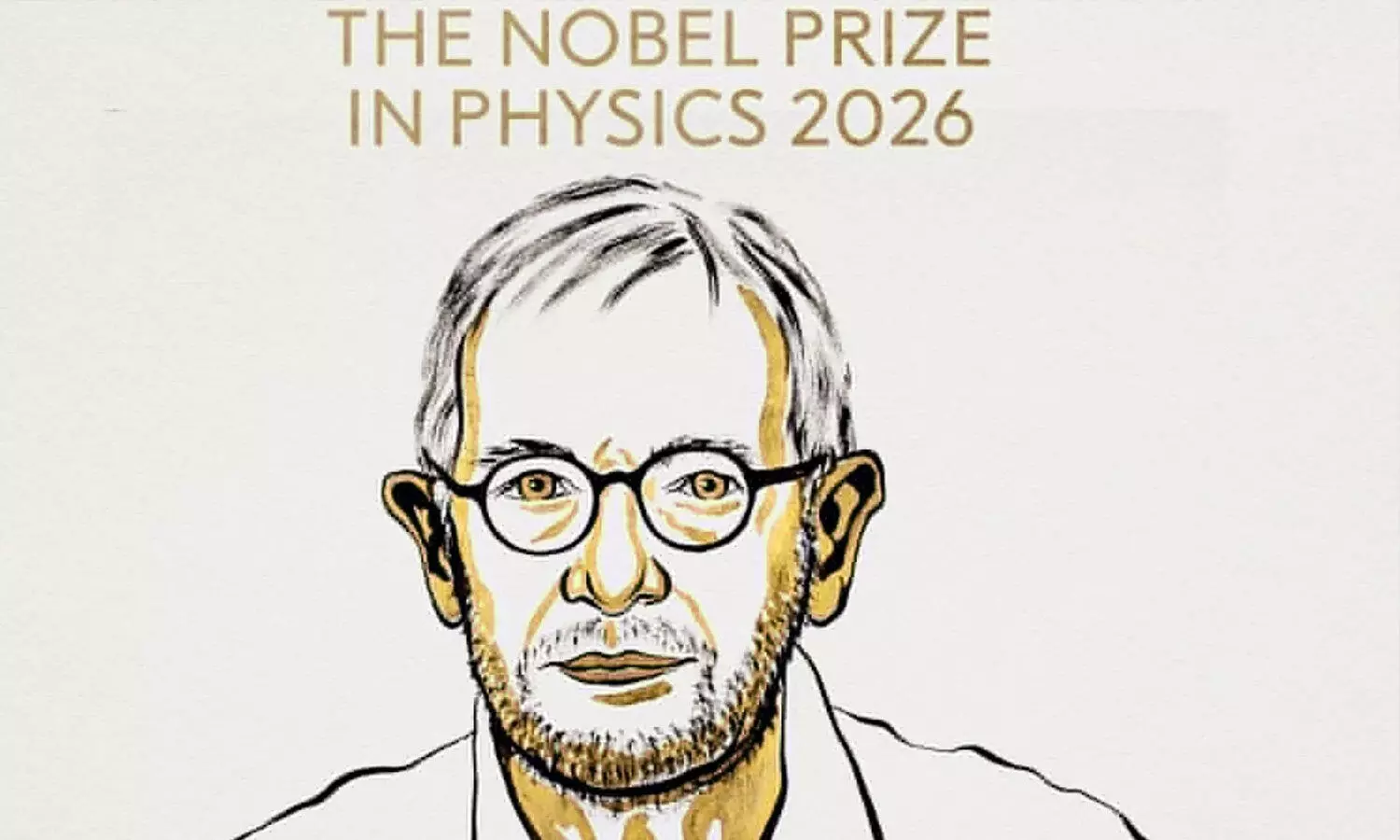
Physicist Francis wins Nobel Prize for IceCube neutrino discovery
Stockholm: Belgian-born scientist Francis Halzen won the Nobel Prize in physics Tuesday for his efforts to demystify a rare group of neutrinos, tiny cosmic particles that researchers believe offer clues to how the universe evolved. "It was a great surprise, and I obviously didn't expect it," Halzen said, speaking to the Nobel Physics Committee by phone from Italy, in a call broadcast at the news conference to announce the winner.
Halzen said it was predicted that he would win the prize, but the announcement still made him feel "strange." "I am working on a proposal, and I hope that this prize will help getting it approved," he said to chuckles from the audience.
Neutrinos are tiny cosmic particles with no electrical charge and extraordinarily small mass, making them difficult to detect. Yet they are everywhere: They spew from stars like the sun, and trillions zip through our bodies every second. Scientists cannot glimpse the mysterious ghost particles zooming around on their own, so they measure what happens when the particles collide with other bits of matter. Neutrinos bump into other particles only rarely, so scientists build large detectors to improve their odds of catching collisions. Halzen had the idea to turn the vast Antarctic ice into such a detector. The Nobel committee said his work was instrumental to the construction of the IceCube Neutrino Observatory in Antarctica, which glimpsed the first high-energy neutrinos from faraway galaxies.
"This experiment in the Antarctic is a revolutionary way of understanding the universe that we didn't have before," said Michael Moloney, chief executive officer for the American Institute of Physics. When a neutrino interacts with ice in the detector, it produces a flash of light that's picked up by sensors.


