Longest neutron star collision simulation powers new era in multimessenger astronomy

Longest neutron star collision simulation powers new era in multimessenger astronomy
Scientists run record-breaking neutron star merger simulation, advancing multimessenger astronomy by predicting gravitational waves, kilonovas, and neutrino signals.
In a major leap for astrophysics, scientists have completed the longest and most detailed computer simulation of a neutron star collision ever attempted. This milestone is expected to significantly boost the field of multimessenger astronomy—an approach that combines gravitational waves, neutrinos, and electromagnetic signals to study cosmic events.
The international research team used between 20,000 and 80,000 CPUs to simulate 1.5 seconds of real-time interaction as two neutron stars spiraled inward, collided, and formed a black hole. The model incorporated Einstein’s general relativity, neutrino emissions, and the effects of strong magnetic fields on ultra-dense matter.
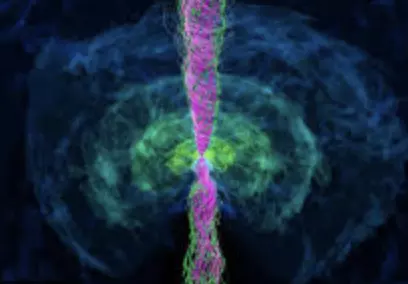
Neutron stars are among the densest known objects in the universe outside of black holes. As they merge, they release gravitational waves—ripples in spacetime—which were the first signals detected in the simulation. Post-merger, a disk of matter forms around the new black hole. This disk's magnetic fields are twisted and amplified, leading to powerful polar jets that emit energy along the black hole’s spin axis.
The simulation also modeled the kilonova—a bright, heavy-element-rich cloud of gas and dust released after the collision. These elements include precious metals like platinum and gold. Insights from the simulation will help astronomers better predict and identify these signals in future cosmic events.
This research builds on the groundbreaking 2017 detection of a neutron star collision, which marked the dawn of multimessenger astronomy. The findings are published in Physical Review Letters.
Keywords:
neutron star merger, black hole, gravitational waves, multimessenger astronomy, kilonova, neutrino emissions, general relativity, astrophysics, space simulation, magnetic fields