Reviving Tradition: The contemporary touch to Cheriyal art
Through his relentless efforts, Sai Kiran is ensuring Cheriyal painting does not become a relic of the past. His work serves as an inspiring reminder that heritage and innovation can go hand in hand
Hyderabad: In an era where ancient art forms fade into oblivion, a few passionate artists are striving to preserve their heritage by embracing modern mediums.
Among them is Dhanalakota Sai Kiran, who is breathing new life into the 400-year-old tradition of Cheriyal painting, ensuring that this cherished art form continues to thrive in contemporary times.
Belonging to one of the few surviving families of Cheriyal artists, Sai Kiran has made it his mission to sustain this unique art form. His family, the Dhanalakotas, has upheld the tradition for generations.
Despite a promising career in a multinational corporation, Sai Kiran chose to walk away from the corporate world to dedicate himself to preserving and innovating Cheriyal paintings.
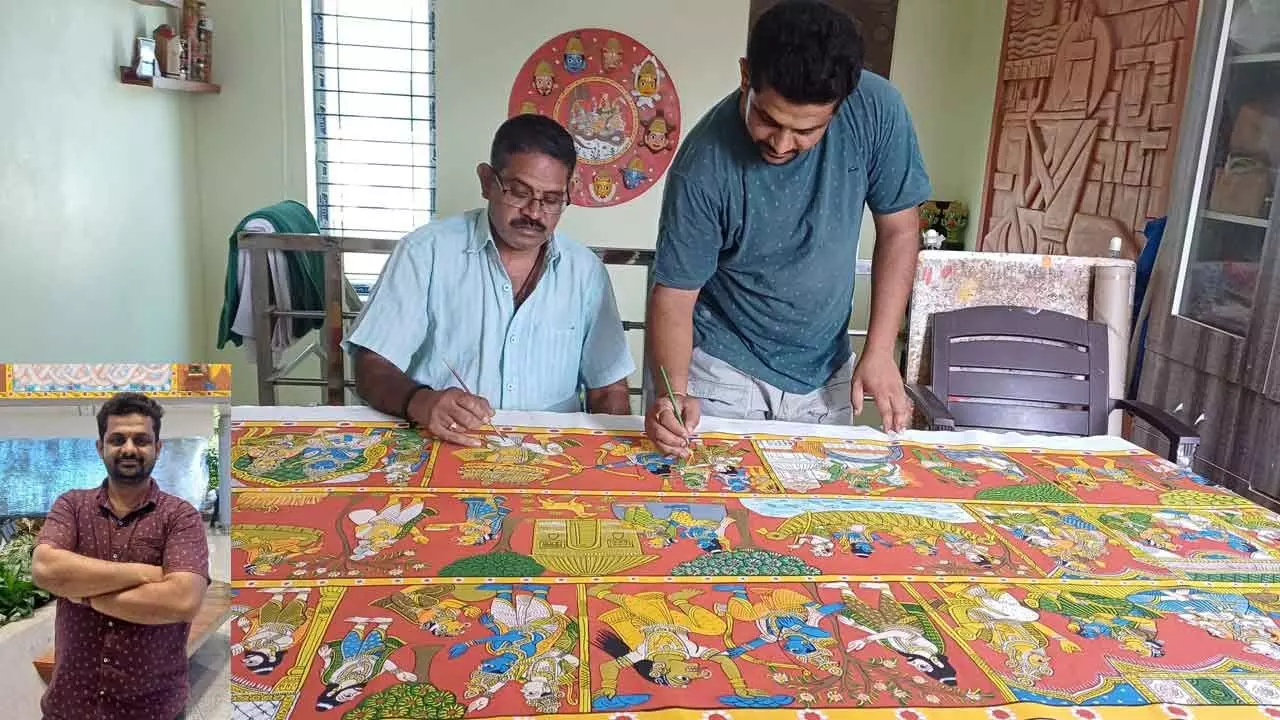
Cheriyal paintings, historically, are visual narratives depicting mythological stories, adorned with vibrant colors and intricate designs.
Traditionally painted on a natural canvas made of khadi cloth, these artworks were once integral to rural storytelling, where bards and storytellers carried the scrolls from village to village. However, with changing times, interest in this form has declined. To bridge the gap between tradition and modernity, Sai Kiran has introduced a contemporary twist to his craft by painting on a variety of mediums, including cardboard, ceramic plates, wooden plaques, T-shirts, fridge magnets, and even masks.
Last Diwali, he took his creativity a step further by crafting Cheriyal art on diyas, bringing this ancient tradition into modern households.
A significant emblem of Telangana’s cultural heritage, Cheriyal scroll painting was once a primary source of entertainment in rural areas, blending storytelling with striking visual representations. The fading presence of this tradition prompted Sai Kiran and a handful of artists to rethink their approach, making the art form more accessible to contemporary audiences.
His innovative efforts have allowed Cheriyal paintings to find a place in prestigious locations such as Rajiv Gandhi International Airport in Hyderabad, Indira Gandhi International Airport in Delhi, a prominent wall mural in Gurgaon, Azim Premji University in Bangalore, and Rashtrapati Nilayam.
Despite these modern adaptations, the core of Cheriyal painting remains intact. The natural colors used in these artworks are still derived from traditional sources such as tamarind seed paste, Gond (tree gum), and vegetable extracts. “The medium might change, but the creative process and the use of natural colors remain the same,” says the 32-year-old artist, emphasizing his commitment to authenticity.
The Dhanalakota family’s dedication to preserving this art form has not gone unnoticed. Last year, Prime Minister Narendra Modi acknowledged the contributions of Sai Kiran’s grandfather, D Chandraiah, in his ‘Mann Ki Baat’ program, appreciating his efforts in propagating Cheriyal art. The family has received numerous accolades over the years: D Chandraiah was honored with the National Award in 1983, Sai Kiran’s father, D Nageshwar, received a State Award in 2003, his mother, D Padma, was recognized with a State Award in 2009, and Sai Kiran himself has won the Konaseema Chitrakala Award twice.
Through his relentless efforts, Sai Kiran is ensuring that Cheriyal painting does not become a relic of the past but continues to evolve while staying rooted in its glorious tradition. His work serves as an inspiring reminder that heritage and innovation can go hand in hand, making age-old traditions relevant in a rapidly changing world.