Majlis, Congress Muslim leaders exploited Waqf properties in TG

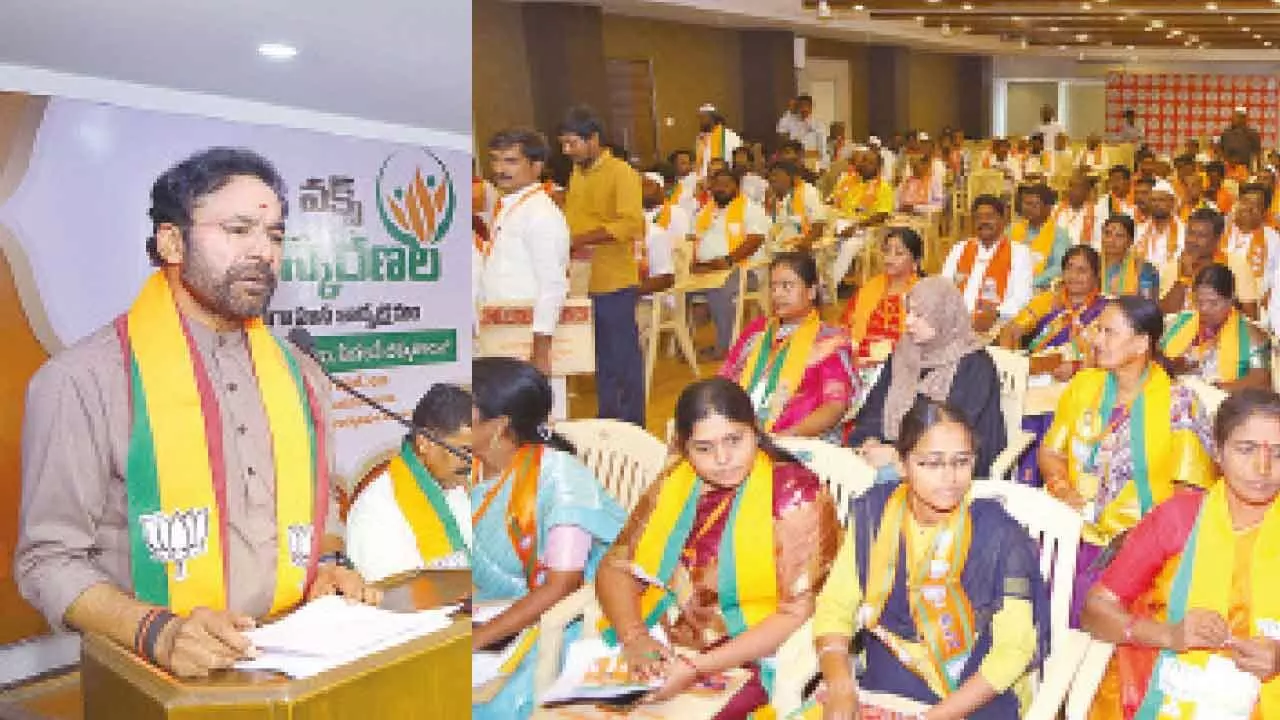
Hyderabad: Union Minister and Telangana BJP chief G Kishan Reddy has alleged that some leaders are trying to incite religious conflicts in the name of the Waqf (Amendment) Act, 2025, renamed the UMEED Act.
Speaking at the “Waqf Sudhar Janajagaran Abhiyan” workshop on Thursday, he said that in Telangana, Waqf has 77,000 acres of land and 35,000 properties.
He asked Chief Minister A Revanth Reddy and AIMIM chief Asaduddin Owaisi disclose the income generated from these properties and explain how much support is provided to poor Muslims. He accused leaders from the Congress and Majlis of exploiting Waqf properties to enhance their political power, stating that many community halls were constructed under false names through the Waqf Board, with the generated income benefiting Darussalam rather than the poor Muslim community. Consequently, changes have been introduced via the Waqf Amendment Act to ensure transparency. He recalled that the BJP had promised to amend the Waqf Act in its election manifesto to benefit poor Muslims.
Recently, the Waqf Amendment Bill was introduced in Parliament, and in August 2024, the Central Government constituted a Joint Parliamentary Committee (JPC) to draft this bill. This committee traveled to around 25 states and gathered input from over one crore citizens and intellectuals. A report based on their suggestions was submitted, followed by a 21-hour discussion in Parliament.
Kishan Reddy challenged Owaisi and Rahul Gandhi, asking how much the Waqf Board has done for poor Muslims, claiming they are supporting the land mafia and the Board’s income isn’t directed towards assisting the needy. Kishan Reddy noted that in 2006, the size of Waqf properties was 4.9 lakh acres, generating only Rs 160 crore. By 2013, this had only slightly increased to Rs 166 crore. Despite rising land values, the Waqf Board’s income has not grown, and this inconsistency must be addressed. According to estimates from the central government, if Waqf properties are utilised effectively, they could generate an annual income of Rs 12,000 crore, which could be dedicated to helping poor Muslims.
He stated, “Mosques are not under the Waqf Board, which are operated by distinct committees. Similarly, endowment lands and temple committees are separate entities that should not be linked.” He expressed that a large number of people from the Muslim community are supporting PM Modi and the Waqf Amendment Act. Following this workshop, district-level meetings will be organised under the Bharatiya Janata Party to address public concerns regarding the act. He appealed for collective efforts to garner public support for the Waqf Amendment Act.