Constitutionally anchored mechanism needed to balance judicial independence and accountability

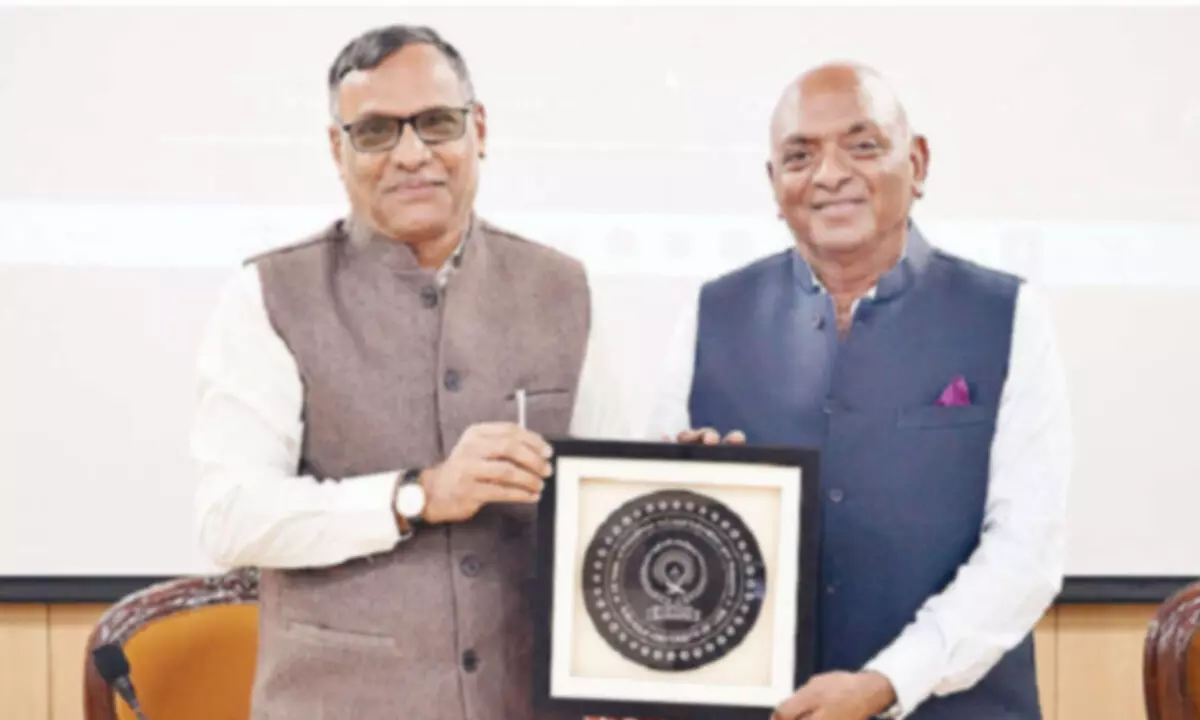
Hyderabad: SeniorAdvocate at the Supreme Court of India and Distinguished Professor of Law at NALSAR, Raju Ramachandran, emphasized the need for a comprehensive, constitutionally anchored mechanism that strikes a balance between the independence of the judiciary and genuine institutional accountability. He underscored the importance of transparency, procedural fairness, and consistency in safeguarding both public confidence and constitutional integrity.
Delivering a lecture as part of the ongoing Distinguished Lecture Series at the NALSAR University of Law on Saturday, delved deep into the theme “Removal of Judges: From Justice V. Ramaswami to Justice Yashwant Verma” in his lecture.
The session commenced with Prof. Anup Surendranath introducing the speaker. Dr. Malvika Prasad provided an overview of the Lecture Series. The event was graced by Prof. (Dr.) Srikrishna Deva Rao, Vice-Chancellor of NALSAR University of Law, Prof. N. Vasanthi, Registrar, Prof. Sitharamam Kakarala, and students, faculty, and members of the legal fraternity.
In his address, Ramachandran drew from historical instances, key legal developments, and his own experience as a member of the Inquiry Committee in the Justice V. Ramaswami case, the first and only full-fledged judicial impeachment proceeding in India.
Ramachandran began by outlining the evolution of judicial tenure protections, starting with colonial frameworks and progressing to the post-independence constitutional safeguards designed to uphold judicial independence. He noted the anomaly presented in the 1964 case of Justice Jaffer Imam, who, suffering from mental incapacity, had to be persuaded by Prime Minister Nehru to resign in the absence of a removal procedure for incapacity short of impeachment.
The lecture focused extensively on the Justice V. Ramaswami case. He recounted the procedural integrity of the inquiry and the political failure of the impeachment motion, which was defeated in Parliament due to abstentions by the ruling party despite the committee’s adverse findings.
Ramachandran criticized the limitations of the current constitutional and statutory framework, emphasizing the excessive dependence on the in-house mechanism, a non-statutory process developed by the judiciary to address allegations of misconduct. He noted that this mechanism lacks transparency, operates outside public scrutiny, and creates constitutional uncertainty when its findings influence or precede impeachment motions in Parliament.
Discussing recent developments, Ramachandran drew attention to the case of Justice Yashwant Varma, where an internal committee recommended impeachment. He raised critical questions about the implications of such findings being challenged in court and how such parallel processes of judicial inquiry and parliamentary impeachment might undermine each other, potentially resulting in what he termed a “reverse-Ramaswami scenario.”