Absence of dharma fuelling extremism, undermining stability: Bhagwat

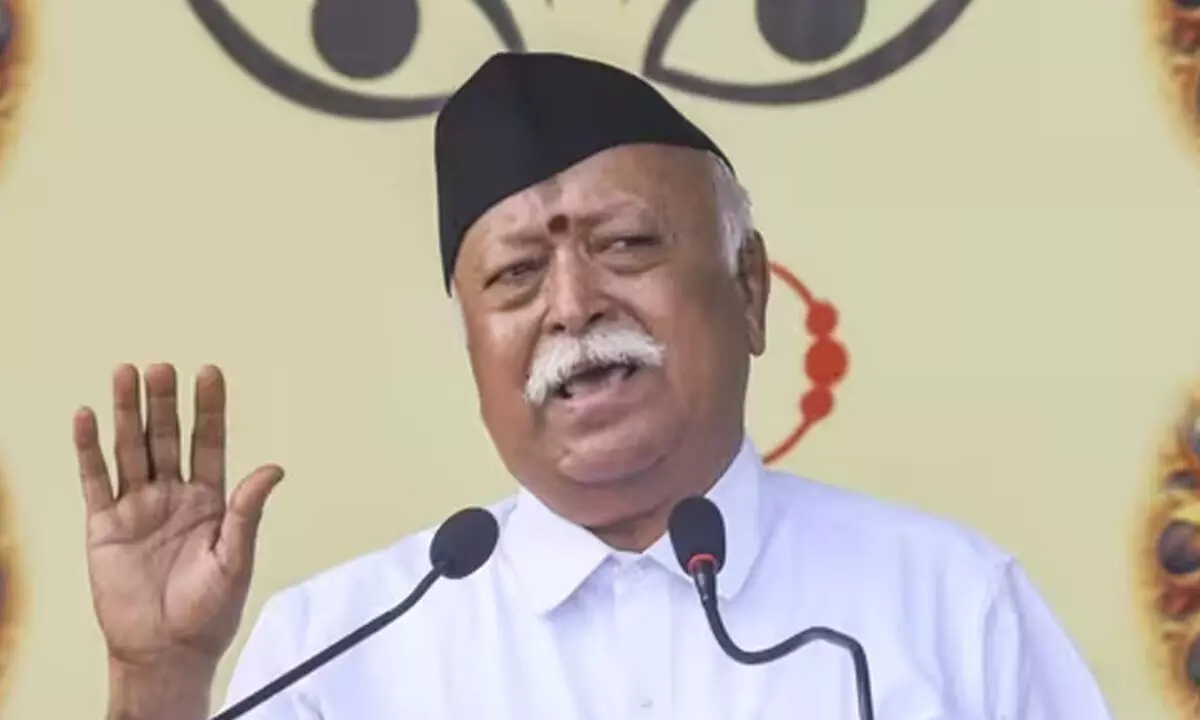
Hyderabad: RSS chief Mohan Bhagwat on Sunday emphasised that India’s vision of becoming Vishwa Guru (Global Teacher) rests on dharma-based living and not on military or economic might to dominate over others.
Addressing the Vishwa Sangh Shibir (VSS)-2025 at Kanha Shanti Van in the city outskirts, he called for a spiritual revival to restore harmony in society and the world. Bhagwat highlighted the need to establish dharma everywhere, positioning India as a moral and spiritual guide rather than a power-driven leader. “Devoid of dharma, humanity risks losing its history, compassion, and moral compass, paving the way for extremism,” he warned.Recalling the contributions of the first and second generation VSS volunteers, Bhagwat praised the Hindu Swayamsevak Sangh (HSS) for setting an example of preserving Hindu traditions globally.
“Irrespective of living in different countries, they have shown that dharma-based living can inspire others worldwide,” he said, while calling upon the Hindu society to stand united for the cause.
On who should take the first step, Bhagwat invoked RSS founder K B Hedgewar’s vision: “We will start it.” The movement encourages individuals to become Svayam Sevaks—volunteers serving society selflessly, guided by the principle “Siva Bhava, Jeeva Seva” as taught by Ramakrishna Paramahamsa.
Bhagwat criticized the tendency to show-off or under compulsion, which, he stated, was rooted in ahankar (ego). “True service is not an opportunity for self-promotion but a sacred duty—performed with tan, man, dhan (body, mind, and wealth) without any expectations in return,” he said. This ethos, he noted, has fuelled RSS’s expansion, with thousands of volunteers abroad preserving traditions while adapting to modern contexts.
Central to the dharmic vision is the concept of Chatur Purushartha—dharma, artha, kama, and moksha. While the world excels in material pursuits (artha) and desires (kama), it struggles to integrate these with dharma.
“You cannot enjoy a Ferrari and still seek moksha, without losing one or the other” he remarked, referring to the book ‘The Monk Who Sold His Ferrari’. The balance of these four aims, inherited from India’s ancestors, is key to sustainable well-being for individuals, society, and nature.
Bhagwat recalled how attempts to create classless societies added new classes and environmental crises.
Quoting Sri Aurobindo, he reiterated that the rise of Sanatan Dharma is essential for a Hindu Rashtra, ‘whose process has already begun’.
Technology, AI, and social media, he said, must remain under human wisdom, not become instruments of destructive tendencies.
“The ultimate goal is not pride but responsibility—to prepare individuals, families, and society for the betterment of the world,” Bhagwat said.
He invoked India’s 3,000-year legacy of peaceful coexistence and urged the Hindu society to swear by dharmic living and ensure all-round prosperity and harmony.