




- Delhi Rains: Heavy Downpour Floods IGI Airport, Nine Flights Diverted Within An Hour
- Congress failed to implement women’s guarantees: Madhusudhanachari
- ‘Dharmasthala Niyojakavargam’ review: A meaningful political drama with a strong social message
- Navies of India and Thailand reaffirm commitment to capacity building, training
- Poco X8, X8 Power Launch in India with Big Batteries and Snapdragon Chips
- AP, Telangana to receive rains amid cyclonic circulation in Bay of Bengal
- Govt to make all efforts for better solution to Bhopal sealing issue: CM Mohan Yadav
- South Korean President Lee designates flood-hit Tongyeong as special disaster zone
Zambian team visits natural farming fields in Sri Sathya Sai dist
In Short
The team observes demonstrations on the nine universal principles of natural farming, including the preparation of Ghanajeevamrutham and Dravajeevamrutham during its visit

Share :
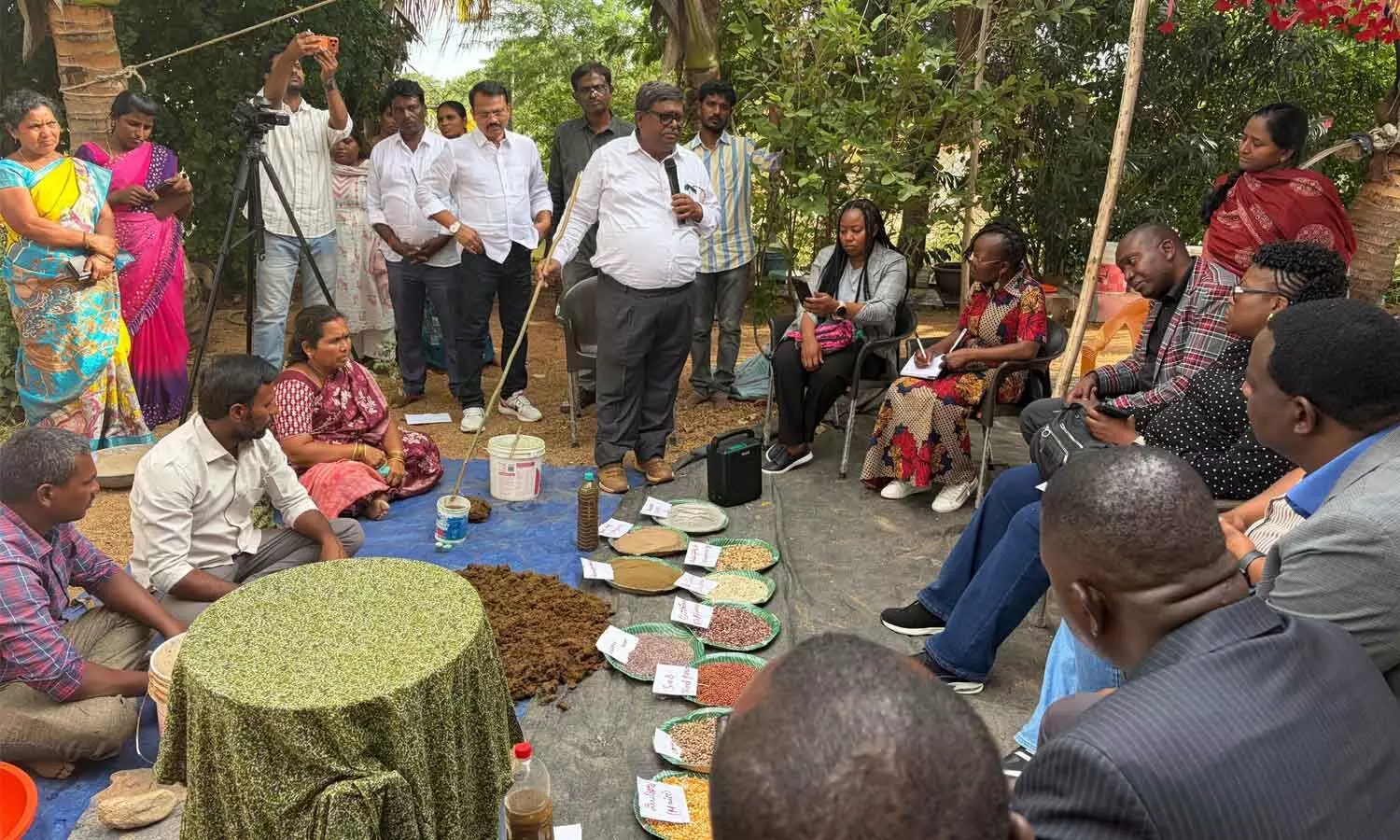
Zambian delegation visits a natural farming field in Sri Sathya Sai district on Monday
Puttaparthi (Sri Sathya Sai district): An eight-member delegation from Zambia visited natural farming fields in Sri Sathya Sai district on Monday to gain first-hand exposure to farmer-led agricultural practices, innovations and sustainable farming models being implemented in Andhra Pradesh.
The delegation is visiting the state from August 31 to September 3 under the South–South Cooperation Programme on Agroecological and Climate-Resilient Farming. The visit is supported by GIZ and coordinated by the Andhra Pradesh Mahila Abhivruddhi Society (APMAS), in collaboration with the Andhra Pradesh Community-managed Natural Farming Programme (APCNF) and the AF Ecology Centre (AFEC) for the Anantapur leg.
The delegation comprises Shadreck Mwale, Mukela Elizabeth Lubasi, Chizumba Shepande and Barbra Mukuni from Zambia’s ministry of agriculture, Etinala Tembo of Participatory Ecological Land Use Management (PELUM) Zambia, Ebony Lolozi of the National Union for Small-Scale Farmers of Zambia (NUSFAZ) and Belindah Chilala and Emmanuel Ngoma of GIZ.
The visit aims to help the delegation understand India’s experience in promoting agroecology and climate-resilient agriculture, with a focus on community-based approaches, institutional mechanisms, scientific evidence, extension systems, financing and partnerships needed to scale up sustainable farming practices.
The exposure to Andhra Pradesh’s natural farming model is expected to provide practical insights for Zambia as it works towards developing its first National Agroecology Strategy.
During the field programme, the delegation observed demonstrations on the nine universal principles of natural farming, including the preparation of Ghanajeevamrutham and Dravajeevamrutham. Rythu Sadhikara Samstha (RySS) chief technology and innovation officer and district project manager Lakshma Naik explained the role of bio-stimulants in natural farming and their importance in improving soil health and crop growth.
The team later visited natural farming fields in Gantapuram village and other parts of the district. The delegates interacted with self-help group (SHG) and village organisation (VO) federations to understand diversified farming practices and strategies for generating continuous income for farming communities.
The field visits offered the delegation an opportunity to observe how farmers are adopting Natural Farming techniques across different crops and farming conditions.
RySS senior thematic lead Sudhakar, thematic lead Suresh, Swathi and other RySS and district-level staff participated in the programme. APMAS representatives Kalaimani and Ramadevi facilitated the field visit and interacted with the Zambian delegation.
The visit is part of a cross-country learning and knowledge-exchange programme aimed at sharing experiences on sustainable agriculture, soil health, water conservation and climate resilience. It also seeks to strengthen understanding of community-based extension systems and practical approaches to building climate-resilient agricultural livelihoods.
PV Sunitha Selected as Best Teacher in Hyderabad District
Kappan conviction reopens old Pala battle, Jose K. Mani calls verdict an insult to constituency
In Jharkhand's Jamtara, beneficiaries explain transformation in their lives under PMAY scheme
Sr Men Inter-Department Hockey: PSPB, RSPB, FCI, SAI win one-sided matches
PM Modi congratulates Giorgia Meloni on becoming Italy's longest-serving Prime Minister
ISRO launches EOS 05 satellite successfully from Sriharikota
Nepal Flood Rescue: 2 Workers Pulled Alive From Hydropower Tunnel After 9 Days
CM Chandrababu wishes Telugu People on Sri Krishna Janmashtami
IndiGo flight hits pole while parking at Srinagar airport; passengers, crew safe
PV Sunitha Selected as Best Teacher in Hyderabad District


