AI-based prediction to green walls, 265 responses to Delhi govt's anti-pollution initiative

From photocatalytic coatings that use sunlight to dissolve pollutants to biofilm panels that clean air without electricity, AI-based dust prediction models and green facades for buildings, the Delhi government's Innovation Challenge initiative has drawn more than 265 proposals to curb the capital's pollution.
The initiative, launched last month by Environment Minister Manjinder Singh Sirsa, invites individuals, startups and research institutions to submit technological solutions aimed at cutting particulate matter (PM2.5 and PM10) emissions in the city. Led by the Delhi Pollution Control Committee (DPCC), the programme has been open to innovators, technology developers, R&D institutions, universities and registered entities across India.
Since the portal went live on October 10, the department has been receiving a steady flow of fresh ideas, described by officials as a wave of innovation to tackle Delhi's toxic air.
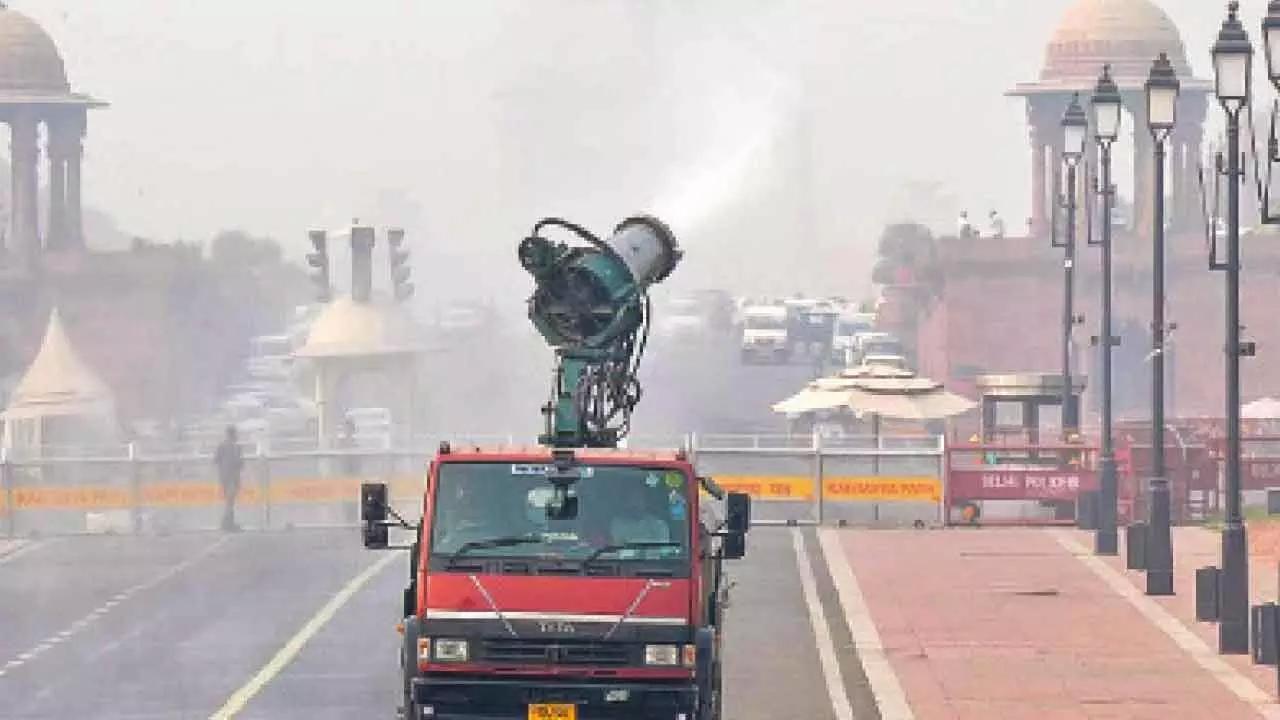
A senior official told PTI that the portal, designed to crowd-source breakthrough technologies for reducing vehicular emissions and purifying ambient air, has attracted submissions ranging from AI-driven dust prediction models and large-scale green facades for building, to outdoor air purification machines that can be mounted on trucks to target smog hotspots. Of the more than 265 proposals, 68 entries (25 per cent) fall under Category A -- Vehicular Emission Control -- while 197 entries (75 per cent) are categorised under Ambient Air Purification.
Officials said the submissions display a wide range of concepts, including electrostatic plasma traps, photocatalytic roads, wet scrubbers, smart tailpipes, bio-enzyme and micro algae-based purification systems, solar-powered air-cleaning units and pulsed radio-wave technologies.
Some ideas focus on large-scale vertical gardening through green walls to reduce pollution and urban heat, while others propose photocatalytic nano-TiO2 (titanium dioxide) coatings to break down pollutants into harmless compounds.
Another set of proposals suggests modular, multi-chamber air purifiers that use mist to trap particulate matter, along with real-time dust concentration models that rely only on image inputs to predict pollution levels. Officials said while a few ideas have undergone initial testing, many remain conceptual.
The DPCC will now evaluate all entries, after which shortlisted innovators will be invited for presentations, field trials and testing. The three-stage selection process includes preliminary scrutiny by the DPCC, a technical review and field trials by an independent committee, and final validation by the National Physical Laboratory (NPL) or similar institutions. Projects clearing the second stage will receive Rs 5 lakh, while those recommended after final testing will get Rs 50 lakh each.
The innovation push comes as Delhi faces hazardous air pollution. Last Tuesday, the AQI crossed 400 and entered the ‘severe’ category, improving slightly later but again reaching 391 by Thursday evening, CPCB data showed. (PTI)