Astronomers Detect Elusive Dark Matter Halo Using Rare Einstein Cross Effect

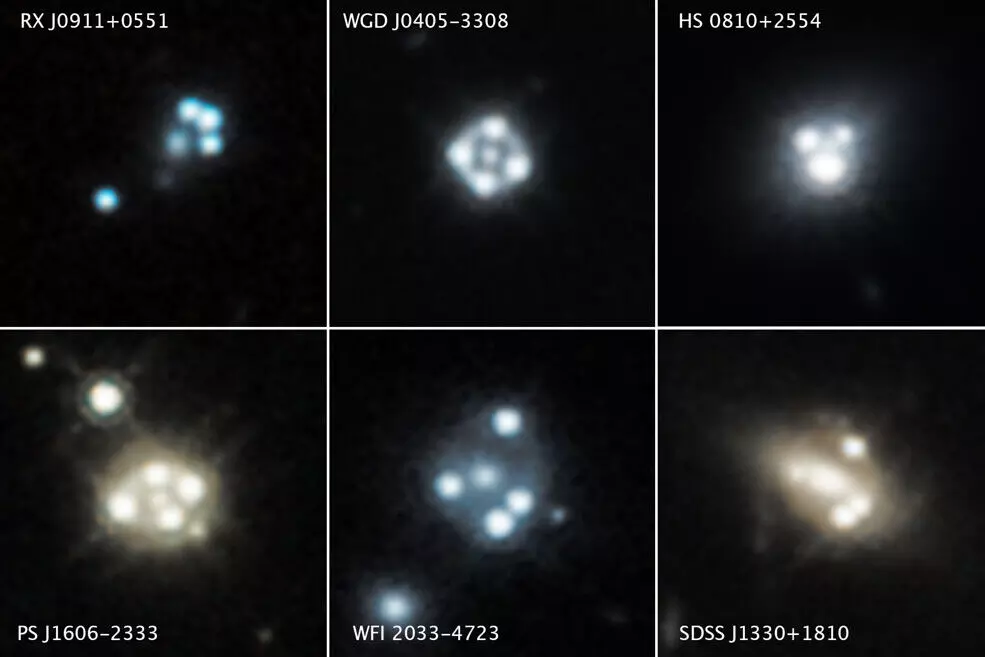
Cosmic “Unicorn”: Astronomers Discover 5-Point Einstein Cross
An international team of astronomer’s dark matter halo discovery an unusual astronomical Einstein Cross phenomenon: a galaxy warped by gravity into a cross, but with five, not four, components.
An Einstein Cross, Explained
As proposed by Albert Einstein nearly a century ago, the gravity of an extremely massive object can warp the space-time fabric. If a distant, more-distant galaxy is lined up almost perfectly behind the foreground object, the background galaxy’s light becomes bent and is seen distorted. For most alignments, the distorted galaxy will appear as four bright spots, forming an “Einstein Cross.”
The galaxy under cosmic lensing study, called HerS-3, is different from most others observed. As seen 11.5 to 12 billion years ago, when the universe was less than one-quarter of its current age, it does display the usual four Einstein Cross images—but it also has a fifth, faintly glowing image at the center of the cross.
The Mystery of the Missing Galaxy
To solve this mystery, the team used computer simulations of gravity’s ability to bend light, but they could not get five bright spots.
To match the hidden dark matter research, this additional foreground galaxy would have to have no visible component, but be extremely massive. The simulations located it to the southeast of the brightest of the four visible foreground galaxies, with invisible new dark matter findings. No visible galaxy is seen in this location, but calculations show the dark halo to be 80,000 to 200,000 light-years distant, and sufficiently massive to create the extra light image.
The Unicorn in the Cross
A look at HerS-3 itself reveals an extraordinary galaxy. The combined exaggeration of the unusual world lensing has cheered the world nearly20-fold, allowing details to be seen that would else be unnoticeable. For illustration, the world is producing new stars at a rate hundreds of times lesser than in our Milky Way. And it's blasting gas outward at further than 350 kilometers( 217 long hauls) per second, due to extremely important astral winds from recently formed short- lived massive stars.