Farmer turns to cashew cultivation, inspires others to follow suit

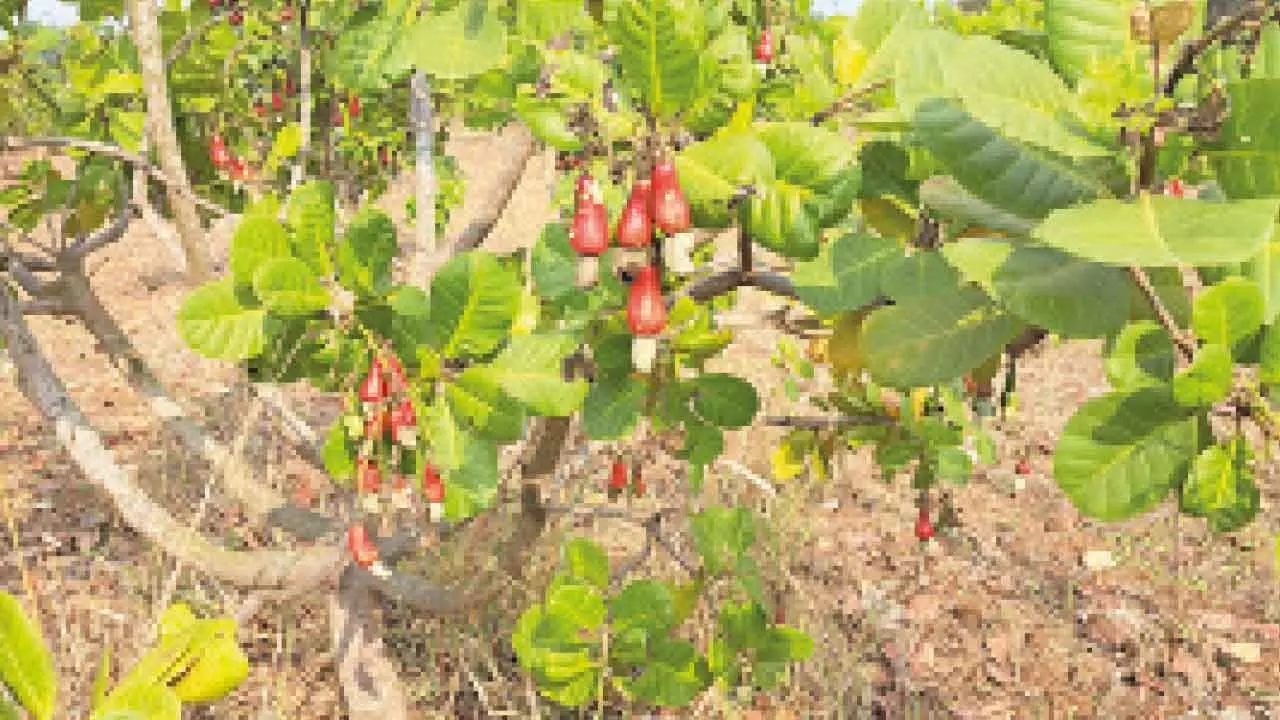
Haveri: In a district where most farmers continue to grow traditional crops like cotton, maize, groundnut, rice, and soybeans, one farmer has broken the mold by embracing a less conventional but promising alternative—cashew cultivation. Ramesh Kadakola, a progressive farmer from Kadakola village in Savanur taluk, has become a local inspiration by turning to cashew farming on a significant portion of his land.
Haveri, which was once hailed as Asia’s largest cotton-producing district, has recently seen a shift in focus toward maize cultivation. However, Kadakola has chosen to take a different path. He has planted around 100 cashew saplings per acre across six acres of land. Of these, the trees on two acres—planted six years ago—have already started bearing fruit. Kadakola has introduced two varieties of cashews, producing both yellow and red fruits.
Currently, only about 100 acres of land in the entire Haveri district is used for cashew cultivation. Kadakola’s six-acre farm is among the most extensive in the area. The plants were sourced from Shivamogga and transplanted into his field, showing encouraging results.
“Each tree is now yielding around two to three kilograms of cashews,” said Kadakola. “By the eighth year, this will increase to up to 10 kilograms. I have two varieties, brought from Hanumanamatti and Shivamogga. One of the advantages of cashew cultivation is the low maintenance cost, making it suitable even for those who cannot engage in active farming.”
He pointed out the challenges of traditional farming, especially the irregular electricity supply—only three hours during the day and three hours at night—making it hard to manage crops that require constant care. “Cashew farming, in comparison, is easier and the market price is favourable,” he added.
Kadakola also emphasised the potential for value addition. “We can use the waste from cashew fruits to produce wine, which could double our income. Unfortunately, the government does not currently permit this. In Goa, wine production from cashew is a well-established industry. If we are allowed to do the same in Karnataka, it would greatly benefit farmers. The government should step in with support and technical guidance.”
Villagers who were initially skeptical are now encouraged by his success. “At first, people advised against growing cashews here,” said Sadanand, a resident of Kadakola. “But seeing Ramesh’s trees grow and thrive has given confidence to other farmers. The plants didn’t produce much in the early years, but they’re doing very well now.”
With his innovative approach and perseverance, Ramesh Kadakola has not only diversified his farm but also sparked a quiet revolution in the region’s agricultural landscape—offering hope and direction for other farmers looking to explore beyond the conventional.