Bengaluru NavaNirmana Party challenges GBA’s method of governance

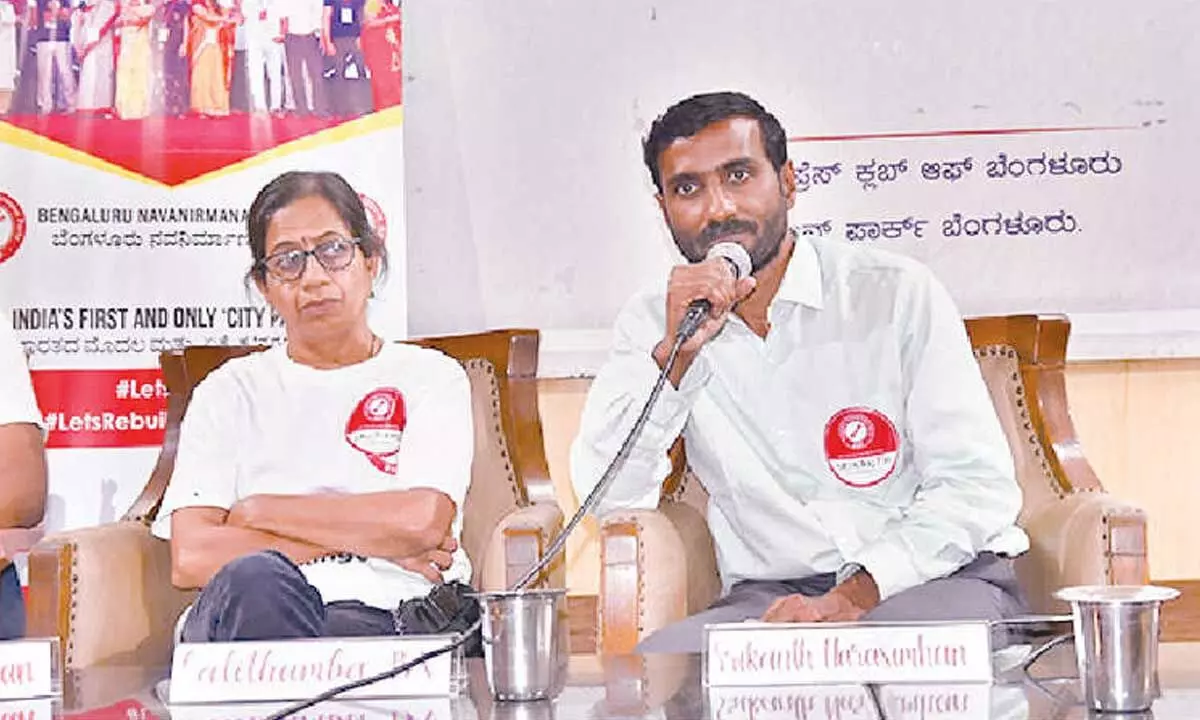
Bengaluru: The Bengaluru NavaNirmana Party (BNP) India’s first and only city-centric political party on Friday announced its bold challenge to the Greater Bengaluru Authority’s centralised method of governance, positioning Area Sabhas as the most effective framework for the city’s sustainable development. The party has also launched their Mission 50 campaign for the upcoming Greater Bengaluru Elections expressing confidence to win at least 50 wards. BNP pledged to usher in a new era of citizen-led governance, empowering local communities to shape decisions that directly impact their neighbourhoods and the city’s future.
Comprising civic leaders, professionals, urban experts, entrepreneurs, and grassroot organisers, BNP positions itself as a governance-first alternative to legacy political parties. The party believes winning 50 wards will give it the critical mass needed to influence decision-making inside the Corporation and institutionalise neighbourhood-level accountability through Area Sabhas.
At the core of the Bengaluru NavaNirmana Party’s (BNP) Mission 50 campaign is the revival and empowerment of Area Sabhas as enshrined under the 74th Constitutional Amendment which they have made the foundation of its citizen-led model after successive governments weakened or ignored the same.
Srikanth Narasimhan, Founder and General Secretary of BNP, emphasized the need for a fundamental shift in how the city is run stating; “Bengaluru is a global economic powerhouse, yet it is governed with a 19th-century mindset. We are at crossroads in 2026, with the GBA transition creating more confusion than clarity. At BNP, we believe the solution isn’t just new laws, but a new breed of leaders. We are bringing corporate discipline to public service, where every project will have a stringent deadline, every official has strict accountability, and every citizen has a voice through empowered Area Sabhas. We aren’t here to play ‘politics’ as usual; we are here to manage our home professionally and transparently.”
BNP has already activated ward teams and Area Sabha leadership across more than 75 wards, working year-round to identify civic issues, coordinate with departments, monitor implementation, and ensure follow-up, treating Area Sabhas not as advisory forums but as active units of people-led governance.
With over 1,000 active members and a broader base of 50,000+ volunteers and supporters, and more than 1,000 new citizens stepping forward in recent months, BNP is witnessing growing public trust in its civic-first approach. The party’s priorities include decentralised ward-level governance, solving everyday issues locally, and ensuring transparency in tenders, budgeting, and implementation through strict adherence to the Karnataka Transparency in Public Procurement Act.
“Bengaluru faces significant fiscal and administrative challenges. Despite contributing over 40 per cent of Karnataka’s economy, the city’s corporations lack fiscal autonomy. Accountability remains a concern as the new GBA is chaired by the Chief Minister rather than an elected Mayor, which keeps power concentrated at the state level. The city is currently facing a governance transition crisis characterized by a fragmentation of authority.
With the city split into five new municipal corporations, residents and businesses are forced to navigate a “multiplicity of approvals” and varying zonal rules for trade licenses and property taxes.
Z This is intensified by the ongoing “parastatal overlap,” where state-controlled bodies manage water, transport, and power without coordination, often resulting in newly paved roads being dug up for utility work” Narsimhan added.
BNP listed out several issues that have plagued Bengaluru due to the long-standing absence of an elected council. Infrastructure and mobility remain in a state of neglect. “Namma Metro” network has expanded, but last-mile connectivity remains an issue. Persistent traffic congestion and the infamous “pothole menace” continue to plague the city, often due to poor drainage systems that undermine even massive investments like white topping. The city has reached a breaking point, with rapid urbanization encroaching on stormwater drains (rajakaluves), leading to both water scarcity and flash floods. Waste management continues to struggle under a “collect-and-dump” model, failing to transition effectively to a circular economy.
The party has also led citywide resistance against inflated property tax notices, helping thousands of resident’s secure corrections and financial relief.” said Narasimhan.