ADA hosts ‘Aeronautics 2047’ seminar in B’luru on India’s aerospace roadmap

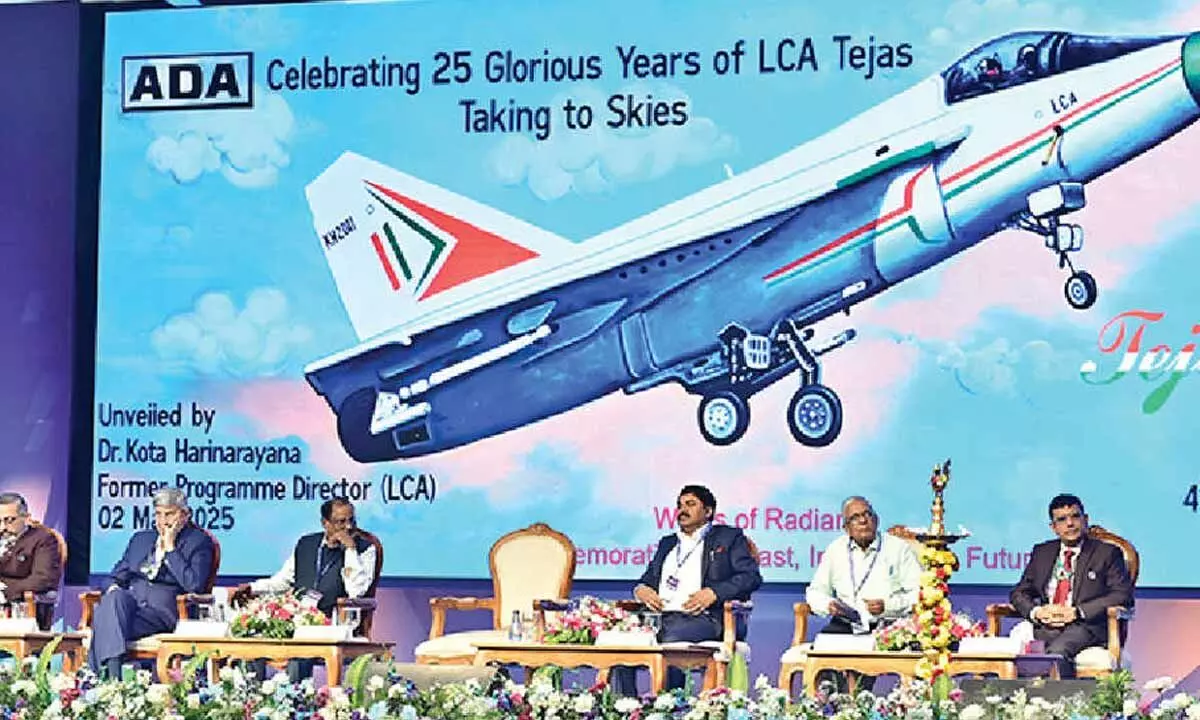
Bengaluru: TheAeronautical Development Agency (ADA) on Sunday inaugurated a two-day national seminar titled ‘Aeronautics 2047’ at the Centre for Airborne Systems (CABS) in Bengaluru, bringing together policymakers, scientists, industry leaders and academics to deliberate on India’s aerospace ambitions aligned with the vision of a developed India by 2047.
The seminar was inaugurated by Chief of the Air Staff Air Chief Marshal A.P. Singh, who congratulated ADA on the completion of 25 years of flight of the Light Combat Aircraft (LCA) Tejas. Emphasising the rapidly evolving global security environment, he underscored the need to continuously transform the Indian Air Force (IAF) into a force that remains operationally ready across all scenarios.
Addressing the gathering, Secretary, Department of Defence Research and Development, and Chairman of DRDO, Dr Samir V. Kamat highlighted the importance of developing cutting-edge indigenous technologies to reduce dependence on imports. He said the aerospace sector would play a critical role in achieving the goals of Viksit Bharat@2047, calling for closer collaboration between government laboratories, academia and industry.
The seminar aims to provide a platform for experts across the aerospace ecosystem to share insights on the evolution of aeronautics, design innovation, manufacturing, and emerging frontiers. Key focus areas include next-generation aircraft production and assembly, digital manufacturing, aerodynamics and propulsion technologies for future combat aircraft, flight testing methodologies, digital twin technology, certification challenges, flight control systems, avionics, and the application of artificial intelligence in aircraft design and precision manufacturing. The programme also traces the journey of the LCA Tejas from the drawing board to squadron induction. Designed and developed by ADA with over 5,600 successful test flights, the Tejas programme involved more than 100 design and work centres, including government laboratories, academic institutions and industry partners. Several advanced technologies—such as carbon composites, lightweight materials, fly-by-wire flight control systems, digital utility management systems and glass cockpits—were indigenously developed to make the LCA a fourth-generation fighter aircraft.
The LCA Mk1A, an advanced variant of the indigenously designed fighter, is expected to serve as a potent platform to meet IAF’s operational requirements. The LCA Mk II and the naval variant are currently under development. India has so far inducted 38 Tejas aircraft—32 fighters and six trainers—into two IAF squadrons. The seminar also features an exhibition showcasing indigenous aerospace products developed by public sector undertakings, defence PSUs, private industries and MSMEs for airborne applications, highlighting the growing depth of India’s domestic aerospace capabilities.