17th Century Umamaheshwara Sculpture Found in Udupi

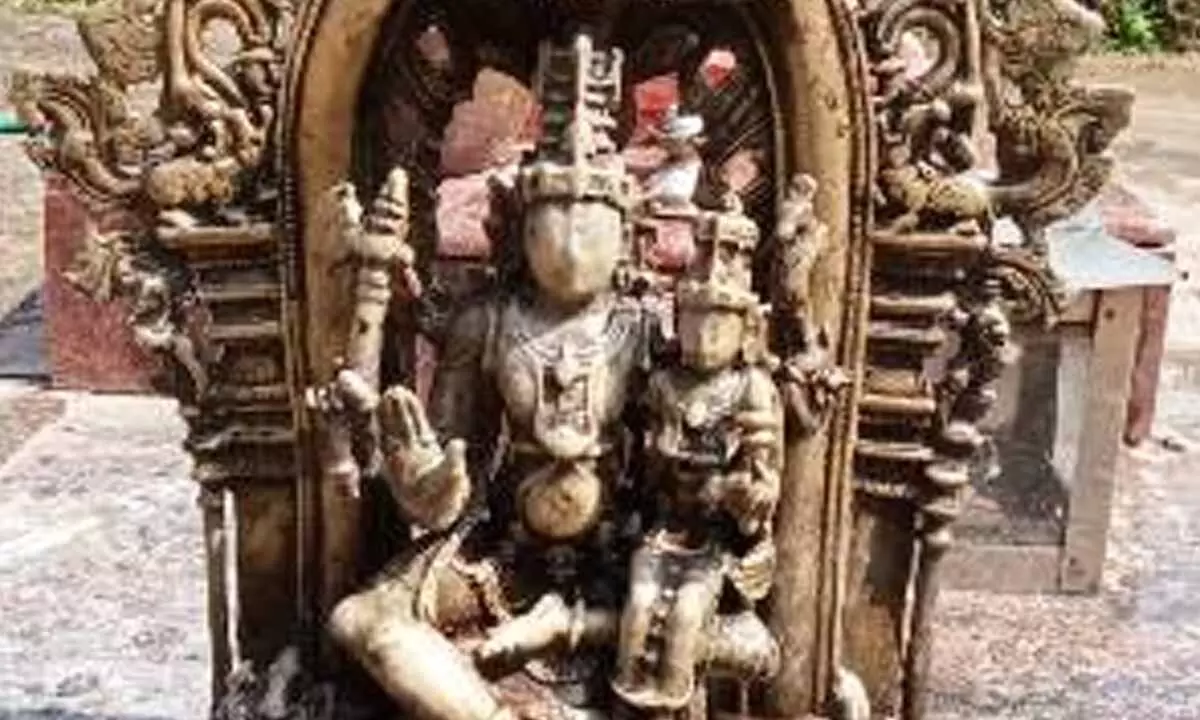
Udupi: A significant archaeological find has come to light in Ajri village, Taggunje, situated in the Kundapura taluk of Udupi district. A Umamaheshwara sculpture, made from a blend of five metals, was recently uncovered. According to Prof. T. Murugeshi, a retired Associate Professor in Ancient History and Archaeology from MSRS, Shirva, the icon is an exquisite example of the fusion of Shaiva, Shaktha, and Naga cult influences, making it an exceptional discovery.
The sculpture portrays Lord Shiva, seated majestically on a lotus platform with his consort Parvathi lovingly perched on his left lap. On his right, Lord Ganesha, and on his left, Shanmukha, share the divine space. Beneath his right foot rests Nandi, the celestial bull. Shiva is depicted in a regal form, adorned with a Jatamukuta (a crown of matted hair) and a third eye on his forehead, signifying his omnipotence. The deity is further characterized by symbolic elements: a Parashu (axe) in his right hand, a Mriga (deer) in his left, and a hand raised in Abhaya Mudra to offer protection. Above Shiva's head hovers a five-headed serpent, acting as an umbrella, completing the divine imagery.
Prof. Murugeshi stated that while the sculpture's design suggests it could be from the 12th century, an inscription found on the platform reveals its true origin. The Kannada inscription, which dates back to the 17th century, describes the sculpture as having been made using 360 grams of gold, with 14 percent of it being pure gold. This discovery challenges earlier assumptions about the sculpture's date and offers new insights into the craftsmanship of the period.
The Umamaheshwara cult, a spiritual tradition founded by Soma Sharma of Gujarat during the 10th-11th century, gained popularity across India, influenced by Vajrayana Buddhism. Love, a central theme of the cult, is reflected in the imagery and symbolism of the sculpture.
The community's role in this discovery was also highlighted by Prof. Murugeshi, who expressed his gratitude to local residents, including Thonse Sudhakar Shetty, Taggunje Dayanda Shetty, and others, for their assistance in studying the artifact. Their collective efforts ensure that this masterpiece is preserved for future generations to appreciate and understand.