You can’t build Viksit Bharat without innovation: IIT Hyd Director

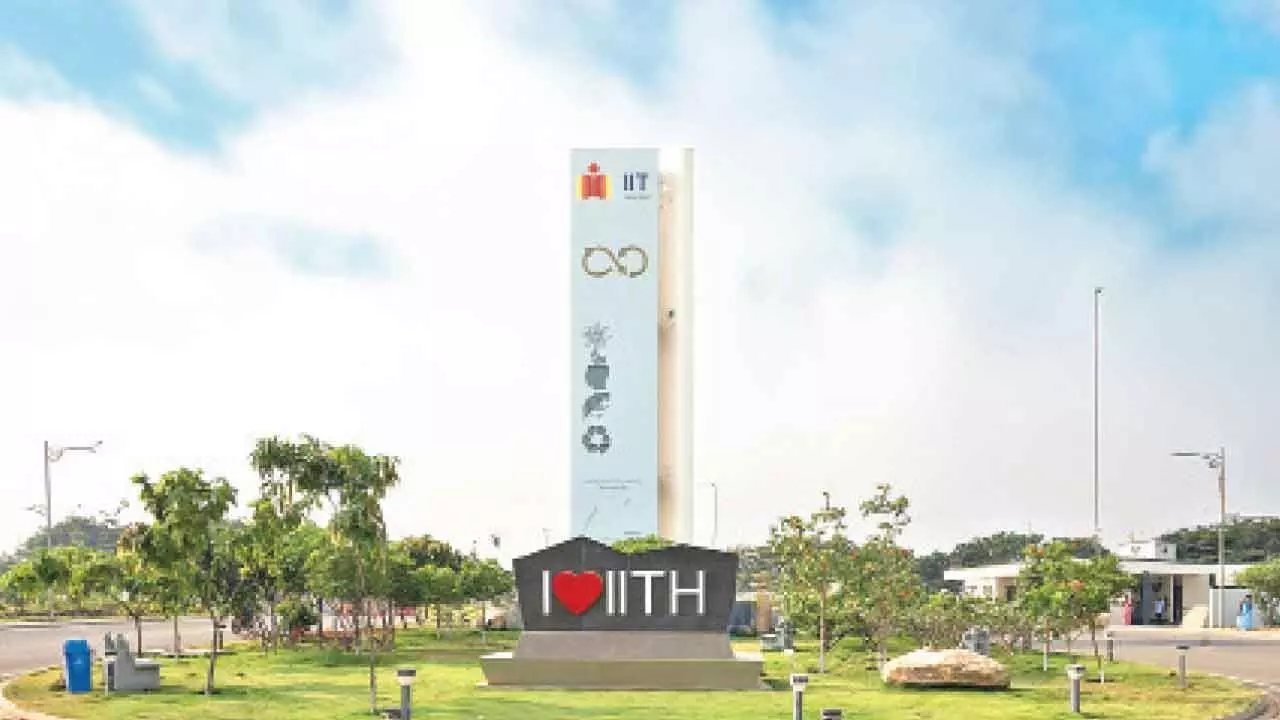
At a time when AI is rapidly reshaping careers and Indian students remain caught in a relentless cycle of grades, rankings, Prof. B. S. Murty, Director of IIT Hyderabad, is quietly steering one of the country’s boldest experiments in higher education. From fractal academics and artists-in-residence to deep-tech startups and AI-powered engineering programmes, his vision challenges long-held assumptions about how engineers should be trained—and what success truly means.
“If somebody comes to me and tells me they have never failed in life,” Prof. Murty says, “I tell them they have probably never learned anything—or never experimented enough.”
That belief underpins the transformation unfolding at Indian Institute of Technology (IIT Hyderabad). In an education system often criticised for rigidity, exam obsession and placement-centric thinking, the institute has emerged as a striking outlier—prioritising freedom, creativity and skills over conformity and fear. Here, students are encouraged to explore across disciplines, build products, create enterprises and think beyond conventional career paths.
In a wide-ranging conversation, Prof. Murty tells The Hans India about the future of jobs in the age of AI, why India must evolve from a service economy into a product nation, and how nurturing skills, innovation and purpose is central to building a truly Viksit Bharat.
Excerpts:
Q: You have often described Indian education as rigid. What do you believe is fundamentally wrong with it?
Education in India has been quite straitjacketed for decades. Students are told what to study, how to study and often what they should become in life. But the current generation does not want to fit into such a structure. They want freedom. They want flexibility.
If you look at older IITs and engineering colleges, the curriculum is very straight. Even electives are often not real electives. Many times, only one elective runs. That means the student is forced to take it—it becomes a core course in disguise. There is no real choice.
When I studied B.Tech, we faced the same issue. That experience stayed with me. We felt it was time to break away from this model and create an environment where students can genuinely explore different interests.
Q: You repeatedly stress the need for deep-tech innovation. Why is this so critical for India?
India is currently known more as a service economy. We provide services to the world. But no country has ever become developed by being only a service economy.
Every developed nation—big or small—is known for its products. India must also be known for its products. Software and apps are important, I do not deny that, but deep-tech innovation is essential.
For me, Viksit Bharat is the day I go to a place like Tokyo or Melbourne and buy a product labelled “Made in India”—because it is high quality, globally competitive and reasonably priced.
Q: Will degrees lose relevance in the coming years?
I am sure that in the years to come, people will not care much about your degree. They will care about your skills.What matters is what you can do, what problems you can solve. Institutions must create environments where skills and ideas are nurtured. The success of our startups already shows that this shift has begun.
Q: You frequently speak about Viksit Bharat. What does that term mean to you personally?
For me, Viksit Bharat is not a slogan—it is a practical vision. A developed nation is one that is known for its products, technology and innovation. Today, India is largely known as a service economy. We provide services to the world, which is good—but it is not enough.
No country in the world has become developed by being only a service provider. Every developed nation—whether it is Germany, Japan, South Korea or the United States—is known for what it makes. For India to become Viksit Bharat, we must become a product nation.
Q: How do student startups fit into the Viksit Bharat narrative?
Startups are not just about valuation—they are about value creation. When a 19-year-old student tells me he has paid salaries to five employees, that is nation-building in action. That is economic activity, confidence and leadership. In six years, IIT Hyderabad students have created 330 startups with ₹1,500 crore in revenue. These are not just numbers—they represent ideas becoming reality. If every IIT produces job creators instead of only job seekers, India’s transformation will accelerate.
We introduced something called Fractal Academics, which is a very unique system in India.Typically, a full semester course is a three-credit course—about 42 hours of teaching spread over 14 weeks. We divided the semester into six segments. This allows us to offer courses worth 0.5 credits, one credit, 1.5 credits, two credits and, of course, three credits.A 0.5-credit course is about seven hours of teaching. A one-credit course is around 14 hours. In the first year especially, we encourage students to explore many such short courses. I compare it to tasting food at a restaurant—you sample different dishes before deciding what you like.Once students discover a subject they enjoy, they can take full three-credit courses and go deeper. This kind of academic freedom—we are the first in the country to offer it at this scale.
Q: IIT Hyderabad has made liberal arts and creative courses mandatory for engineers. Why was that mandatory?
If India has to become Viksit Bharat, innovation is essential. And for innovation, intuition is just as important as intelligence.Engineers are trained to calculate everything. Out-of-the-box thinking does not come easily. Artists, on the other hand, think intuitively. That is why we decided that about 10% of a B.Tech student’s total credits—out of roughly 130—must come from liberal arts and creative arts.These include anthropology, psychology, philosophy, music, dance, painting and even martial arts.We are now introducing sports as credit-based courses—cricket, tennis, hockey—where students study, practise and are evaluated. When students balance left-brain logic with right-brain creativity, you get far better innovation.
Q: You strongly advocate student choice. Why does this matter?
At 17 years of age, we allow citizens to decide who becomes the Prime Minister of India. Then why can’t they decide what they want to become?
Why should someone be told, “You must become a mechanical engineer”? Many students later realise this is not what they wanted in life. Education should expand freedom, not curtail it.
When parents ask me, “What kind of job will my child get?”, I ask them—why should every B.Tech graduate get a job? Let them create jobs. India needs job creators, not just job seekers. We need leaders.
Parents often measure success only through salary packages. How do you respond to that mindset?
I understand parental anxiety. It comes from concern for their children’s future. But salary should not be the sole measure of success.
A student who builds a startup, creates employment, files patents or works on deep-tech innovation may not earn the highest salary in the first year—but they contribute far more to the nation in the long run. At IIT Hyderabad, we have students who chose not to sit for placements because they are building companies, pursuing research or working on socially relevant technologies. That is also success.
We must broaden our definition of achievement beyond the first job or first salary slip.