Students soar high at National Model Rocketry and CANSAT competition

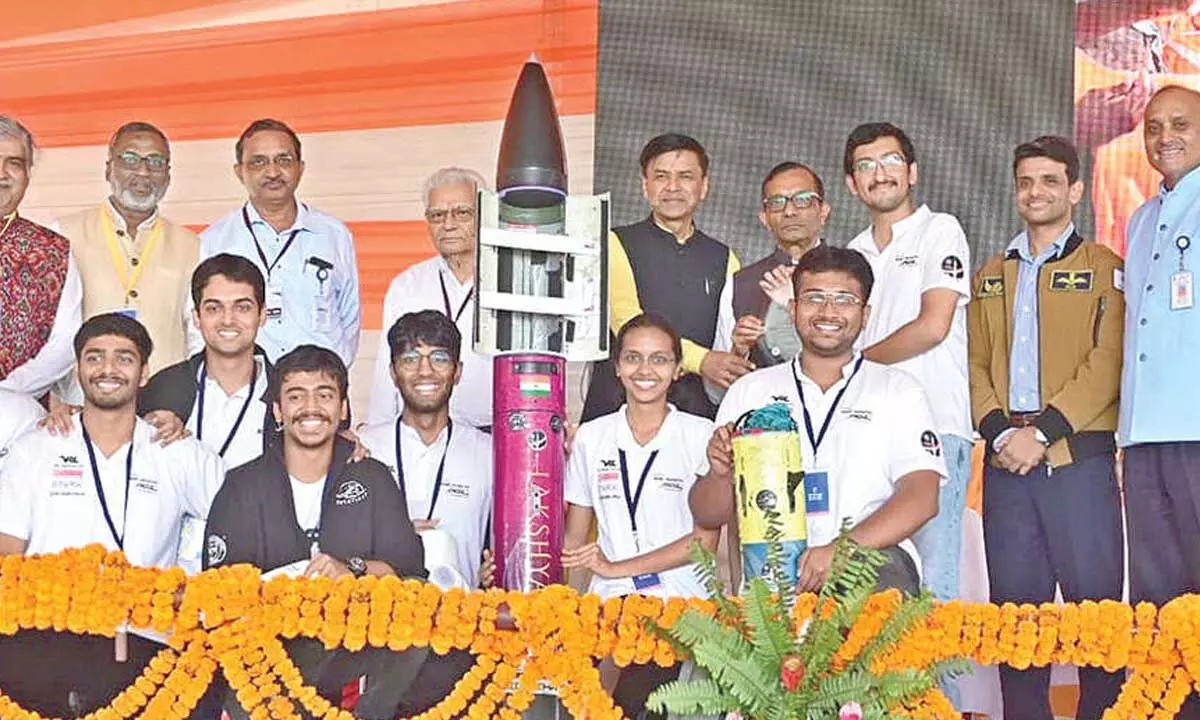
A hub of scientific curiosity and youthful innovation as the IN-SPACe Model Rocketry and CANSAT India Student Competition 2024–25 concluded after four days of intense, hands-on learning and competition.
Organised jointly by the Indian National Space Promotion and Authorisation Centre (IN-SPACe), ISRO, and the Astronautical Society of India (ASI) — with support from the Government of Uttar Pradesh and local administration — the event brought together 67 student teams from across India. The participants represented some of the country’s most promising young innovators in rocketry and satellite systems, demonstrating how teamwork and experimentation are driving the next generation of space talent.
A total of 37 launches — 13 in the Model Rocketry and 24 in the CANSAT category — were conducted successfully, showcasing both technical skill and creative design. The teams were evaluated by a jury of scientists from ISRO and IN-SPACe on a range of parameters including structure, recovery systems, mission execution, and data analysis.
In the Model Rocketry category, R.V. College of Engineering, Bengaluru, emerged as the top performer, while SVKM’s Dwarkadas J. Sanghvi College of Engineering, Mumbai, claimed first place in the CANSAT segment. They triumphed over strong competition from leading institutions such as PSIT Kanpur, Nirma University Ahmedabad, BITS Pilani Hyderabad, and Dayanand Sagar College of Engineering Bengaluru.
While competition was fierce, the spirit of collaboration and learning was evident throughout the event. Students spent days refining their models, running last-minute tests, and working through real-time challenges in design, simulation, and telemetry. The environment encouraged peer learning, mentorship, and innovation under pressure — a true reflection of the “learning by doing” approach central to modern engineering education.
The competition also served as a meeting ground between young innovators and India’s leading space scientists. During interactions and mentorship sessions, students gained insights into mission design, propulsion, avionics, and sustainable technologies for space exploration. Experts emphasised how such experiences help participants apply classroom knowledge to real-world systems — an essential skill for future aerospace professionals.
In the Model Rocketry segment, teams were judged on parameters like flight performance, descent and recovery systems, and post-launch data analysis. Meanwhile, in the CANSAT challenge, students built miniature satellite prototypes capable of carrying sensors, collecting atmospheric data, and executing controlled descent missions. The integration of coding, electronics, and mechanical design tested both technical acumen and teamwork.
Beyond the competition, the event fostered wider community engagement. A space exhibition drew over 650 school students from nearby districts, allowing them to interact directly with participating teams and gain exposure to rocketry and satellite-building concepts. The exhibition also showcased winning artworks from ASI’s “Art-in-Space” and “Space Quiz 20:20” outreach programmes, which together reached nearly 75,000 students across seven districts of Uttar Pradesh.
Adding a unique learning dimension, the event featured an Analog Astronaut Training Habitat, set up by AAKA Space, where students underwent simulated astronaut missions — experiencing the demands of life in space through controlled exercises in a 24-hour training module. For many participants, it was their first exposure to astronaut training concepts and mission-based teamwork.
The closing ceremony celebrated not just winners but every team’s perseverance, curiosity, and dedication to innovation. Certificates were awarded to all participants, recognising their contribution to advancing student-led research and practical learning in space sciences.
More than a contest of rockets and satellites, the event became a platform where engineering met imagination — where young minds learned to translate theory into creation and challenges into opportunities. For students across India, it was a reminder that the future of space exploration will be shaped not only in labs and institutions but also through competitions like these, where learning takes flight in the truest sense.