Hyderabad school students build CubeSat payload for upcoming ISRO launch

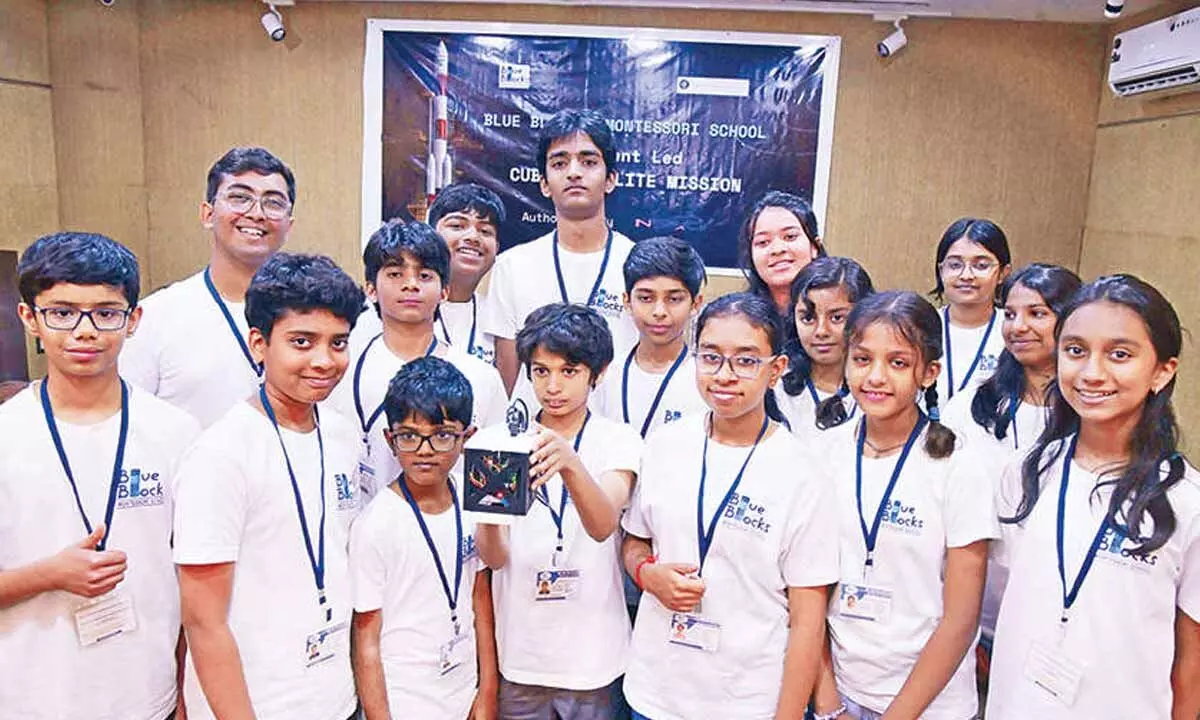
Hyderabad: A group of school students from Hyderabad has designed and built a flight-ready CubeSat payload scheduled to be launched aboard the Indian Space Research Organisation’s (ISRO) PSLV-C62 mission later this month. The project marks a rare instance of adolescents completing an end-to-end aerospace engineering cycle, from design and assembly to testing and launch readiness.
The payload, named Project SBB-1 (Satellite Blue Blocks-1), was developed by 17 students aged between 12 and 15. ISRO has officially manifested the student-built payload for launch, which is scheduled for January 12 at 10.17 a.m. from the Satish Dhawan Space Centre, Sriharikota.
Earlier this week, final administrative and integration-related formalities were completed in Ahmedabad, allowing the payload to move forward for launch vehicle integration. According to those involved, the project stands apart from typical school-level science initiatives as it did not rely on pre-assembled kits or simulation-only models.
The students designed the CubeSat payload hardware independently and wrote firmware to enable real-time telemetry. Commercial off-the-shelf sensors were manually integrated and soldered by the team to study thermal behaviour in the vacuum conditions of space. The payload underwent multiple rounds of debugging and testing as part of the development process.
Technical mentoring was provided by scientists from the private space technology sector, though the execution of engineering tasks was carried out entirely by the students. Organisers said adult intervention during the build phase was intentionally limited to encourage independent problem-solving.
One student involved in the project described debugging communication failures between sensors and onboard systems as the most challenging aspect of the work. “Getting the data to transmit reliably took repeated testing and revisions,” the student said.
The initiative has also attracted attention beyond India. The project’s methodology has been invited for discussion at international academic and science forums, and the student team is scheduled to present a technical review of the payload at a global conference later this year. A technical briefing was recently held in Hyderabad, where the students themselves responded to questions on payload design, firmware development, and integration processes, highlighting their direct involvement in the mission-ready project.